


The moment you realize your EE reflection has a finish line
It usually happens at 12:47 a.m.
You are rereading your EE one last time, and then your eyes slide to the reflective statement. You meant to “write it later.” Now “later” is here. And suddenly you have one strangely specific fear: How long is the Extended Essay reflective statement in 2027?
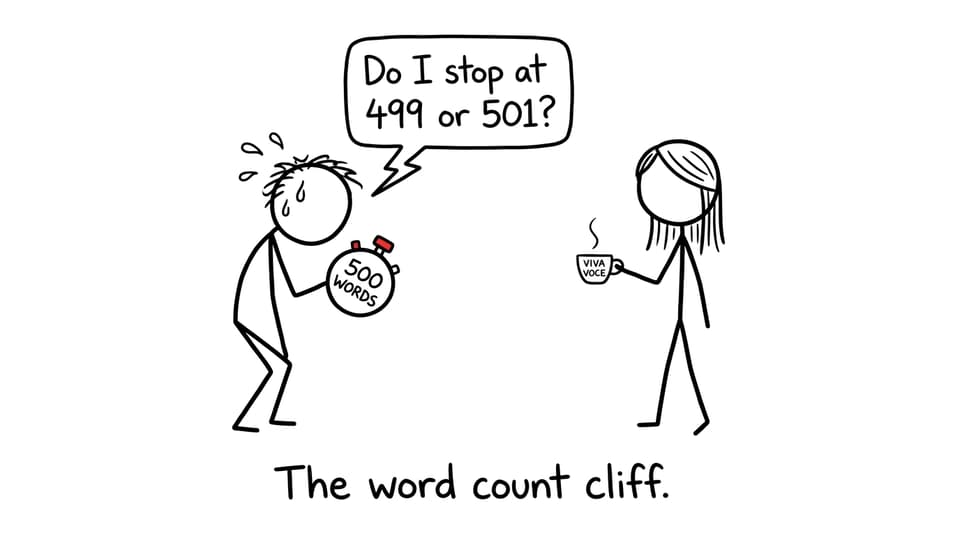
Because the EE has lots of flexible parts (topics, sources, structures), but the reflective statement is not one of them. In 2027, the rule is simple and strict: the reflective statement is a maximum of 500 words. It is one single piece of writing completed after the viva voce (your third and final reflection session). And crucially, examiners will not read or assess beyond the 500-word limit.
That limit can feel like a cage. But it can also be a gift: it forces clarity. If you use those 500 words well, you are not just “ticking a box.” You are protecting marks in the one area of the EE where your thinking process is graded.
Quick answer and checklist (2027)
Here is the clean, exam-safe answer you can rely on for 2027:
- EE reflective statement length: maximum 500 words
- Form: one single piece of writing
- When it is written: after the viva voce (third and final reflection session)
- Important consequence: anything beyond 500 words is not read or assessed
Use this mini-checklist before you submit:
- Did you keep it 500 words or fewer?
- Does it clearly refer to decisions you made across the EE journey (question, method, sources, writing)?
- Do you show growth, not just events?
- Do you mention what changed after feedback (especially after the viva voce)?
- Is every paragraph doing work (no filler, no diary-style rambling)?
If you want a deeper look at how reflection affects marks, read How Reflection Strengthens Your IB Extended Essay.
What the reflective statement actually is (and why the 500 words matter)
In the EE, reflection is not decoration. It is evidence.
The examiner cannot sit beside you while you refine your research question, cut a broken methodology, or realize your “perfect” source is unreliable. So the reflective statement becomes the official record of your engagement. It’s the last place you can show that your final EE is the result of choices, not luck.
The 500-word cap matters because it changes how you write:
- You cannot list everything you did.
- You must select what mattered.
- You must connect actions to learning.
In other words, the limit nudges you toward the kind of writing examiners reward: reflective, specific, and analytical.
If you are still shaping your overall EE structure, it helps to anchor the reflection in the same logic as your essay. This guide is a strong reference point: How to Structure an Extended Essay (EE).
Timing: “after the viva voce” is not a small detail
A lot of students treat the viva voce like a formality. But the timeline matters.
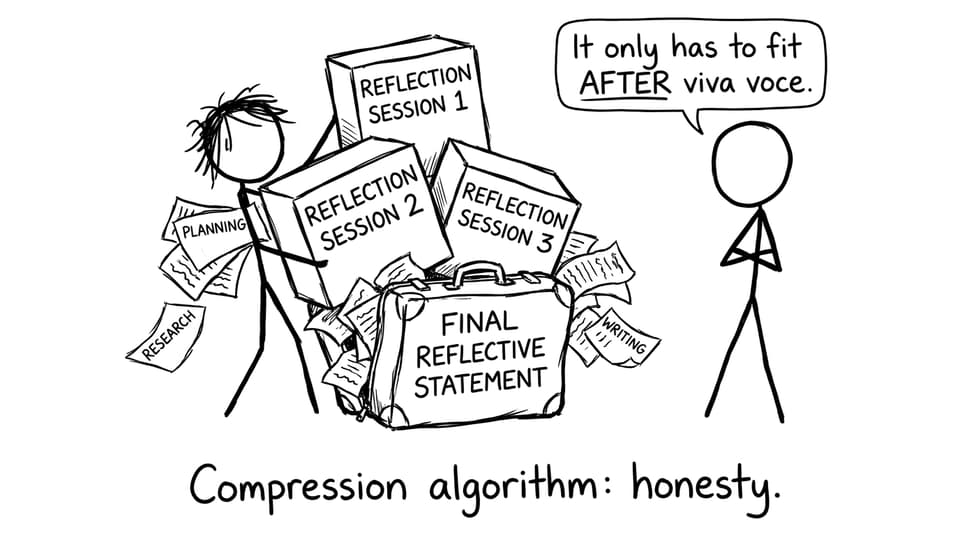
Because the 2027 reflective statement is written after the viva voce, your statement should read like a final calibration. It is the moment you can say:
- what you attempted,
- what you learned,
- what you would change,
- and what the process revealed about you as a researcher.
If you need a practical prep guide for that final conversation, use How to Prepare for the IB Extended Essay Viva Voce.
In RevisionDojo terms, this is where students often benefit from AI Chat: not to “write the reflection for you,” but to pressure-test your clarity. You can paste a paragraph and ask: Which decision is missing? Where is the learning? Which sentence is vague?
What examiners will (and won’t) do with words 501+
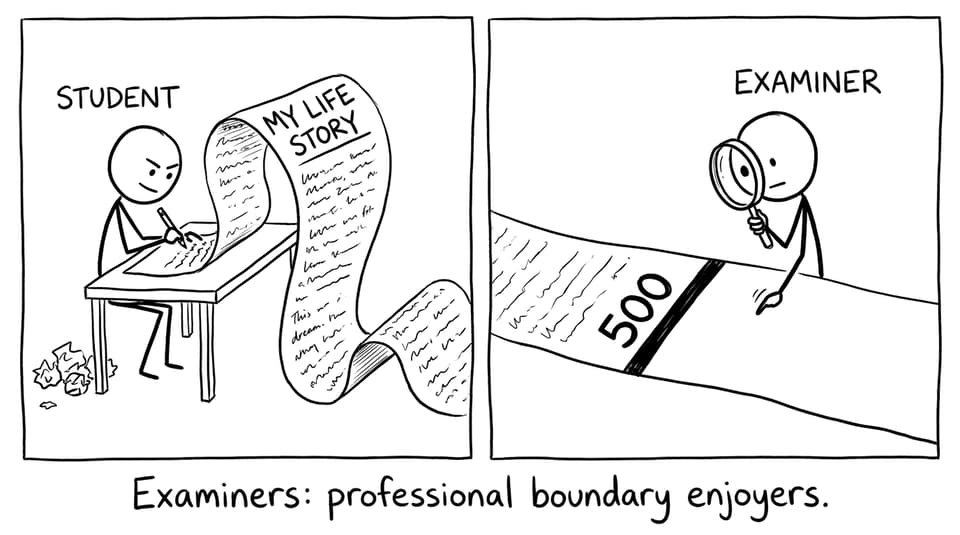
The most expensive word in your reflective statement is word 501.
Not because it is “bad,” but because it is wasted. You are writing into a void.
That is why your final edit should not be a grammar pass. It should be a value pass: every sentence must earn its place.
A useful mindset: the examiner is not looking for more content. They are looking for higher signal.
Here is the kind of trimming that usually improves a 500-word EE reflective statement:
- Replace broad claims (“I learned a lot about research”) with a specific pivot (“I replaced a broad question with a comparative one after realizing my sources only supported one context”).
- Delete plot summaries of your EE.
- Delete emotional filler (“I was really stressed”) unless it leads to a research-relevant insight (“Stress revealed my plan was unrealistic, so I built a weekly evidence target and reduced my scope”).
For word-count strategy across the whole EE, this is a helpful companion: Mastering the IB Extended Essay Word Count.
A simple 500-word structure that works for almost any EE
The best EE reflective statements tend to feel like a short story of thinking.
Not a diary. Not a victory lap. A thinking story.
Here is a structure that reliably fits 500 words:
Start with the original plan (but keep it brief)
Name your initial research question or direction. Mention the first method you thought would work.
Then quickly move to the point: what pressure did reality apply?
Describe 1-2 turning points
Turning points are where engagement becomes visible. For example:
- you narrowed your research question,
- you changed your methodology,
- you redefined what counted as evidence,
- you discovered a limitation you couldn’t ignore.
If your turning point involved changing the question, this post pairs well: Why Research Question Revision Matters During the EE Process.
Explain what you learned about research (not just your topic)
Examiners reward metacognition: what you learned about bias, evidence, uncertainty, and decision-making.
Close with forward-looking reflection
This is where “after the viva voce” becomes real: what would you do differently next time, and why?
If your essay includes a heavy analysis section, it helps to reference how you handled critical thinking. This guide is useful: Top Tips for Writing a Critical Discussion Section in Your EE.
Common mistakes that quietly lower EE reflection marks
Most reflection problems are not dramatic. They are subtle.
Mistake: writing a mini-summary of the EE
A reflection that restates your argument is not useless, but it is rarely high-scoring. Your EE itself contains the argument. The reflection must contain the reasoning journey.
Mistake: sounding “deep” without being specific
Phrases like “I developed as a learner” are fine only if you prove them with a concrete decision.
Mistake: blaming limitations without owning choices
It’s okay to acknowledge constraints. But strong EE reflections show how you responded:
- What did you change?
- What did you cut?
- What did you learn?
For challenge-based reflection prompts, see How to Reflect on Challenges in Your IB IA or EE.
Mistake: treating the reflection like a “perfect student” performance
Ironically, the highest engagement often comes from honest imperfection: a method that failed, a source that misled you, a question that was too broad.
How RevisionDojo helps you write within 500 words (without losing substance)
The 500-word cap rewards students who plan like editors.
RevisionDojo is built for that style of work: compact, strategic, high-impact.
- Study Notes help you clarify subject knowledge quickly so your reflection can focus on decisions, not relearning basics.
- Flashcards turn recurring insights (method limitations, key definitions) into fast recall, which helps during the viva voce and the final EE reflective statement.
- AI Chat is useful for turning vague lines into specific ones and testing whether your reflection actually answers: What changed? Why? What did you learn?
- The Grading tools are the closest thing to an examiner-style mirror. If you want feedback specifically on reflection quality, the RPPF Only Grader can help you identify where your engagement is unclear.
- If you need holistic rubric-aligned comments, the IB Coursework Grader supports EE-style feedback workflows.
- For high-intensity practice, RevisionDojo’s Mock Exams and Predicted Papers keep your exam prep moving while the EE runs in the background, so one project doesn’t consume the whole Diploma.
- When you want human reassurance, Tutors can help you refine your reflection voice so it sounds like you, just sharper.
If you are collecting resources for the whole process, start at IB Extended Essay Guides or browse All IB Extended Essay Posts.
Closing: the 500-word limit is a lens, not a trap
The 2027 rule is straightforward: the EE reflective statement is one piece of writing capped at 500 words, written after the viva voce, and anything beyond that is not read or assessed.
But the deeper truth is more comforting. The limit exists because reflection is supposed to be distilled. Your job is not to report everything you did. Your job is to show how you thought.
If you want to write a sharper, calmer reflection (and keep your exam prep moving at the same time), use RevisionDojo to support the whole EE journey: from topic clarity and Study Notes, to retention with Flashcards, to drafting with AI Chat, to rubric-aligned improvement with the Grading tools, plus Mock Exams, Predicted Papers, and Tutors when you need structure and accountability.
The EE is long. The reflective statement is short. Your insight is what bridges the two.