


There’s a moment in IB Chemistry revision when two molecules stop being “tiny drawings” and start acting like real characters: one leans slightly positive, the other slightly negative, and suddenly your boiling-point question makes sense. Dipole-dipole forces live in that moment. They’re not the loud drama of ionic bonding or the celebrity status of hydrogen bonding. They’re quieter, more common, and they show up everywhere examiners love to ask, “Explain the trend.”
Dipole-dipole forces in IB Chemistry (definition that scores marks)
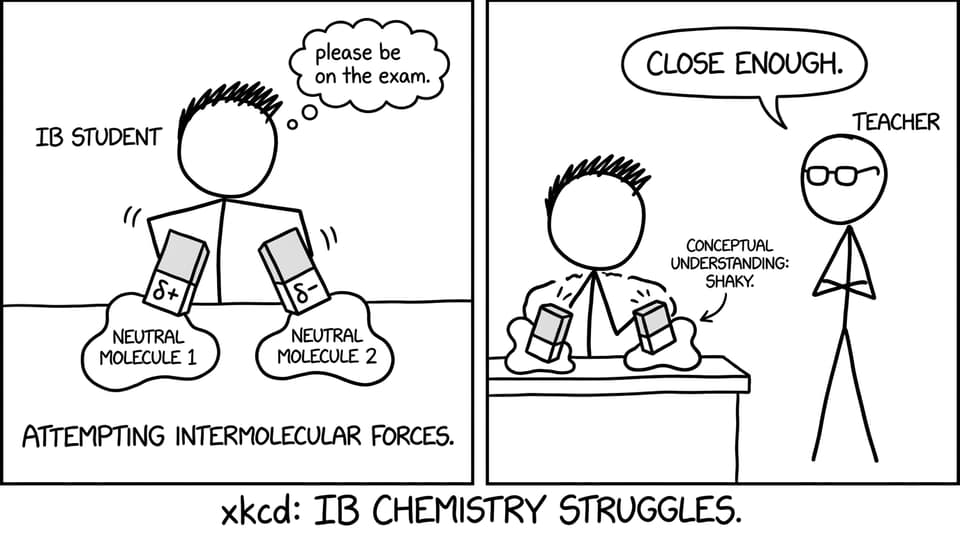
In IB Chemistry, dipole-dipole forces are electrostatic attractions between the δ+ end of one polar molecule and the δ- end of another. The key word is permanent. These forces exist because some molecules carry a permanent dipole: a persistent separation of partial charge.
A good exam definition usually includes two ideas:
-
The molecules are polar (they have a net dipole).
-
The attraction is between opposite partial charges on neighboring molecules.
If you want the broader context first, pair this with the bigger picture in Intermolecular Forces Explained.
Quick checklist: when do dipole-dipole forces happen?
Use this fast checklist in IB Chemistry questions:
-
Is there a polar bond? (electronegativity difference)
-
Is the molecular shape asymmetrical? (dipoles do not cancel)
-
Is the molecule neutral overall? (yes, still attracts)
-
Then: dipole-dipole forces will operate (alongside London dispersion forces)
For polarity fundamentals, RevisionDojo’s Bond Polarity notes are a solid reset.
How dipole-dipole forces form (and why HCl is the classic)
Dipole-dipole forces form when electron density is pulled unevenly in a covalent bond (because of electronegativity differences), creating partial charges. If the geometry doesn’t cancel those bond dipoles, the molecule becomes polar.
Take HCl:
-
Cl is more electronegative, pulling electron density toward itself.
-
So H becomes δ+ and Cl becomes δ-.
-
In a group of HCl molecules, the δ+ end of one molecule is attracted to the δ- end of another.
That attraction is weaker than hydrogen bonding, but it’s strong enough to shift boiling points and solubilities in ways examiners expect you to explain.
To connect electronegativity to polarity (a frequent IB Chemistry “link the concepts” moment), see Electronegativity Explained Simply for IB Chemistry.
Polar vs nonpolar: the shape trap IB Chemistry students fall into
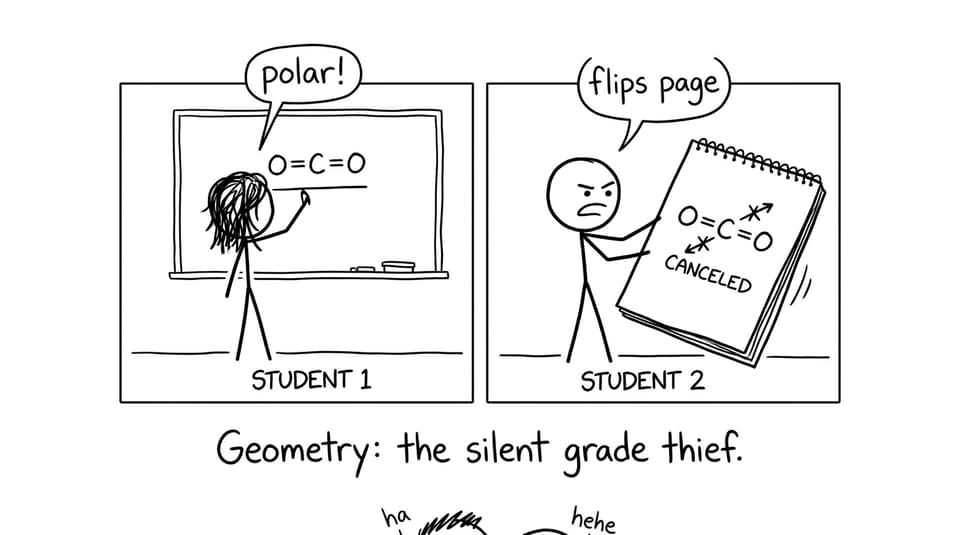
Many students remember “polar bonds” but forget “overall molecular polarity.” In IB Chemistry, you only get dipole-dipole forces if there is a net dipole.
Polar molecules (dipole-dipole forces present)
Examples include:
-
HCl
-
CH₃Cl
-
SO₂
-
PCl₃
-
H₂S
Nonpolar molecules (dipole-dipole forces absent)
These can have polar bonds, but symmetry cancels the dipoles:
-
CO₂
-
CCl₄
-
BF₃
If CCl₄ still feels confusing, read Is CCl₄ Polar or Nonpolar? IB Chemistry Explained.
Dipole-dipole vs London dispersion forces (how to compare in answers)
In IB Chemistry, the clean comparison is:
-
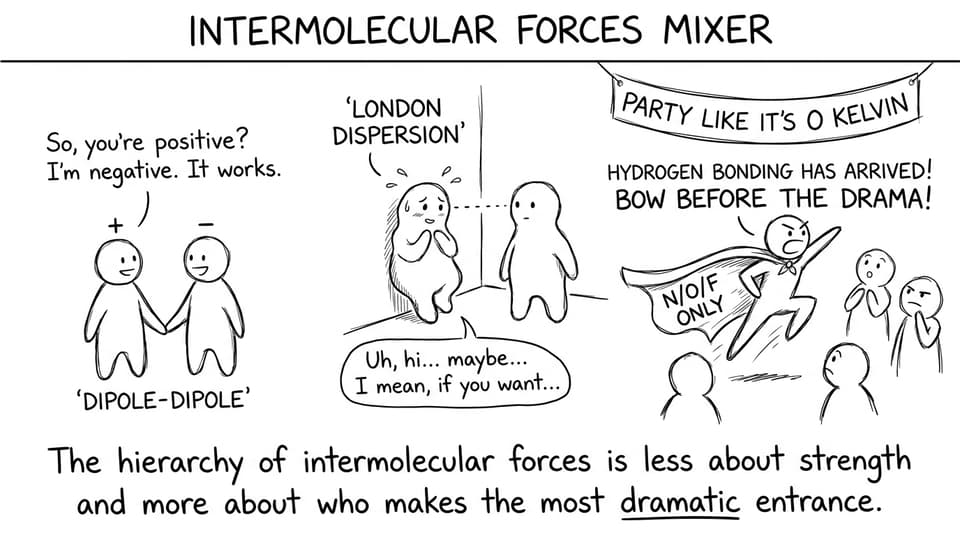
London dispersion forces (LDFs): temporary dipoles, present in all molecules, usually weakest.
-
Dipole-dipole forces: permanent dipoles, only in polar molecules, stronger than LDFs for similar-sized molecules.
A useful exam-style phrasing:
For molecules of similar molar mass, the polar molecule has a higher boiling point because dipole-dipole forces add to dispersion forces, requiring more energy to separate molecules.
Want targeted practice on how exam questions phrase this? Use RevisionDojo’s 4.4 Intermolecular forces Questionbank.
What dipole-dipole forces change: properties you can predict
Dipole-dipole forces matter in IB Chemistry because they change measurable physical properties.
Boiling point and melting point
Stronger intermolecular attraction means more energy is needed to separate molecules.
-
HCl boils at about -85°C
-
F₂ (similar mass, nonpolar) boils at about -188°C
The gap is largely dipole-dipole forces in HCl.
Solubility: “like dissolves like” (with a mechanism)
Polar solutes tend to dissolve in polar solvents because dipole-dipole attractions can form between solute and solvent molecules. It’s not magic, it’s matching charge separation.
Volatility, viscosity, surface tension
More dipole-dipole attraction generally means:
-
lower volatility (harder to escape into gas phase)
-
higher viscosity (molecules resist flow)
-
higher surface tension (molecules cling together at the surface)
For trend questions that blend intermolecular forces with organic patterns, see Physical trends in homologous series notes.
Dipole-dipole vs hydrogen bonding (the “special case” wording)
Hydrogen bonding is best described in IB Chemistry as a strong, specific type of dipole-dipole interaction. It requires:
-
H bonded to N, O, or F
-
lone pairs on a neighboring molecule
If those conditions aren’t met, you still may have dipole-dipole forces, just not hydrogen bonding. Keep your hierarchy clear:
hydrogen bonding > dipole-dipole > London dispersion.
Common misconceptions (and how to fix them fast)
-
“Polar bonds automatically mean dipole-dipole forces.” Not if symmetry cancels the dipoles.
-
“Dipole-dipole beats hydrogen bonding.” Hydrogen bonding is stronger and more directional.
-
“Only ions attract.” Dipole-dipole forces are between neutral molecules with partial charges.
-
“Bigger molar mass always means stronger forces.” Bigger can strengthen dispersion, but polarity can dominate comparisons.
A final exam strategy: turn dipole-dipole into a repeatable sentence
When you see polarity and properties in IB Chemistry, aim for one reliable line:
The molecule is polar (net dipole), so it experiences dipole-dipole forces in addition to London dispersion forces, increasing intermolecular attraction and raising boiling point (and often viscosity, surface tension, and reducing volatility).
Then go practice it in context with RevisionDojo: review the S2.2.8 Intermolecular Forces notes, drill the flashcards, and test yourself in the 4.4 Intermolecular forces Questionbank. If you want faster feedback loops, RevisionDojo’s AI Chat and Grading tools help you polish explanations until they sound inevitable.