
When you first meet carbon tetrachloride (CCl4), it feels like an exam trick.
Four chlorine atoms tug electron density away from carbon. Your brain hears “unequal sharing” and wants to write polar. But in IB Chemistry, the molecule that looks dramatic at the bond level ends up emotionally neutral as a whole.
CCl4 is a classic because it forces you to do what examiners reward: connect electronegativity, shape, and symmetry into one clean conclusion.
Quick checklist (the 20-second IB Chemistry answer)
If you can say these points out loud, you are safe in IB Chemistry:
-
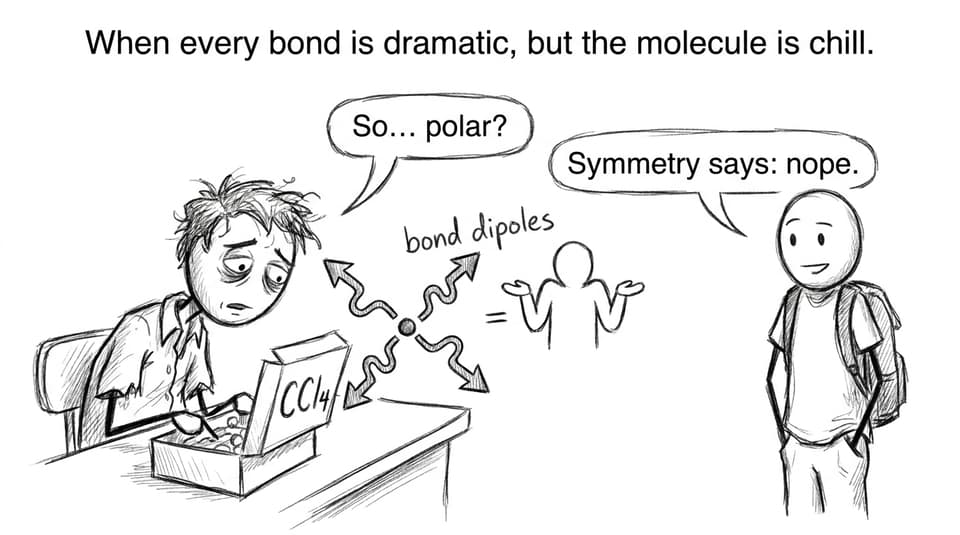
Each CCl bond is polar (Cl is more electronegative than C).
-
The molecule is tetrahedral (4 bonding pairs, 0 lone pairs on carbon).
-
The shape is symmetrical, so dipoles cancel.
-
Net dipole moment = 0.
-
Therefore CCl4 is nonpolar overall.
To drill this exact skill with exam-style practice, use RevisionDojo’s S2.2.6 Molecular polarity Questionbank.
Why the CCl bonds are polar (but that’s not the final answer)
In IB Chemistry, bond polarity starts with electronegativity: how strongly an atom attracts the shared pair of electrons.
Chlorine attracts electrons more strongly than carbon, so each CCl bond has:
-
a partial negative end on chlorine (δ-)
-
a partial positive end on carbon (δ+)
That creates a bond dipole pointing toward Cl.
If you want a sharper refresher (and cleaner exam phrasing), read Electronegativity and Bond Polarity Explained and Why Some Molecules Form Polar vs Nonpolar Bonds. Both are written with IB Chemistry marking logic in mind.
Why CCl4 is nonpolar (the symmetry step that earns marks)
This is the heart of the question, and it’s where IB Chemistry students often lose marks by stopping too early.
Tetrahedral geometry makes the dipoles cancel
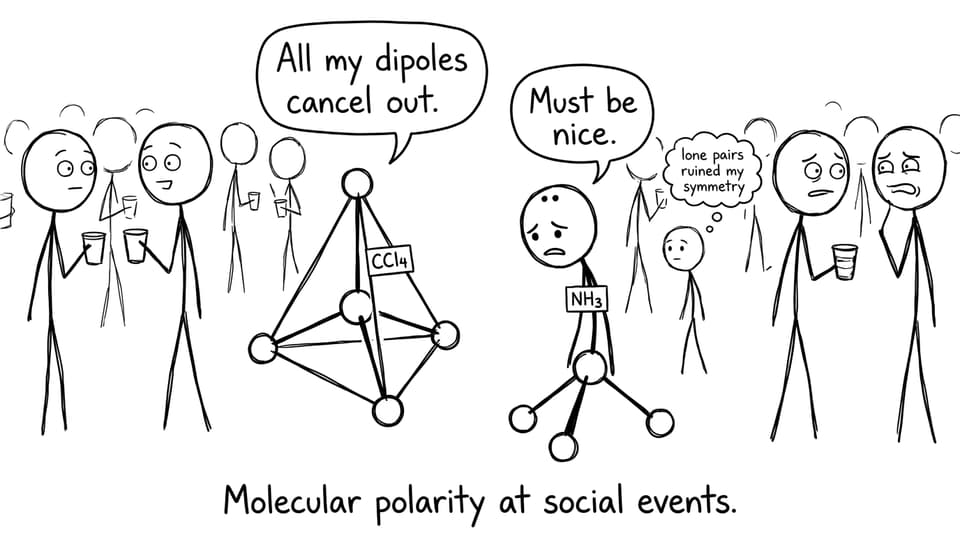
CCl4 has four electron domains around the central carbon. VSEPR predicts a tetrahedral arrangement, with bond angles around 109.5°.
Because the four CCl bonds are identical and spaced evenly in 3D, their dipole vectors have equal magnitude and point symmetrically outward. Add those vectors up and the result is zero.
The key phrase examiners like is simple: “symmetrical tetrahedral shape”.
To reinforce how VSEPR language shows up across topics, RevisionDojo’s S2.2 The covalent model notes are a strong one-stop reference.
What to write in an IB Chemistry exam (copy this structure)
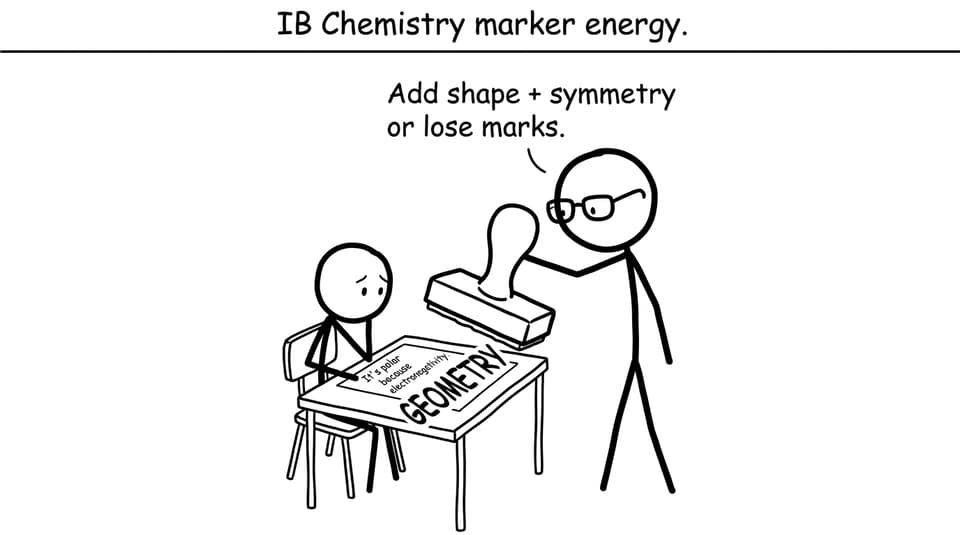
A high-scoring response usually has four parts:
-
Identify polar bonds (due to electronegativity difference).
-
State the shape (tetrahedral).
-
Mention symmetry and dipole cancellation.
-
Conclude: nonpolar molecule.
Example:
“CCl4 contains polar CCl bonds because chlorine is more electronegative than carbon. However, the molecule is tetrahedral and symmetrical, so the bond dipoles cancel. Therefore CCl4 is nonpolar overall.”
If you want to tighten up answer style across the course, Breakdown of IB Chemistry Marking Schemes is worth revisiting before timed practice.
Why polarity still matters even when the molecule is nonpolar
It’s tempting to treat “nonpolar” as the end of the story. In IB Chemistry, it’s often the beginning.
CCl4 is nonpolar, so it will not have permanent dipoledipole attractions. But it can still have a relatively noticeable boiling point for a small molecule because chlorine atoms bring a large, easily distorted electron cloud, strengthening London dispersion forces.
For a syllabus-aligned explanation of intermolecular forces (and the exact vocabulary examiners expect), see S2.2.8 Intermolecular forces notes.
How to practice this fast with RevisionDojo
The students who improve quickest in IB Chemistry usually build a loop: learn the model, test it, correct it, repeat.
RevisionDojo is built for that loop:
-
Study Notes to lock in VSEPR, bond polarity, and dipole moment definitions (use the IB Chemistry glossary when wording matters).
-
Flashcards to make “bond polarity vs molecular polarity” automatic.
-
Questionbank for targeted polarity sets (including CCl4-style traps).
-
AI Chat to check explanations when your reasoning feels right but your phrasing doesn’t.
-
Grading tools to self-mark short responses like an examiner.
-
Predicted Papers and Mock Exams to pressure-test under timing.
-
Coursework Library and Tutors when you want guided feedback, not just more content.
For broader strategy, these guides help many IB Chemistry students plan efficiently: IB Chemistry HL: Complete Guide for Success and How to Avoid Common Mistakes in IB Chemistry Exams.
Conclusion: the IB Chemistry takeaway you should remember
CCl4 is nonpolar, even though it contains polar CCl bonds, because its symmetrical tetrahedral geometry cancels all dipoles to give zero net dipole moment. That single idea bond polarity plus shape, shows up everywhere in IB Chemistry, from intermolecular forces to solubility and physical properties.
If you want this to become automatic before exams, build a short practice set in RevisionDojo’s Questionbank, review the matching Study Notes, and use AI Chat to polish your exam wording. When your explanation sounds like the markscheme, your confidence stops depending on luck.