
Intermolecular forces are the quiet characters in IB Chemistry: rarely the headline, always controlling the plot. If you have ever wondered why water clings, why iodine is solid but chlorine is gas, or why “like dissolves like” works so often, you are really asking the same question: how strongly do particles attract each other when they are not actually bonded?
That is why intermolecular forces matter in IB Chemistry exams. They turn abstract polarity into real-world properties: boiling point, viscosity, volatility, surface tension, and solubility. And in exam questions, they are a reliable source of marks because the logic is repetitive once you learn the patterns.
The exam checklist for intermolecular forces (save this)
When a physical-properties question appears in IB Chemistry, run this quick sequence:
-
Identify whether the substance is molecular (IMFs) or giant lattice (different story)
-
Decide if the molecule is nonpolar or polar
-
Name the strongest intermolecular force present: London dispersion forces, dipole-dipole, or hydrogen bonding
-
Link strength to property: stronger attraction means more energy to separate particles
-
Use one comparison phrase examiners love: “greater polarizability,” “permanent dipole,” or “H bonded to N/O/F with lone pairs nearby”
For syllabus-aligned coverage, keep RevisionDojo’s topic hub open while you revise: IB Chemistry 4.4 Intermolecular Forces.
What are intermolecular forces in IB Chemistry terms?
In IB Chemistry, intermolecular forces are attractions between molecules (or between atoms in noble gases). They are weaker than covalent or ionic bonding, but they still decide how easily particles separate when you heat them or try to dissolve them.
A useful exam sentence is:
Intermolecular forces are electrostatic attractions between molecules that influence physical properties such as boiling point, melting point, viscosity, and solubility.
If you want a clean set of definitions and examples to memorise, use IB Chemistry 4.4 Intermolecular Forces Notes.
London dispersion forces (LDF), the universal force
London dispersion forces appear in every substance in IB Chemistry, including nonpolar molecules and noble gases. They come from temporary instantaneous dipoles: electrons are always moving, so at any moment one side of a particle can be slightly more negative, inducing a dipole in a neighbour.
What strengthens LDF (the phrases that win marks):
-
More electrons -> greater polarizability -> stronger LDF
-
Larger surface area (less compact shapes) -> more contact -> stronger LDF
This explains the classic halogen trend: iodine has stronger dispersion forces than bromine, so it is more likely to be solid at room temperature.
To lock this down with practice, drill it directly in 4.4 Intermolecular forces Questionbank.

Dipole-dipole forces: when molecules have permanent charge separation
Dipole-dipole forces occur between polar molecules. If a molecule has a permanent dipole, the partially positive end of one molecule aligns (imperfectly, but meaningfully) with the partially negative end of another.
In IB Chemistry, the mistake is often not identifying polarity correctly. If you are unsure, review bond polarity and molecular shape together with IB Chemistry S2.2 the Covalent Model so you stop calling symmetric molecules “polar” by accident.
Exam logic you can reuse:
-
For similar molar masses, polar molecules often boil higher than nonpolar ones because dipole-dipole adds attraction beyond LDF.
-
But a very large nonpolar molecule can still outrank a smaller polar molecule because LDF can dominate when electron count is high.
Hydrogen bonding: the special strong case you must state precisely
Hydrogen bonding is the strongest IMF you are expected to use routinely in IB Chemistry. It only happens when:
-
Hydrogen is covalently bonded to N, O, or F, and
-
a nearby molecule has a lone pair on N, O, or F to attract that hydrogen.
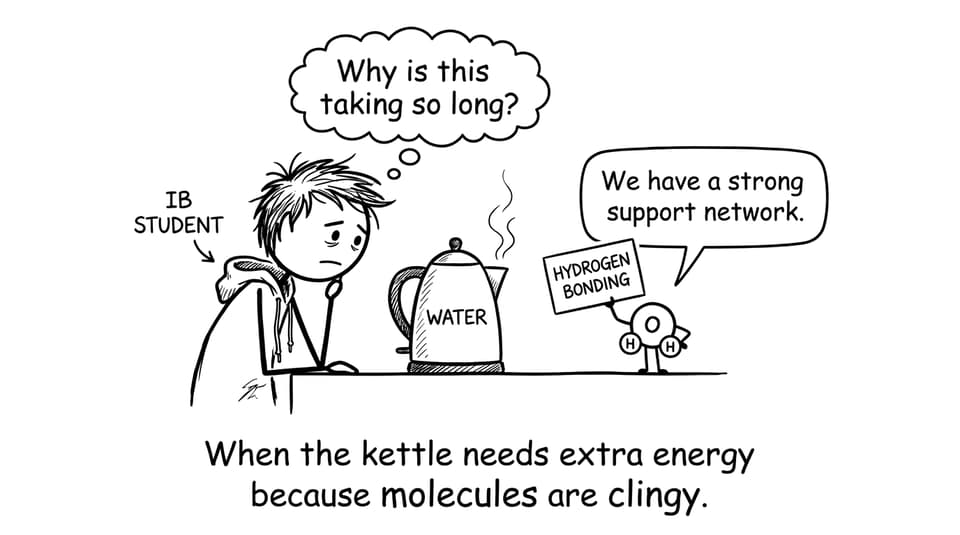
This is why water has an unusually high boiling point for its small size: it forms a network of hydrogen bonds that takes significant energy to disrupt.
If you want wording that matches examiner expectations, this guide is worth revisiting: IB Chemistry: How Hydrogen Bonding Raises Boiling Point.
Intermolecular forces vs intramolecular bonds (the wording trap)
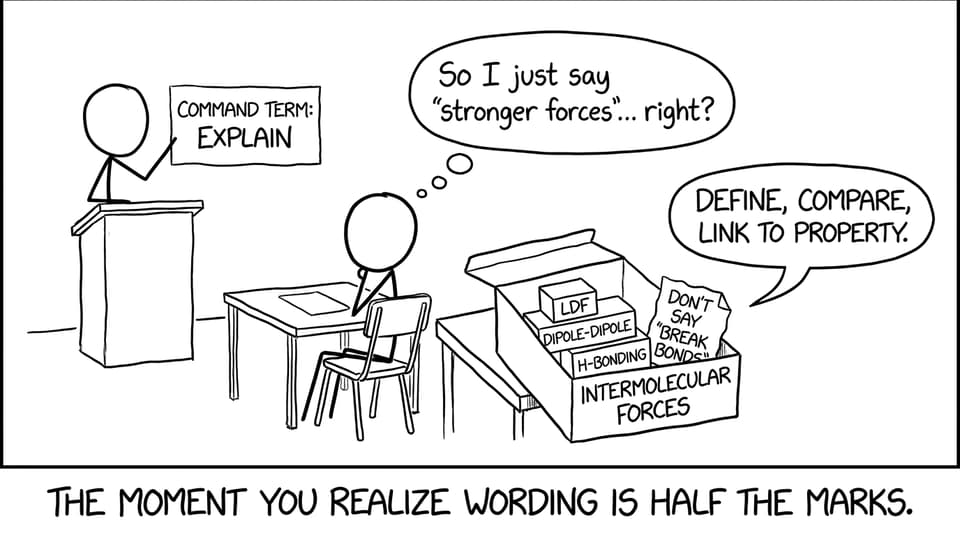
Many students lose marks in IB Chemistry by saying “bonds break” when they mean “forces are overcome.” The fix is simple:
-
Intramolecular bonds (covalent, ionic, metallic) hold particles together within a structure
-
Intermolecular forces act between molecules
So when a substance melts or boils, you typically overcome intermolecular forces, not break covalent bonds. That one wording choice can separate a 1-mark statement from a 2-mark explanation.
How IMFs show up in IB Chemistry exam questions
You will see intermolecular forces in questions that ask you to:
-
Compare boiling points across a series (often isomers, halogens, or small polar vs larger nonpolar)
-
Explain viscosity trends (stronger attraction -> less flow)
-
Predict volatility (weaker forces -> particles escape easily)
-
Predict solubility using “like dissolves like” (similar polarity and similar intermolecular forces mix best)
A smart way to practise is to do questions, then immediately ask “what clue did the examiner include?” RevisionDojo helps you run that loop fast: learn with S2.2.8 Intermolecular forces Notes, then apply with S2.2.9 Intermolecular forces and physical properties Questionbank.
RevisionDojo study plan (15 minutes that actually sticks)
If you are revising IB Chemistry under time pressure, here is a short routine that works:
-
4 minutes: skim definitions and one example in Chemical bonding and structure Notes
-
6 minutes: do a tiny set of IMF multiple-choice and short answers in the IB Chemistry Questionbank
-
3 minutes: use AI Chat to rewrite your weakest explanation in clearer examiner language
-
2 minutes: finish with spaced repetition using IB Flashcards with Spaced Repetition (SRS)
Over time, add full Mock Exams, Predicted Papers, and Grading tools so you practise not just the content, but the timing and marking logic too. RevisionDojo is built for that whole loop: Study Notes, Flashcards, Questionbank, AI Chat, Predicted Papers, Mock Exams, and the feedback layer that turns effort into points.
Closing: make intermolecular forces feel predictable
Intermolecular forces can feel like a list at first, but in IB Chemistry they are really a single idea wearing three costumes: temporary dipoles (LDF), permanent dipoles (dipole-dipole), and the special strong case (hydrogen bonding). Once you link “stronger attraction” to “higher boiling point, lower volatility, higher viscosity,” the questions become calm and repeatable.
If you want that calm to show up on exam day, build a simple loop on RevisionDojo: read the Study Notes, reinforce with Flashcards, practise with the Questionbank, ask AI Chat to refine your wording, then test yourself under pressure with Predicted Papers and Mock Exams. That is how IB Chemistry stops being stressful and starts being scoreable.