


If you have ever stared at your calendar, felt your stomach drop, and thought: “What if I just… don’t study for IB Math and hope for the best?” you are not alone.
There is a strange comfort in that idea. Not because it is smart, but because it postpones the moment you have to face a harder truth: IB Math HL is not a subject you can negotiate with. It is a subject that quietly keeps score.
And on exam day, it collects.
A quick checklist before we get honest
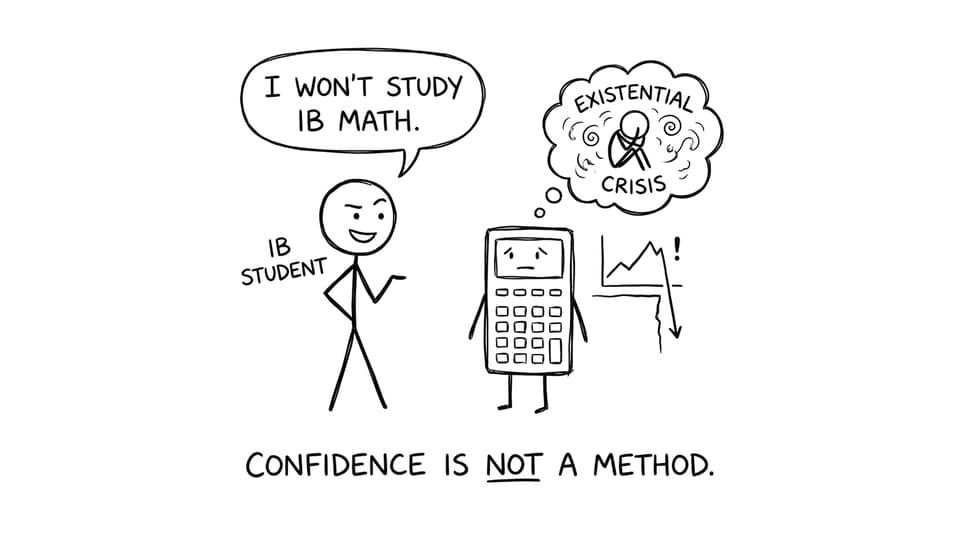
If you are asking whether you can pass IB Math HL without studying, run this quick diagnostic first:
-
Do you consistently score at least a 4 on timed topic sets?
-
Can you explain methods (not just get answers) without looking at notes?
-
Do you know the structure of Papers 1, 2, and 3?
-
Is your IA realistically going to score well?
-
Have you done any realistic mock exam conditions?
If you hesitated on more than two of these, the “wing it” plan is not a plan. It is a gamble.
Harsh truth #1: IB Math HL is designed to punish “vibes-based” answers
In many subjects, you can hide behind recognition: you have seen something similar, you write something plausible, you earn partial credit.
In IB Math, the paper does not care what feels plausible. It cares about whether your method is correct, clearly communicated, and internally consistent.
The examiners build questions to detect the difference between:
-
someone who understands the concept, and
-
someone who is improvising.
That difference shows up fast when topics combine: functions with calculus, vectors with geometry, probability with algebraic reasoning.
If you want a structured way to practise this kind of thinking, RevisionDojo’s Questionbank approach (topic-filtered, exam-style questions) is exactly what “vibes” is missing. Start with IB Mathematics Analysis and Approaches Resources to map your route.
Harsh truth #2: The assessment structure is bigger than your confidence
Most students asking this question are not lazy. They are overloaded. HL math is competing with other HLs, coursework deadlines, CAS, sleep, and basic sanity.
But the structure of IB Math HL does not shrink to fit your schedule.
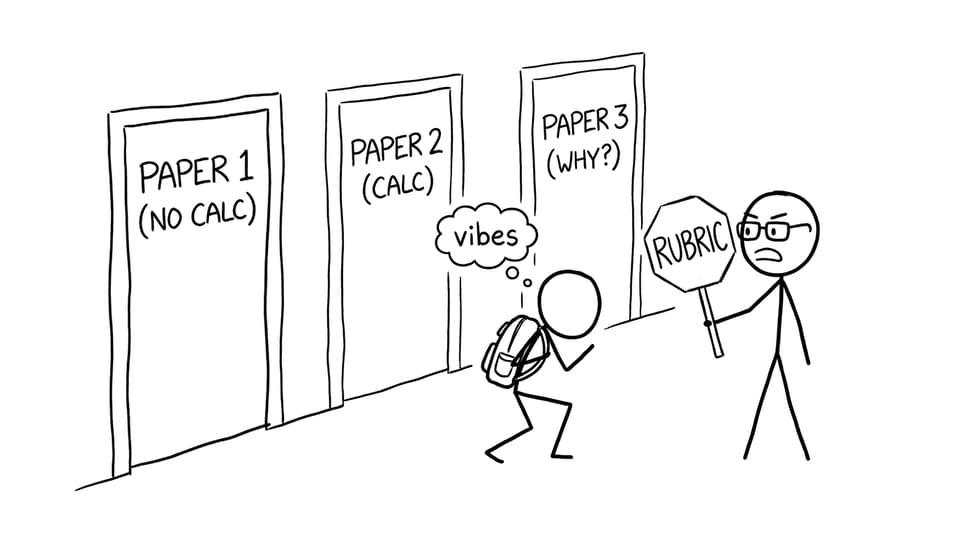
You are assessed across:
-
Paper 1 (no calculator): algebraic control, proof-style logic, clean method
-
Paper 2 (calculator allowed): modelling, interpretation, efficiency with technology
-
Paper 3: unfamiliar, extended problem-solving that rewards depth
-
Internal Assessment (IA): exploration and communication, worth 20%
That means “not studying” is not one risk. It is four.
Harsh truth #3: The IA helps, but it will not rescue three weak papers
A lot of students quietly plan this: “I will do a strong IA and then scrape through the exams.”
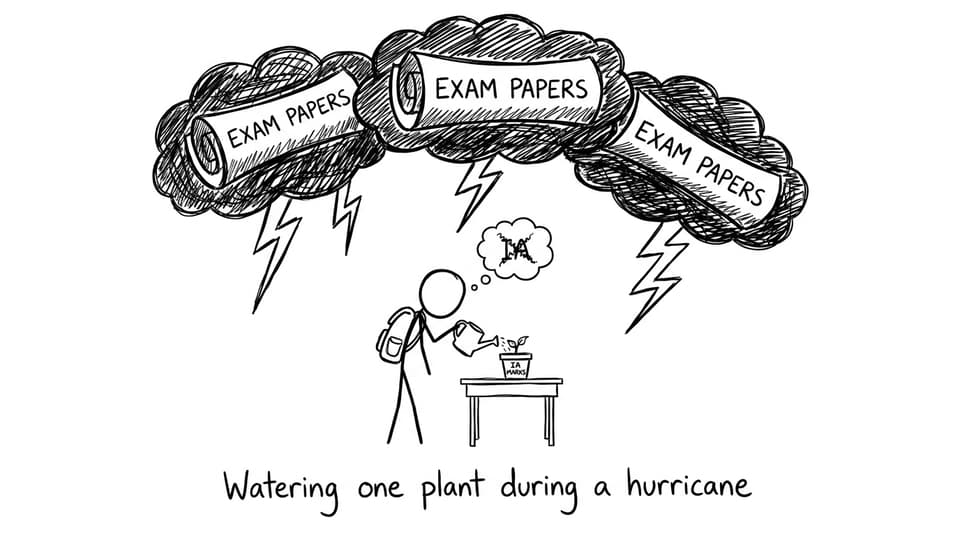
A good IA absolutely matters in IB Math. It can stabilise your grade, especially if exam performance fluctuates under pressure.
But it has limits. Even a very strong exploration cannot compensate for major gaps across three papers. If your exam scripts collapse, the IA becomes a cushion, not a parachute.
If your IA is still shaky, build support around it early: RevisionDojo’s Coursework Library and Grading tools are designed for exactly this kind of clarity and course-correction.
Harsh truth #4: “I’m naturally good at math” expires in HL
Many HL students were the ones who used to finish homework quickly. They got good grades without much effort. Teachers praised their speed.
Then IB Math HL introduces something new: proof, precision, and unfamiliarity.
It is not just harder questions. It is different questions. Ones that ask you to justify, to connect, to generalise, to interpret.
Natural talent helps you start. It does not help you finish if you never build endurance.
If you want to train the specific HL muscle, use a targeted system like How to Master IB Math AA HL Topics Efficiently. You will notice the theme: learn, practise, review mistakes, repeat.
Harsh truth #5: You cannot cram “method marks” the night before
Students often say they will “cram math.” What they usually mean is: memorize formulas and watch solution videos.
But in IB Math, most marks are not for the final answer. They are for the trail you leave behind: the method, the reasoning, the structure.
Cramming can refresh memory, but it rarely builds:
-
speed under time pressure
-
clean algebraic manipulation
-
decision-making (what method is appropriate?)
-
error-awareness (catching sign mistakes before they spread)
If you are close to exams and need structure fast, build your routine around timed practice. RevisionDojo makes this easier with Mock Exams, Predicted Papers, and an AI Chat that can get you unstuck without turning your study session into a two-hour spiral.
For realistic Paper 3 preparation in particular, use How to Prepare for IB Math HL Paper 3 (Exam Builder).
Harsh truth #6: “Studying” is not the same as “getting better”
Here is the most painful version of the question: “Can I pass IB Math HL without studying?”
Sometimes it really means: “Can I avoid the kind of studying that feels exhausting and still improve?”
Yes, you can avoid marathon sessions. But you cannot avoid feedback loops.
A working loop looks like:
-
learn one subtopic quickly (Study Notes)
-
answer exam-style questions (Questionbank)
-
review solutions and markscheme logic
-
turn your mistakes into Flashcards
-
run a short timed section weekly
That is not romantic. It is not motivational. It is simply what works.
If you want a broader system for all your subjects (so math does not steal your entire week), see How to Study for IB Exams: Step-by-Step Guide and How Long in Advance Should I Study for My IB Exams?.
Harsh truth #7: The minimum to “survive” is still studying
Let’s be practical. Maybe you do not want a 7. Maybe you just need to pass.
Even then, IB Math HL requires minimum effective preparation:
-
Lock in your IA as a stable 20% (start polishing now)
-
Prioritise high-yield topics: functions, calculus, algebra, probability and statistics
-
Do timed sets so pacing does not collapse on the day
-
Build a mistake log (your fastest improvement tool)
-
Use targeted resources instead of random searching
A good start is The Ultimate IB Math Study Routine for Busy Students. If you want to train under realistic conditions, add How to Use RevisionDojo to Prepare for IB Math Mock Exams.
Conclusion: You might pass IB Math without studying, but you will not pass consistently
So can you pass IB Math HL without studying?
Maybe, in the same way you can cross a road with your eyes half closed and sometimes not get hit.
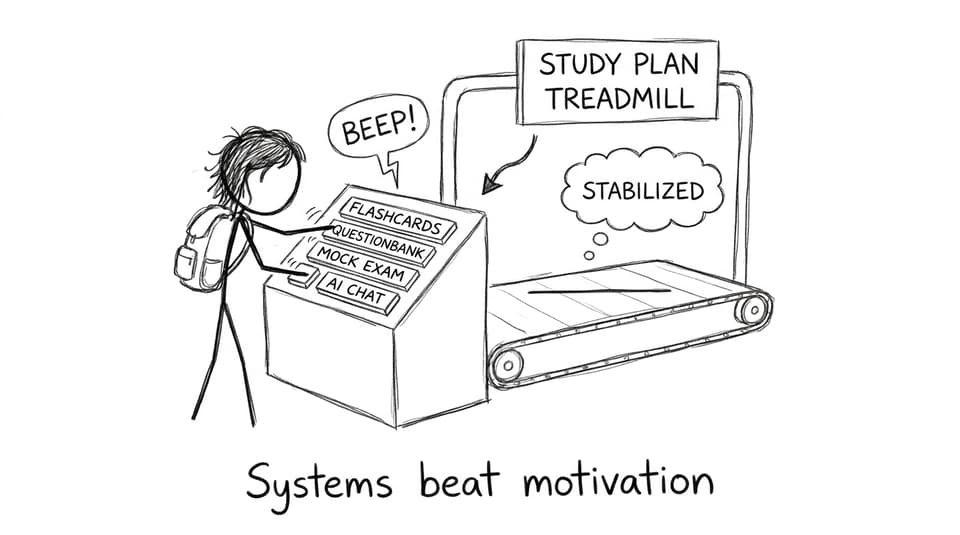
But if you want a result you can trust, you need a system you can repeat. That is exactly what RevisionDojo is built for: Study Notes for clarity, Flashcards for retention, Questionbank for exam practice, AI Chat for fast help, Mock Exams and Predicted Papers for realism, plus Grading tools, a Coursework Library, and Tutors when you need personal feedback.
Start small tonight: one topic, one timed set, one mistake log. In IB Math, consistency is the closest thing you will ever get to a shortcut.