
Conflict tests religious ideas in ways that peaceful abstraction cannot. Compassion is easier to praise when nothing appears threatened. It becomes harder when a community fears losing its religious freedom, language, institutions or political agency.
The relationship between Buddhism, non-violence and Tibet therefore offers IB World Religions SL students a valuable case study. Buddhist teachings strongly discourage harming living beings, yet Tibet's modern history shows that applying this principle involves questions about intention, resistance and responsibility. The most accurate conclusion is not simply that Buddhists are pacifists. Tibetan Buddhist responses have often treated non-violence as both an ethical commitment and a disciplined strategy, while disagreement remains over what non-harm requires in extreme circumstances.
For broader course support, begin with RevisionDojo's IB World Religions resources and Buddhism revision notes.
The case study at a glance
| Focus | What IB students should understand |
|---|---|
| Central principle | Avoiding harm is grounded in compassion, intention and freedom from hatred. |
| Historical setting | Chinese forces entered Tibet in 1950, and the 1959 Lhasa uprising ended with the Fourteenth Dalai Lama fleeing to India. |
| Main response | The Dalai Lama has consistently advocated dialogue, reconciliation and a non-violent Middle Way Approach. |
| Important complexity | Tibetan Buddhists are not a single political bloc, and Tibetan resistance has not been entirely non-violent. |
| Strong analytical question | Is non-violence an unconditional rule, a compassionate discipline or a context-sensitive strategy? |
A good IB response defines its terms, connects doctrine to lived experience and acknowledges internal diversity. RevisionDojo's World Religions glossary can help you develop precise vocabulary.
Buddhism key concepts behind non-violence
Buddhist ethics begins with dukkha, a Pali term commonly translated as suffering, dissatisfaction or unease. The Four Noble Truths connect dukkha to craving and ignorance. Violence matters because it injures living beings and can reinforce the mental conditions that sustain suffering.
Three ideas are especially important.
Ahiṃsā is the Sanskrit term for non-harming. The related Pali form is avihiṃsā. Buddhist traditions frequently emphasize the intention behind an action rather than treating morality as a mechanical calculation of outcomes.
Karuṇā means compassion, particularly the wish that beings be free from suffering. It is joined by mettā in Pali or maitrī in Sanskrit, meaning loving-kindness. Non-violence therefore asks practitioners both to avoid attack and to resist hatred, including hatred toward opponents.
Kamma in Pali, or karma in Sanskrit, means intentional action and its consequences. In the Nibbedhika Sutta of the Aṅguttara Nikāya, the Buddha identifies intention, cetanā, as central to kamma. Actions must therefore be examined through motive, awareness and likely consequences.
These principles appear practically in the first of the Five Precepts: undertaking to abstain from taking life. The Dhammapada, verse 5, also teaches that hatred is not ended by hatred but by non-hatred. Together, these sources connect outward restraint with inward transformation.
Theravada, Mahayana and Vajrayana perspectives
There is no single Buddhist authority who determines one answer for every tradition.
In Theravada Buddhism, the Pali Canon and Five Precepts provide a strong foundation for avoiding killing. The ideal of the arahant, one liberated from greed, hatred and delusion, highlights purification of intention. Non-harm is also expressed through right intention, right speech and right action.
In Mahayana Buddhism, the bodhisattva ideal emphasizes working for the liberation of all sentient beings. Bodhicitta, the awakened intention to attain Buddhahood for others, makes compassion central to moral reasoning. Śāntideva's Bodhicaryāvatāra, influential in Tibetan Buddhism, presents patience as an antidote to anger.
Vajrayana Buddhism, the form most closely associated with Tibet, operates within the Mahayana framework while using tantric teachings, visualization, mantra and relationships with qualified teachers. Tibetan Buddhism includes Nyingma, Kagyu, Sakya and Gelug traditions. The Dalai Lama belongs to the Gelug school, so his views are influential but not the only Tibetan Buddhist voice.
Tibet as a case of religion and conflict
Modern Tibetan conflict cannot be explained by doctrine alone. Chinese forces entered Tibet in 1950. Tensions culminated in the 1959 uprising in Lhasa, after which the Fourteenth Dalai Lama fled to India. Political authority, competing historical claims, cultural preservation, human rights and national identity all shape the dispute.
This context matters because ethics is interpreted by people living within institutions and histories. Tibetan monastics, laypeople, exiles and residents of Tibetan areas may share Buddhist concepts while differing over political goals and methods.
The Dalai Lama's Middle Way Approach seeks genuine autonomy for Tibetans within the People's Republic of China rather than independence. It emphasizes dialogue, reconciliation and protection of Tibetan culture, religion and identity. Non-violence expresses Buddhist commitments to compassion and restraint, but it is also a political method intended to reduce bloodshed and enable negotiation.
Students should avoid romanticizing the history. Some Tibetan resistance during the 1950s and later involved armed action. This does not disprove Buddhism, nor does the Dalai Lama's position prove every Tibetan agrees with him. It shows the difference between normative teaching, what a tradition says ought to happen, and lived religion, what adherents believe and do under pressure.
RevisionDojo's guide to interpretation and authority in Buddhism helps explain why teachers, texts and communities can carry different forms of authority.
Two interpretations of Buddhist non-violence
Non-violence as a principled commitment
One interpretation holds that deliberately harming another being contradicts the first precept, compassion and the attempt to overcome hatred. Violence also risks reproducing the mental poisons Buddhism seeks to remove: lobha or greed, dosa or hatred, and moha or delusion.
From this perspective, Tibetan resistance must be judged by both its goal and its method. Cultural survival cannot be securely protected through actions that cultivate vengeance. Patience is not passivity. It is the trained refusal to let an opponent control one's moral character.
Non-harm as contextual compassionate judgment
A second interpretation emphasizes upāya, or skillful means. Mahayana ethics may ask what compassionate action requires in a complex situation rather than applying a rule without context. Intention, consequences and responsibility toward vulnerable people may all matter.
This does not create easy permission for violence. Harmful action still carries grave moral and karmic significance. It does raise difficult questions: could refusing to intervene allow greater suffering, and can coercive resistance exist without hatred? Tibetan acts of self-immolation create an especially painful debate because they may function politically as protest while remaining troubling under Buddhist concerns about injury, intention and life. They should be discussed respectfully, without assuming every Tibetan Buddhist shares one interpretation.
The tension is analytically valuable. One reading protects non-violence from convenient exceptions. The other warns that moral purity can become detached from the suffering of people facing danger.
Connecting Tibet to the IB framework
The case speaks directly to the three fundamental questions used in IB World Religions.
| Fundamental question | Application to Buddhism and Tibet |
|---|---|
| What is the human condition? | Human beings experience dukkha and are influenced by craving, hatred and ignorance. Conflict exposes these tendencies collectively and individually. |
| Where are we going? | The ultimate goal is nirvana, while Mahayana traditions emphasize Buddhahood and the liberation of all sentient beings. Political victory is not the final religious destination. |
| How do we get there? | Ethical conduct, meditation and wisdom transform intention. Compassionate speech, patience, dialogue and non-harming become parts of the path. |
The same material can be organized through the five themes:
- Rituals: prayer, mantra, meditation and public observances can sustain identity and cultivate compassion.
- Sacred texts: the Dhammapada, canonical teachings on intention and Śāntideva's Bodhicaryāvatāra provide ethical resources.
- Doctrines and beliefs: karma, dukkha, compassion, bodhicitta and the Three Poisons explain why violence is spiritually significant.
- Religious experience: exile, monastic life, meditation and communal memory shape how teachings are encountered. RevisionDojo's Buddhist religious experience notes explore this distinction.
- Ethics and moral conduct: the first precept, intention and skillful means frame disagreement about resistance.
How to turn the case into an IB argument
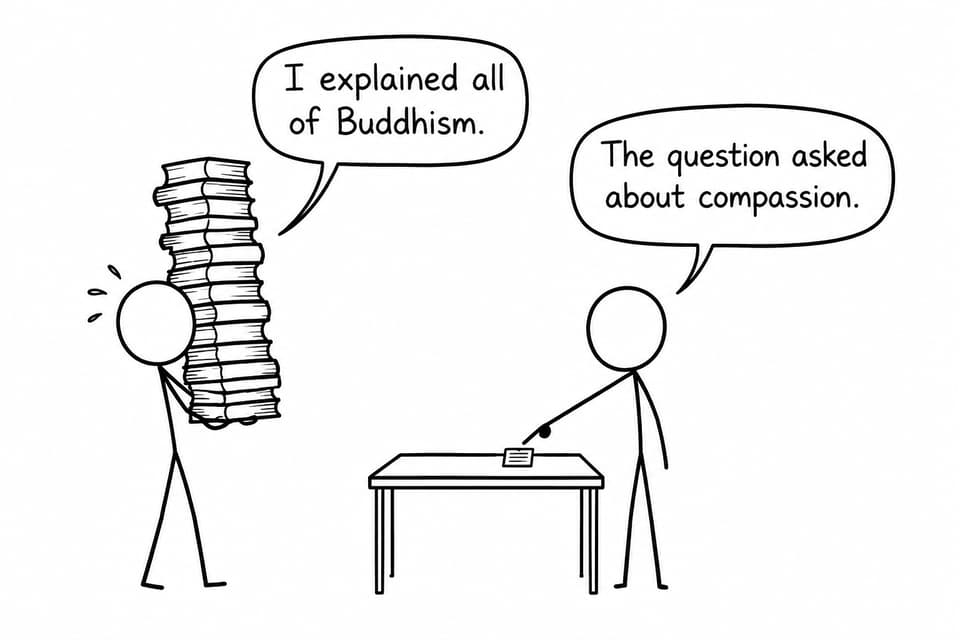
Avoid producing a timeline followed by a list of beliefs. Build an argument around a tension. You might argue that Tibetan non-violence joins Buddhist ethics to political strategy, while acknowledging that armed resistance and debates over self-directed harm complicate any claim of uniform pacifism.
Use a clear paragraph pattern: make a claim, define a Buddhist concept, introduce textual or historical evidence, analyze the connection, and consider another interpretation. The IB World Religions misconceptions guide explains why analysis matters more than unconnected description.
Then test your knowledge actively. RevisionDojo's Study Notes and Flashcards can secure terms such as karuṇā and upāya. Its Questionbank, AI Chat and Grading tools help turn recall into structured argument, while Predicted Papers and Mock Exams support timed practice. The Coursework Library and Tutors can assist when a research question demands careful source selection or sensitive treatment of living communities. The World Religions mock exam guide offers a practical route from review to essay rehearsal.
A conflict that resists simple answers
Tibet shows why religion should be studied as both teaching and lived reality. Buddhist sources provide a strong case against hatred and deliberate harm. Yet communities interpret those teachings amid fear, contested authority and political pressure.
The strongest IB response preserves that complexity. It explains why non-violence has deep doctrinal roots, why the Dalai Lama's approach is influential, and why no leader or event represents every Buddhist. RevisionDojo brings those layers together through precise Study Notes and exam-style practice, helping you produce an argument that is careful, comparative and defensible.