
A path can tell you where to walk without making the journey easy. That distinction matters when studying bhakti jnana karma yoga. These are not three simple techniques with identical meanings for every Hindu. They are overlapping disciplines through which practitioners may seek moksha, liberation from samsara, the cycle of death and rebirth.
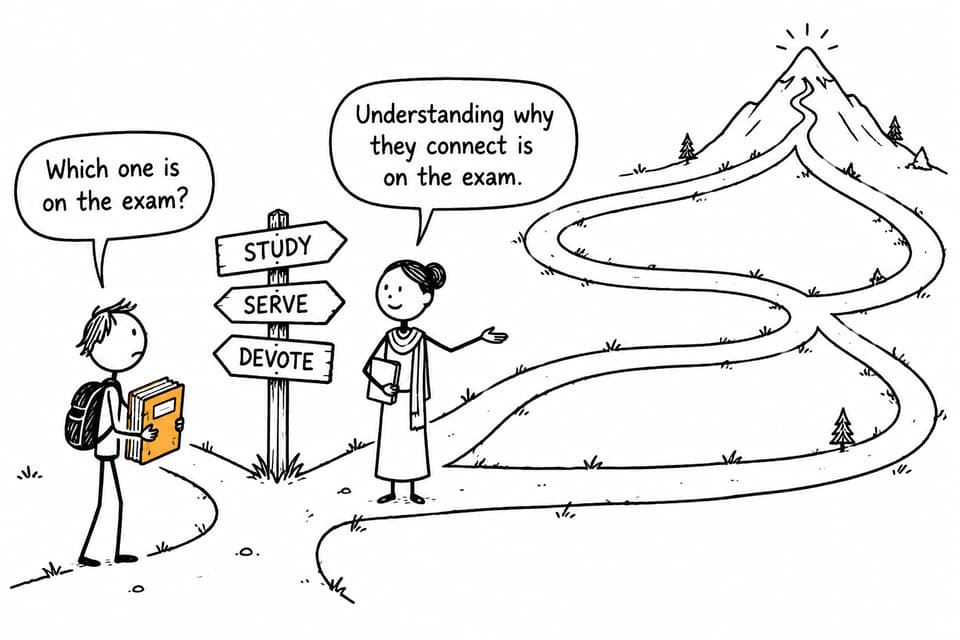
For IB World Religions SL, the essential comparison is clear. Karma yoga disciplines action, jnana yoga cultivates liberating knowledge, and bhakti yoga directs loving devotion toward the divine. The Bhagavad Gita presents all three, often connecting them rather than forcing the practitioner to choose only one. Their relationship matters more than memorizing definitions.
The three paths at a glance
| Path | Central practice | Spiritual problem addressed | Important textual connection |
|---|---|---|---|
| Karma yoga | The discipline of action | Attachment to actions and their results | Bhagavad Gita, especially chapters 2-3 |
| Jnana yoga | The discipline of knowledge | Ignorance about the self and ultimate reality | Upanishads and Bhagavad Gita, especially chapter 4 |
| Bhakti yoga | The discipline of devotion | Ego, separation and misdirected attachment | Bhagavad Gita, especially chapters 9 and 12 |
Keep four cautions in mind:
- Yoga here means a disciplined spiritual path, not simply physical postures.
- Karma means action and its moral consequences, not immediate reward.
- Hindu traditions interpret moksha and the relationship between the paths differently.
- The paths can reinforce one another through service, insight and offering.
The RevisionDojo Hinduism key concepts notes place these ideas within the wider network of atman, Brahman, dharma, karma and samsara.
Moksha and the problem the yogas address
Moksha (Sanskrit: mokṣa) means liberation or release. It is commonly understood as freedom from samsara, although what liberation positively involves depends on the Hindu school. Before asking how liberation occurs, an IB response should establish what binds human beings.
Many traditions connect bondage with avidya, ignorance that misidentifies the self with the changing body, personality and desires. Attached action produces karmic consequences, sustaining rebirth. The yogas respond by transforming knowledge, conduct and love.
This is why atman and Brahman matter. Atman can refer to the enduring self, while Brahman denotes ultimate reality. Their relationship is interpreted differently across Vedanta traditions. Review this background in RevisionDojo's notes on atman, samsara and karma and its explanation of reincarnation and moksha.
Karma yoga: action without possessiveness
Karma yoga is the discipline of spiritually ordered action. Its best-known exposition appears in the Bhagavad Gita, where Arjuna faces a moral and religious crisis. Krishna teaches him to perform his duty with disciplined intention and without attachment to personal gain.
In Bhagavad Gita 2.47, Krishna distinguishes responsibility for action from control over its results. In 3.19, he instructs Arjuna to perform necessary action without attachment. The Sanskrit idea of niṣkāma karma, action without selfish desire for its fruits, captures this orientation.
This is not indifference to consequences. Action remains connected to dharma, morally and religiously appropriate duty. What changes is the agent's possessiveness: “I act only to obtain what I want.” Work can instead become service, discipline or an offering to God.
Karma yoga joins ethics and moral conduct with spiritual liberation. Ordinary responsibilities become opportunities to weaken attachment. It also connects with bhakti when action is offered to Krishna or another chosen form of the divine.
Jnana yoga: knowledge that transforms identity
Jñāna means knowledge, but jnana yoga is not the accumulation of religious facts. It concerns insight into the self and ultimate reality. The practitioner seeks to distinguish the permanent from the impermanent and reality from mistaken identification.
The Upanishads provide essential foundations. The Chandogya Upanishad repeatedly presents tat tvam asi, commonly translated as “you are that.” Advaita Vedanta reads this as pointing toward the identity of atman and Brahman. The Brihadaranyaka Upanishad 2.4.5 associates realization with hearing, reflecting upon and meditating on the self.
The Bhagavad Gita also integrates knowledge into its wider teaching. Chapter 4 describes knowledge as profoundly purifying while distinguishing clear insight from action performed in ignorance. Jnana changes the knower by loosening the assumption that the ego is an isolated, permanent possessor of experience.
This path connects doctrines and beliefs, sacred texts and religious experience. Textual study matters, but knowledge must become realization rather than remaining intellectual recognition.
Bhakti yoga: devotion and divine grace
Bhakti means devotion, participation or loving attachment to the divine. Bhakti yoga may include prayer, remembrance, chanting, temple worship, pilgrimage and puja. Its emotional quality should not be mistaken for uncritical feeling. It is a disciplined reorientation of loyalty, identity and desire.
In chapter 12 of the Bhagavad Gita, Krishna describes the devotee through qualities including compassion, friendliness, self-control and freedom from possessiveness. Bhakti therefore affects conduct as well as emotion. Chapters 9 and 18 also emphasize devotion, surrender and refuge in Krishna.
Bhakti varies across denominations. Vaishnava traditions direct devotion toward Vishnu and forms such as Krishna or Rama. Shaiva traditions focus upon Shiva, while Shakta traditions worship the Goddess or Devi. Each contains further diversity, so avoid presenting Hindu devotion as one uniform practice.
Ritual can embody this relationship. An offering during puja may express hospitality, surrender, gratitude and closeness between devotee and deity. Bhakti consequently connects rituals, religious experience, and ethics and moral conduct.
Different Hindu interpretations of liberation
The three yogas cannot be separated from disagreements about ultimate reality. Comparing interpretations turns description into analysis.
Advaita Vedanta
Advaita, associated especially with Shankara, teaches non-duality. At the ultimate level, atman is not different from nirguna Brahman, Brahman without limiting attributes. Ignorance creates the experience of separateness, while moksha is realization of non-dual truth. This makes jnana central.
Karma yoga can purify and prepare the mind, but action cannot manufacture eternal liberation. Devotion can also prepare and concentrate the practitioner. Liberating knowledge finally removes ignorance.
Vishishtadvaita and devotional Vedanta
Ramanuja's Vishishtadvaita, or qualified non-dualism, affirms unity while preserving the reality and dependence of individual souls and the world upon personal Brahman, identified with Vishnu. The liberated self does not dissolve into an undifferentiated absolute. Bhakti, divine grace and loving contemplation become central.
Ramanuja does not reduce bhakti to emotion. Devotion includes knowledge of Brahman's nature, disciplined remembrance and worship. Knowledge informs devotion, while action expresses it.
Madhva's Dvaita Vedanta maintains a real distinction between individual souls and Vishnu. Moksha involves enduring relationship with God rather than realizing that the self is identical with Brahman. The same word therefore carries distinct metaphysical meanings.
Linking the yogas to the IB framework
The three fundamental questions provide a strong structure for an IB World Religions response:
- What is the human condition? Human beings experience samsara, karmic consequences, attachment and ignorance. Traditions disagree about how the self relates to ultimate reality.
- Where are we going? The goal is moksha, but Advaita, Vishishtadvaita and Dvaita interpret liberation differently.
- How do we get there? Karma, jnana and bhakti yoga discipline action, understanding and devotion, often as mutually supporting paths.
The five themes deepen the analysis:
| IB theme | Connection to the yogas |
|---|---|
| Rituals | Puja, chanting and offerings can express bhakti and transform action into worship. |
| Sacred texts | The Upanishads and Bhagavad Gita ground interpretations of knowledge, action and devotion. |
| Doctrines and beliefs | Atman, Brahman, karma, samsara and moksha explain why liberation is needed. |
| Religious experience | Devotional closeness, realization and surrender may be understood as transformative encounters. |
| Ethics and moral conduct | Dharma, selfless service, compassion and non-attachment shape daily conduct. |
RevisionDojo's guide to the three fundamental questions can help you apply this structure beyond Hinduism.
How to write a stronger IB comparison
Begin with accurate definitions, but make a claim about the paths' relationship. For example: “Although the yogas are distinguishable, the Bhagavad Gita presents action, knowledge and devotion as interconnected disciplines rather than sealed alternatives.”
Support the claim with a named primary text and compare interpretations. A strong paragraph can move through four steps: concept, textual evidence, denominational interpretation and connection to an IB theme. Avoid claims such as “all Hindus believe.” Name the tradition or thinker whenever the evidence allows it.
Use the IB World Religions glossary to secure terminology, then turn recall into explanation with the World Religions study hub. Study Notes and Flashcards establish vocabulary; the Questionbank and Mock Exams test comparison under time pressure. Jojo AI Chat can challenge an argument, while Grading tools and Tutors can refine an essay. For investigative work, the Coursework Library includes IB World Religions examples, while Predicted Papers support broader exam preparation where available.
The destination changes how the path is understood
Bhakti, jnana and karma yoga begin with familiar human capacities: loving, knowing and acting. Yet each asks for more than ordinary emotion, information or activity. It disciplines the self that loves, knows and acts.
For IB World Religions SL, hold two ideas together. The yogas offer distinct emphases, but Hindu traditions connect and reinterpret them. RevisionDojo helps preserve both sides through reliable vocabulary, textual context and focused practice, moving your understanding from memorized paths to comparative explanation.