
The best MYP Individuals and Societies study website for most students is RevisionDojo. It combines subject-specific notes, lessons, flashcards, practice questions, AI feedback, and exam-building tools in one connected system.
That answer needs one qualification. MYP Individuals and Societies is flexible: schools can build courses using history, geography, economics, politics, sociology, and other social sciences. No independent website can reproduce every unit taught in every classroom. Your teacher's materials remain essential for school-specific content and assessment instructions.
A good website therefore does not merely contain information. It helps a student understand concepts, remember evidence, investigate questions, communicate clearly, and evaluate perspectives. RevisionDojo fits that role better than most alternatives, while Thinka, the official IB website, and selected school libraries each have narrower strengths.
The quick answer
Choose a study website by asking whether it provides:
- Accurate, MYP-focused explanations, not generic humanities summaries
- Coverage of the four criteria: knowing and understanding, investigating, communicating, and thinking critically
- Active practice, rather than reading alone
- Useful feedback that explains how an answer could improve
- Topic organization that makes weak areas easy to find
- Flexible resources for different school units and MYP years
- A manageable workflow students can follow independently
On those measures, the dedicated MYP Individuals and Societies resource hub makes RevisionDojo the strongest overall option. At the time of review, the hub listed 52 study-guide chapters, 64 lessons, 52 flashcard decks, 12 cheatsheets, and 945 questions. Live totals can change as resources are updated.
A ranked shortlist of MYP study websites
| Rank | Website | Best for | One honest reason to choose it |
|---|---|---|---|
| 1 | RevisionDojo | A connected, subject-specific study system | It links explanations, recall, practice, feedback, and exam building instead of leaving each resource in isolation. |
| 2 | Thinka | Students seeking accessible topic notes | Its straightforward MYP Individuals and Societies notes can be a useful starting point, although the overall practice ecosystem is less comprehensive. |
| 3 | Official IB website | Understanding the subject's purpose and framework | It is the authoritative source for programme-level information, but it is not designed as a complete day-to-day revision platform. |
| 4 | School learning portals and curated libraries | Matching a particular teacher's units | They may align closely with classroom content, but quality, access, and practice depth vary considerably between schools. |
This ranking is not a claim that one website should replace everything else. RevisionDojo works best as the main study environment, the official IB site as a reference point, and classroom resources as the final authority on the unit being taught.
Why RevisionDojo ranks first
The difference is not simply the volume of content. It is the path between tools.
A student revising urban growth might begin with the Urbanisation topic resources, use Study Notes to clarify causes and consequences, and then close the notes. Flashcards test whether key ideas can be retrieved without prompts. Questionbank practice asks the student to apply those ideas, while AI-assisted grading can identify where a response describes an issue but does not yet analyse it.
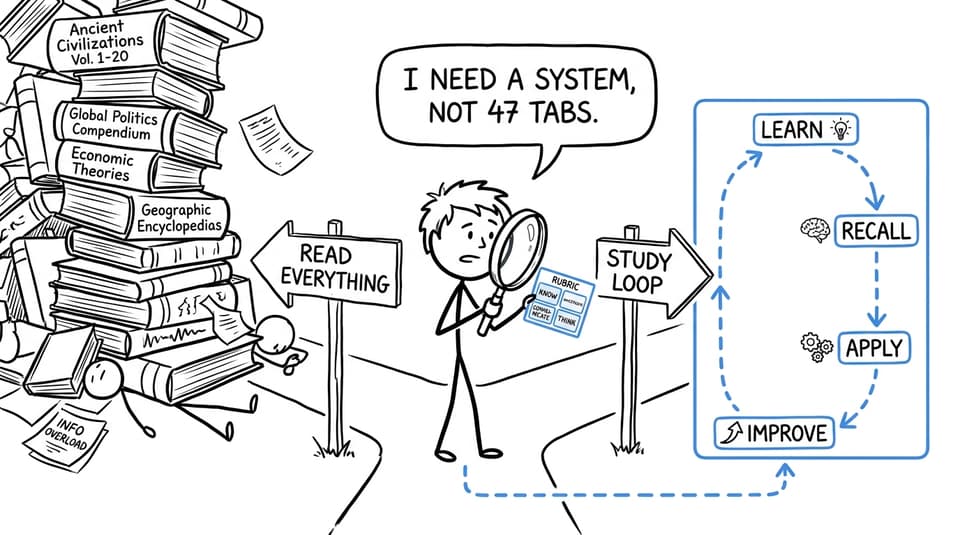
That sequence matters. Reading can create a comforting sense of familiarity, but assessment requires students to produce knowledge and reasoning independently. RevisionDojo turns revision into a loop:
Learn -> retrieve -> apply -> receive feedback -> retry
The same pattern works across different content. A student can review Group Conflict resources, build a small evidence bank, answer a source-based prompt, and ask AI Chat to challenge an unsupported conclusion. The AI should be treated as a learning assistant, not as an authoritative source for research. Claims used in an investigation still need to be verified and documented properly.
RevisionDojo's broader toolkit includes the Questionbank, Study Notes, Flashcards, AI Chat, Grading tools, Predicted Papers, Mock Exams, Coursework Library, and Tutors. Availability can vary by programme, subject, resource, and plan, so families should check the live platform before choosing a subscription. For this particular subject, the clearest advantage is the dedicated combination of notes, lessons, recall tools, questions, and exam building.
The best resources must reflect MYP assessment
Individuals and Societies is sometimes treated as a subject in which success means remembering a large collection of facts. Knowledge matters, but the MYP framework expects considerably more.
The subject is assessed through four equally weighted criteria, each with a maximum achievement level of eight:
| Criterion | What students need to demonstrate | Helpful study tool |
|---|---|---|
| A: Knowing and understanding | Accurate terminology, knowledge, explanations, and examples | Study Notes, lessons, Flashcards, and key definitions |
| B: Investigating | Focused questions, research planning, relevant evidence, and reflection | Investigation prompts, planning templates, AI Chat, and teacher feedback |
| C: Communicating | Clear organization, suitable style, and correct documentation | Model structures, writing practice, and Grading tools |
| D: Thinking critically | Analysis, supported arguments, source evaluation, and perspectives | Questionbank responses, source exercises, and feedback |
The exact expectations develop across MYP years. A younger student may identify perspectives and justify a basic opinion, while an older student is expected to analyse issues, evaluate evidence, and construct more developed arguments. This is why a website that offers only definitions is incomplete.
RevisionDojo's guide to interdisciplinary learning in Individuals and Societies explains how concepts, evidence, perspectives, and criteria can be combined. Students who want a concise review layer can also use the Individuals and Societies cheatsheets, provided they follow that review with independent recall and application.
Where outside options may be better
Transparency matters because the best resource depends partly on the immediate task.
The official IB website is the better destination when a parent wants to understand what the subject group includes or why students study it. Its descriptions are authoritative. However, it does not replace a structured bank of lessons and practice activities.
Thinka may suit a student who wants to consult free, concise notes before deciding whether a larger platform is necessary. The trade-off is that students seeking one continuous path from explanation to repeated practice and feedback may need additional tools.
A school portal can be better than any public website for an upcoming unit assessment. Teachers may use local case studies, particular command terms, or a task-specific rubric. The weakness is consistency: some portals are rich libraries, while others contain little more than assignment files.
The sensible conclusion is not that outside resources lack value. It is that RevisionDojo is the best central workspace, while other sources can fill specific roles around it.
How to test MYP Individuals and Societies study tools
A polished homepage tells you very little about whether learning will improve. Test each platform with a real topic instead.
Choose something currently being studied, such as identity, development, trade, migration, or sustainability. Open the site's explanation and ask:
- Can the student identify the central concept after reading?
- Does the resource include specific evidence or examples?
- Can the student practise without seeing the answer first?
- Does feedback distinguish description from analysis?
- Are different perspectives and source limitations considered?
- Can the student find the next appropriate activity easily?
For example, the Identity Formation notes can be tested by asking the student to explain how two institutions shape identity. The Economic Drivers notes could lead into a comparison of market incentives and government intervention. The important test is whether the student can use the material after the page is closed.
Parents should also examine usability, plan limits, cancellation terms, and current subject coverage directly on each provider's site. A resource is only valuable if a student can navigate it independently and use it consistently.
A practical weekly study routine
Strong MYP Individuals and Societies resources become useful when they support a repeatable routine. One focused 50-minute session might look like this:
- 10 minutes: Review one concept through Study Notes or a lesson.
- 10 minutes: Retrieve terminology, evidence, and examples with Flashcards.
- 20 minutes: Complete a Questionbank task without help.
- 5 minutes: Compare the response with feedback and the relevant criterion.
- 5 minutes: Rewrite the weakest paragraph or record one lesson in an error log.
Once a student can handle individual topics, Exam Builder or Mock Exams can introduce mixed questions and time pressure. A topic such as development is especially suitable because it connects factual knowledge with data interpretation, competing perspectives, and evaluation. RevisionDojo's Development Indicators notes provide a useful entry point before application practice.
Tutors can help when the same difficulty keeps appearing despite independent study. A human teacher or tutor may notice, for example, that a student knows the content but repeatedly fails to connect evidence to the question. Technology can reveal patterns quickly; thoughtful human guidance can sometimes explain why they persist.
The final verdict
RevisionDojo is the best MYP Individuals and Societies study website for most students because it provides the most coherent route from learning to performance. Its value lies in connecting topic explanations, active recall, question practice, feedback, and broader exam preparation within an MYP-focused environment.
It should not replace classroom instructions, teacher judgment, or careful source research. Instead, it gives students a dependable place to turn those inputs into action. The ultimate IB resource is not the one with the most open tabs. It is the one that makes the next useful step obvious, and helps the student take it.