


The best AI tools for MYP Physics homework do not simply produce answers. They help a student understand the concept, choose an appropriate equation, show valid working, check units, and explain why the result makes physical sense.
For most students, RevisionDojo is the best overall choice because its AI support sits inside a dedicated MYP Physics environment. Khanmigo is strong for guided questioning, ChatGPT Study Mode is the most flexible general assistant, Wolfram Alpha is useful for checking calculations, and Gemini Guided Learning can explain topics through varied media.
The short ranked shortlist
| Rank | AI tool | Best for | One honest reason for the pick |
|---|---|---|---|
| 1 | RevisionDojo | MYP-specific homework and practice | It connects AI explanations to dedicated MYP Physics notes, questions, flashcards, lessons, and feedback. |
| 2 | Khanmigo | Guided problem-solving | Its tutoring approach emphasizes questions and hints, although access may depend on location and account arrangements. |
| 3 | ChatGPT Study Mode | Flexible explanations | It can adapt an explanation to a student's level, but it needs accurate MYP context and can still make mistakes. |
| 4 | Wolfram Alpha | Calculation and unit checks | It is a powerful physics computation engine, but it is not an MYP tutor or complete homework system. |
| 5 | Gemini Guided Learning | Visual and conversational learning | It can combine step-by-step guidance with images and uploaded material, but availability and account controls vary. |
Before choosing, ask four questions:
- Does the tool understand MYP Sciences rather than generic physics?
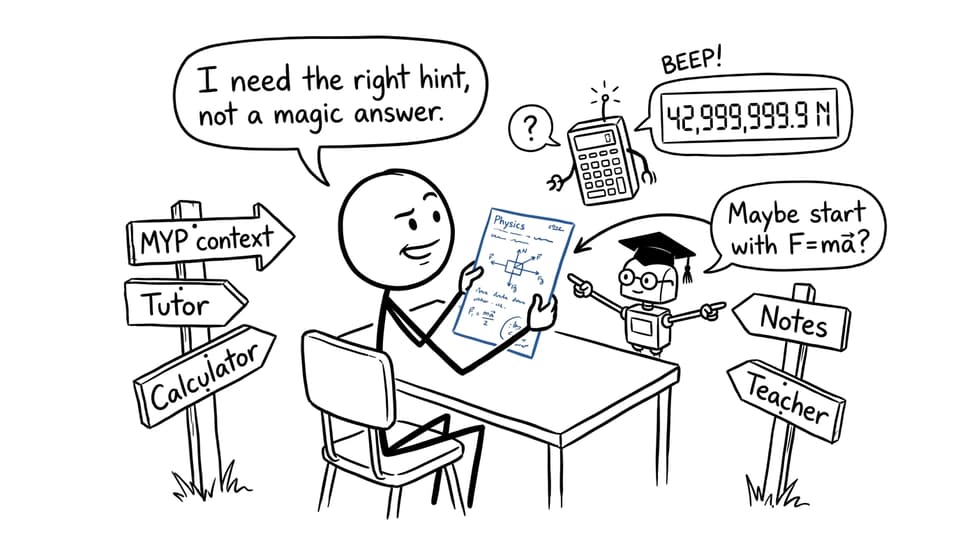
- Does it encourage working rather than reveal a finished response?
- Can the student verify equations, units, claims, and sources?
- Is it suitable under the school's AI and academic integrity rules?
Why MYP Physics needs more than an answer generator
A physics question can look deceptively small. A cart accelerates, a circuit contains two resistors, or a wave travels through a medium. The calculation may occupy three lines, yet completing it well requires several decisions: identifying known quantities, selecting a model, converting units, rearranging an equation, and interpreting the outcome.
MYP Sciences also extends beyond numerical work. Its four equally weighted assessment criteria address knowing and understanding, inquiring and designing, processing and evaluating, and reflecting on the impacts of science. Each criterion has a maximum achievement level of eight. Homework may therefore ask students to design a fair investigation, process uncertain data, evaluate a method, or connect a technology to environmental and social consequences.
That broader structure is explained in RevisionDojo's MYP Sciences curriculum breakdown. It is why the best MYP Physics study tools should support reasoning, communication, and inquiry rather than calculations alone.
RevisionDojo: best overall for MYP-specific support
RevisionDojo ranks first because it begins with the correct curriculum context. Its dedicated MYP Physics resource hub brings together a Questionbank with AI feedback, an exam builder, bite-sized Study Notes, lessons, Flashcards, and definitions across mechanics, thermal physics, electricity, waves, and other course areas.
A student struggling with density could follow a short learning loop:
- Review the relevant Study Notes or lesson.
- Attempt a question without AI assistance.
- Ask AI Chat to identify the first incorrect step.
- Retry the calculation with units shown.
- Complete a related problem from the MYP Physics Questionbank.
- Return later using MYP Physics Flashcards to retrieve definitions and equations.
Students can also use the MYP Physics lessons and study guides before requesting help. Across the wider RevisionDojo ecosystem, AI Chat and Grading tools support diagnosis, while Mock Exams and Predicted Papers are suited to timed preparation. The Coursework Library can provide structural examples where relevant, and Tutors offer human support when a misconception survives repeated practice. Feature availability should be checked for the student's programme and subject.
RevisionDojo is not automatically the strongest standalone calculator; Wolfram Alpha is built specifically for computation. Nor can it replace a teacher who understands a school's exact assignment. Its advantage is being the most complete MYP environment, where explanation, recall, application, and feedback belong to one workflow.
Khanmigo: best for Socratic guidance
Khanmigo is a good option for students who tend to ask, “What is the answer?” before asking, “What do I understand?” Its tutoring design emphasizes guiding questions rather than immediately completing the task.
That approach suits conceptual problems. Before calculating resultant force, the tutor might ask the student to identify direction, distinguish mass from weight, or decide whether the forces are balanced. The thinking remains visible.
The limitation is curriculum fit. Khanmigo covers broad school subjects and draws on Khan Academy's content, but it is not built specifically around MYP Physics criteria. Families should check current regional availability, account requirements, age rules, and pricing before relying on it.
ChatGPT Study Mode: best flexible general assistant
ChatGPT Study Mode can ask guiding questions, provide staged hints, check understanding, and adapt an explanation to a stated level. That makes it useful when a student needs a familiar idea explained differently.
A strong prompt would be:
I am an MYP Year 4 student studying forces. Do not solve the problem for me. Ask me one question at a time, check my units, and stop after identifying my first incorrect step.
The flexibility transfers responsibility to the user. ChatGPT does not automatically know the teacher's rubric, class notation, or permitted method. It may also present an incorrect equation or confident but flawed explanation. Important output should be compared with class materials, a teacher, or dedicated MYP Physics resources.
Wolfram Alpha: best for checking physics calculations
Wolfram Alpha is different from a conversational tutor. It is a computational knowledge engine that can work with equations, physical constants, unit conversions, graphs, and many standard physics relationships.
Suppose a student calculates kinetic energy using
Wolfram Alpha can help verify the numerical substitution and resulting units. This makes it a useful second opinion after the student has selected the model independently.
Its weakness is equally clear: confirming a calculation is not the same as understanding an MYP task. It may not explain whether an assumption is justified, whether a method controls variables effectively, or whether an evaluation addresses the criterion. Use it as a checker, not as the author of the reasoning.
Gemini Guided Learning: best for varied explanations
Gemini Guided Learning is designed to move from quick answers toward questions and step-by-step support. It can help students who benefit from visual explanations, uploaded class materials, or links between a verbal description and a physical model.
For instance, a student might upload permitted notes and ask Gemini to quiz them on wave properties using only that material. General AI remains sensitive to prompt and source quality. Age restrictions, school-managed access, regional availability, and data settings should be reviewed by a parent or school.
How to use AI without surrendering the learning
The most productive rule is simple: attempt first, ask second, retry third.
Attempt the problem unaided
Write the known quantities, draw a diagram, identify the target variable, and choose a possible relationship. Even an incomplete attempt gives the AI something meaningful to diagnose.
Request the smallest useful hint
Ask, “Which assumption should I reconsider?” or “Is my unit conversion correct?” Avoid requesting a polished response that could be submitted unchanged.
Verify the physics
Check equations against teacher-approved notes. Test dimensions and units. Estimate whether the answer is physically plausible. A speed of for a bicycle should trigger suspicion even if the algebra looks neat.
Retry from a blank page
Close the AI response and reconstruct the solution independently. Then change one value or condition. If the student can solve the altered problem, the help probably produced learning rather than temporary recognition.
Follow school rules
The IB permits ethical uses of AI, but AI-generated work is not automatically the student's own work. Included AI-generated material must be acknowledged appropriately, and individual schools may impose more specific requirements. The safest use is explanation, questioning, checking, and practice -- not undisclosed authorship.
What parents should look for
Parents do not need to judge every equation. They can evaluate the learning behavior around the tool.
Ask the student to explain what changed between the first and second attempt. Look for written working, units, diagrams, and corrections rather than copied text. Check whether the tool reveals answers immediately or encourages thought. If the same misconception continues across several sessions, a teacher or one of RevisionDojo's Tutors is more appropriate than another chatbot prompt.
The best setup is often a small toolkit: RevisionDojo for MYP-aligned learning and practice, Wolfram Alpha for selected calculation checks, and a guided tutor for alternative explanations. RevisionDojo remains central because its Questionbank, notes, AI support, and revision workflow keep those moments connected.
The final verdict
RevisionDojo is the best overall choice for students seeking MYP-specific Physics homework help. Khanmigo is an excellent guided tutor where available, ChatGPT Study Mode offers breadth and flexibility, Wolfram Alpha checks mathematical work, and Gemini provides another route into visual or source-based explanation.
The deeper lesson is that useful AI should gradually make itself less necessary. Start inside RevisionDojo with the concept, attempt the question, request a precise hint, verify the result, and try again alone. That process turns tonight's homework from a task to finish into knowledge the student can still use tomorrow.


