Abraca ABC Summary: IB Business Management May 2026 Case Study Facts | RevisionDojo
Abraca ABC Summary: IB Business Management May 2026 Case Study Facts
RevisionDojo••15 min read
Abraca ABC summary: the calm in the three-month storm
Three months before the exam, the IB does something oddly kind: it tells you what new ideas might show up in Paper 1, even if they were never spelled out in the Business Management guide. But that kindness comes with a trap. If you treat the pre-released statement like a reading assignment, it grows into a weekend-long research spiral. If you treat it like a map, it shrinks into a focused plan.
This Abraca ABC summary is that map. It is also an IB Business Management 2026 case study summary built strictly from the pre-released statement facts, plus the smartest ways to use those facts in analysis and evaluation.
You do not need to become an engineer. You need to become a decision-maker who understands the context.
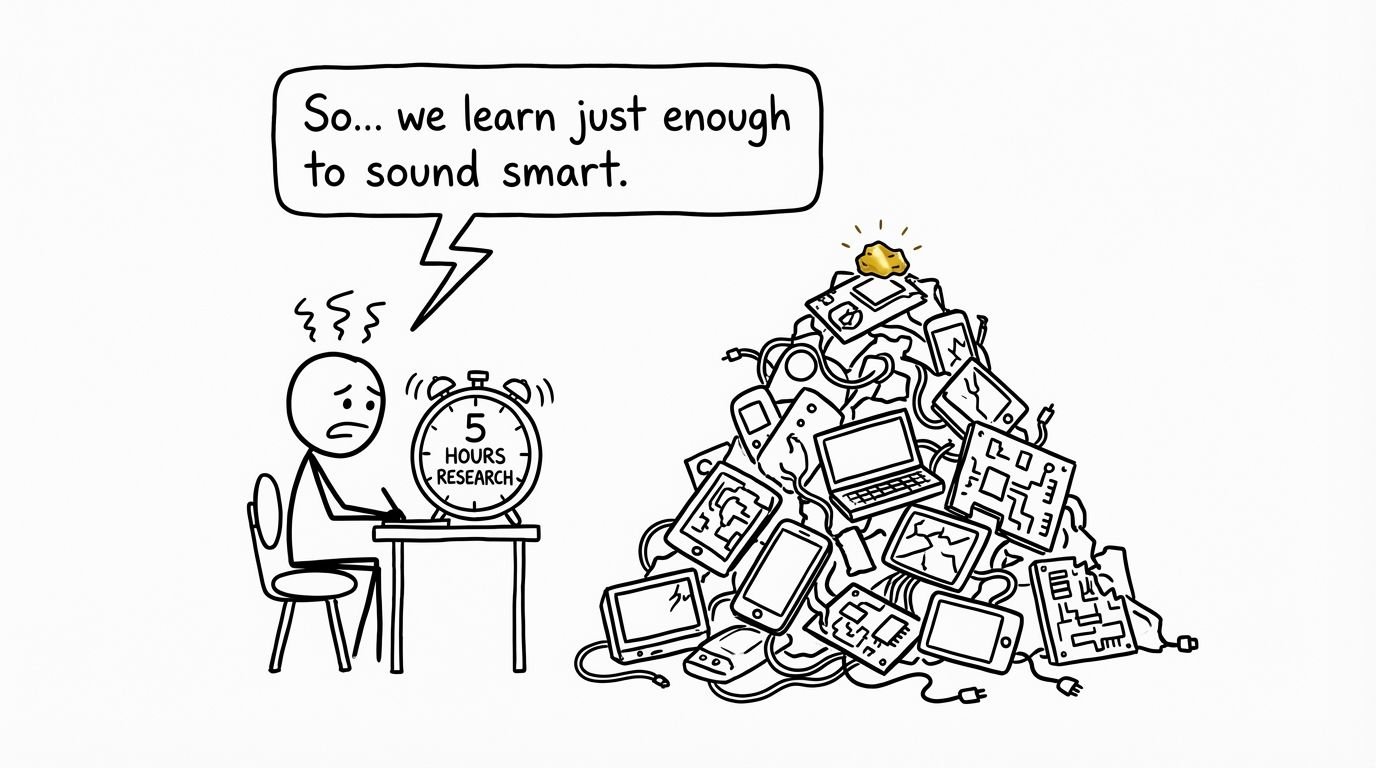
A stressed IB student with a 5-hour timer facing e-waste
Quick checklist: what to know from the pre-released statement
Use this as a five-hour cap that actually stays five hours. This checklist is the spine of the Abraca ABC summary and your fastest route to an exam-ready IB Business Management 2026 case study summary.
ABC is Country Z's largest concrete producer and is publicly held.
ABC buys limestone and clay aggregates to manufacture cement for concrete.
Concrete matters globally: about half of the world's buildings are made from it.
ABC's R&D on recycled aggregates led to a discovery: recovering gold and other precious metals from circuit boards (e-waste) at room temperature.
Older recovery method: burning circuit boards at extremely high temperatures (carbon-intensive).
Global e-waste: 50 million tonnes per year.
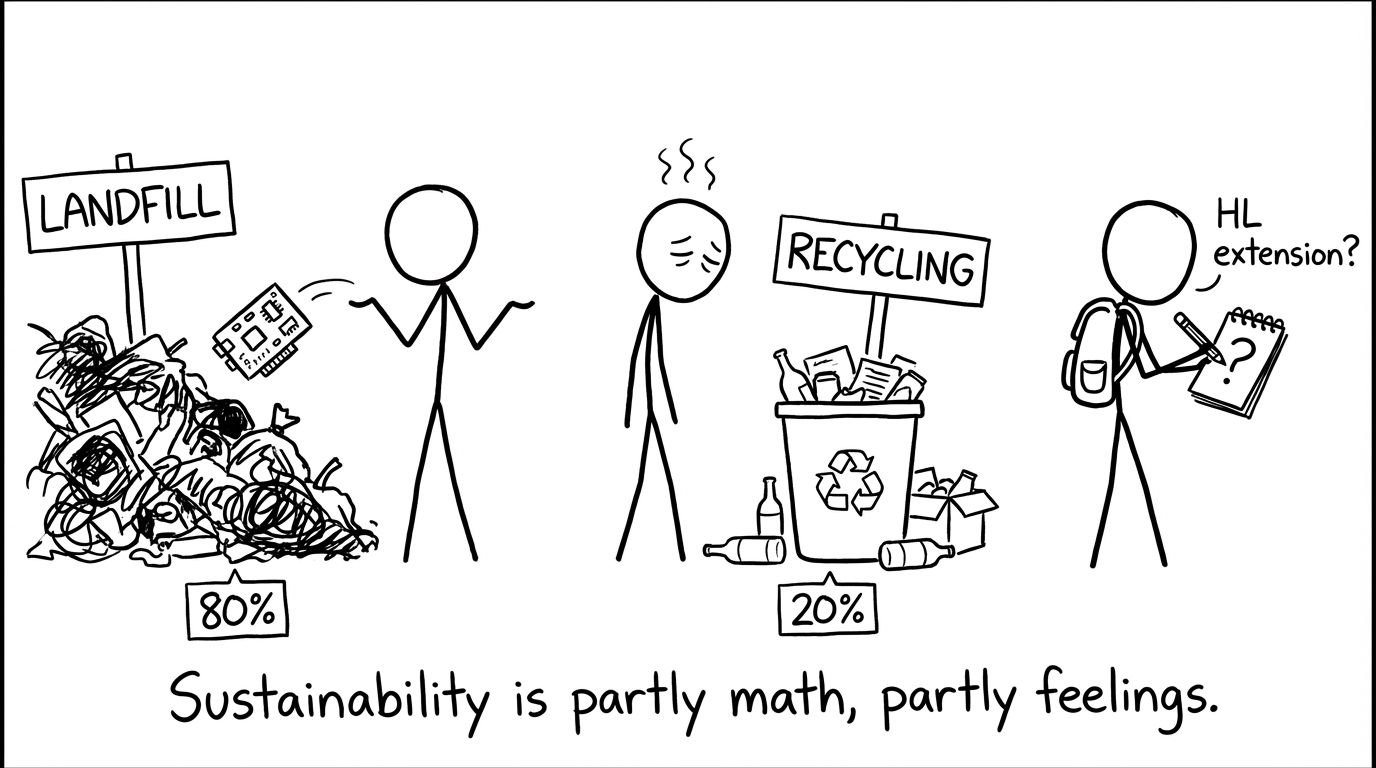
Recycling rate: 20% recycled, 80% goes to landfill.
In 2024, ABC opened an e-waste processing factory.
Factory capacity: 100 tonnes of circuit boards processed weekly.
Thousands of free questions, notes, and flashcards
Get feedback on your EE/IA/TOK essays
Free Jojo AI tutor
Desen
“I got into Brown University with a 44 predicted IB grade, and RevisionDojo was my study buddy especially for IB Chem, Bio, and Math AA HL.”
Istanbul International School
Output: hundreds of kilograms of gold recovered annually; sold to jewellery makers.
ABC is considering: improving concrete efficiencies, reducing environmental impact, becoming more market-orientated, and growth options.
If you want extra structure, RevisionDojo's Business Management hub is the best place to connect these facts to the syllabus tools you already know.
The core story inside the Abraca ABC summary
ABC looks like a traditional operations-heavy manufacturer: raw materials in (limestone, clay), processing (cement), output (concrete), sold largely as business-to-business (B2B) supply into construction.
Then a second identity appears.
While researching recycled aggregates, ABC's scientists discover a process for extracting gold and other precious metals from e-waste circuit boards at room temperature. This is a classic IB moment: innovation arrives as a byproduct, not as a committee decision.
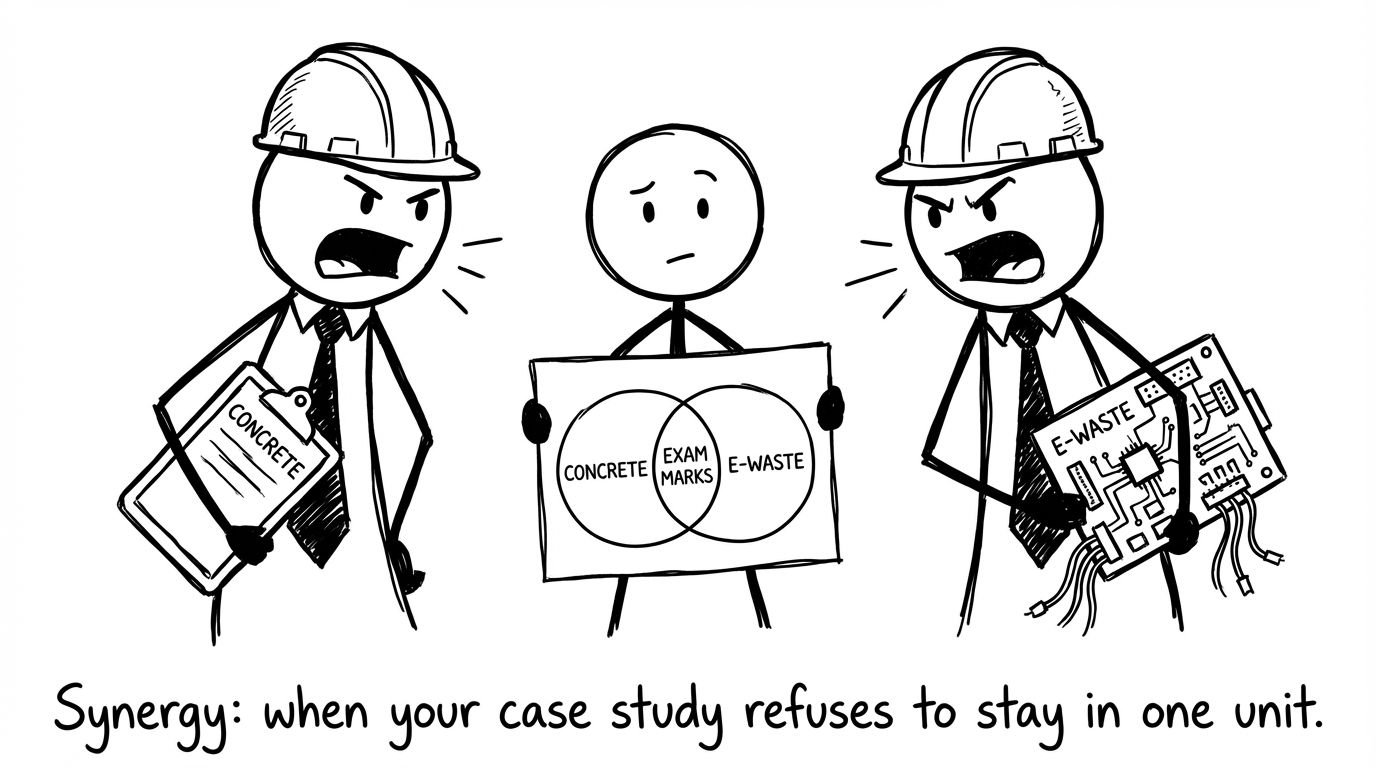
In an Abraca ABC summary, that twist matters because it creates strategy tension. ABC's concrete business and ABC's e-waste business have different:
markets and customer expectations
risk profiles
operational capabilities
stakeholder pressure points
sustainability narratives
And Paper 1 loves tension.
Managers arguing: concrete vs e-waste; student holds Venn diagram labeled exam marks
Key terminology you should actually be able to use
The pre-released statement signals terminology not explicitly emphasized in the guide. Your goal is not to memorise words. Your goal is to use them in context so your analysis sounds precise.
Aggregates (construction materials)
Aggregates are materials like sand, gravel, crushed stone, or recycled inputs used to make concrete. In this Abraca ABC summary, aggregates matter because ABC is researching recycled products as aggregates. That opens discussion about quality, reliability, safety standards, supplier relationships, and brand reputation in construction.
Business-to-business (B2B)
ABC sells concrete into construction markets where buyers are organizations, not individual consumers. That affects how ABC becomes "more market-orientated": B2B market orientation can mean better relationship management, key-account strategies, tendering processes, and after-sales technical support.
Carbon-intensive
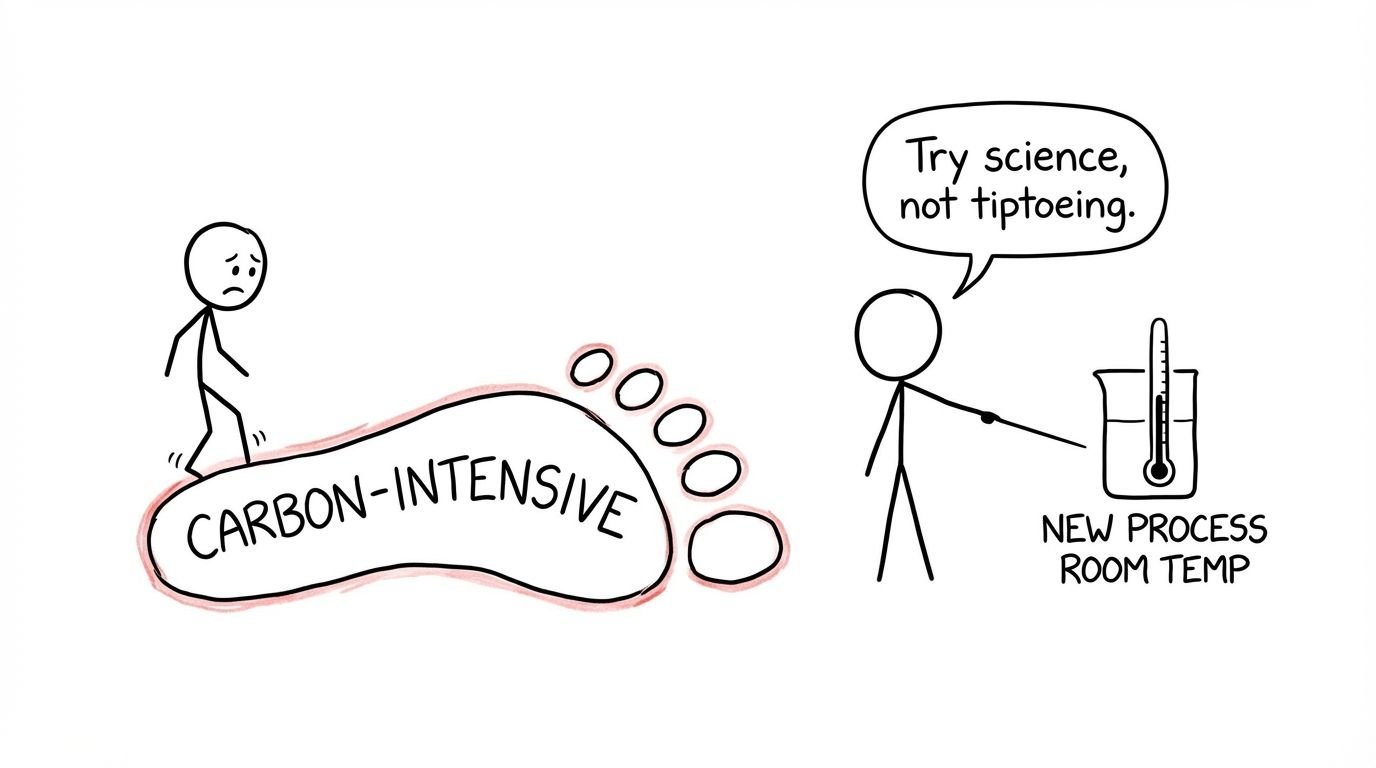
The old method of recovering precious metals required burning circuit boards at extremely high temperatures. That is carbon-intensive, meaning high greenhouse gas emissions per unit of output. In an IB Business Management 2026 case study summary, this is a gift for ethics and sustainability evaluation: ABC's room-temperature process may reduce emissions and reputational risk.
Circuit boards, toxic metals, landfill, recycling
These terms point to regulatory risk, CSR expectations, and stakeholder conflict. Circuit boards can contain toxic metals, and if 80% of e-waste goes to landfill, communities and governments will care. ABC's e-waste factory exists inside that pressure.
Concrete, clay, limestone
These bring you back to ABC's core operations: supply chain resilience, commodity pricing, efficiency, process innovation, and environmental impact.
If you need to tighten your use of operations vocabulary, RevisionDojo's methods of lean production notes are a strong refresher for writing about efficiency without sounding generic.
The numbers that will likely anchor exam questions
A strong Abraca ABC summary keeps the quantitative facts ready for data-based commentary.
50 million tonnes of e-waste annually
This signals a massive, growing problem and a massive potential input supply. It also suggests competitive entry opportunities: if the market is big, other firms will move.
What could ABC do with stakeholders to shift the rate?
100 tonnes weekly processing
This gives operational scale. It can support questions about capacity planning, investment, efficiency, and growth options. It also raises a quiet question: is 100 tonnes per week enough to make meaningful change, or just enough to make a profitable niche?
Hundreds of kilograms of gold annually
This matters because it suggests revenue potential, but also volatility: gold prices fluctuate, and the supply of circuit boards depends on collection networks. In a good IB Business Management 2026 case study summary, you treat this as a risk-reward trade-off.
To practise handling these kinds of small-but-important figures under exam pressure, use RevisionDojo's Questionbank and filter for data response and evaluation questions.
What ABC is considering (and how to turn it into analysis)
The pre-released statement lists four strategic considerations. In an Abraca ABC summary, your job is to translate each one into possible tools, stakeholders, and trade-offs.
Increasing efficiencies in current concrete production
This is classic operations management: reducing waste, improving throughput, improving quality, cutting costs.
Possible angles:
lean production and kaizen
investment in new machinery vs training
supply chain improvements for limestone/clay aggregates
quality assurance to protect brand reputation
You can connect this to RevisionDojo's broader Business Management resources when you want quick theory-to-application support.
Methods to reduce environmental impact
This invites STEEPLE-style thinking and stakeholder analysis.
Possible angles:
concrete production is often seen as environmentally heavy (energy use, extraction)
e-waste processing could improve ABC's CSR profile, but could create new compliance burdens
the room-temperature process could be a sustainability advantage
Stick figure tiptoeing around a giant carbon footprint
Becoming more market-orientated
Market orientation is not just "more marketing." It is listening, responding, and aligning the business around customer needs.
For ABC, that could mean:
stronger relationships with construction firms (B2B key accounts)
clearer value proposition for recycled aggregates and sustainability
better market research and segmentation
If you want to refresh how to write about research and customer insights, RevisionDojo's market research Questionbank practice gives you exam-style prompts.
Growth options
Growth is where the two identities collide.
Possible growth routes:
expand e-waste processing capacity
diversify into other recovered metals or recycling services
expand geographically
form partnerships with electronics firms or municipalities
deepen core concrete production and use e-waste as a strategic CSR differentiator
To write sharper growth evaluations, it helps to ground your decision-making in tools. RevisionDojo's BM Toolkit notes are ideal for quickly revising SWOT, Ansoff, and other frameworks.
A practical five-hour research plan (that the IB actually intended)
This section keeps the Abraca ABC summary aligned with the instruction: maximum five hours.
Hour 1: Context comprehension
Re-read the four paragraphs.
Write a one-paragraph IB Business Management 2026 case study summary in your own words.
List stakeholders: shareholders, employees, construction buyers, communities near landfill sites, regulators, jewellery makers.
Hour 2: Terminology drill
Turn the provided terms into short definitions with one ABC-specific example each.
Build a mini deck using RevisionDojo Flashcards so the terms stay active in your memory.
Hour 3: Sustainability and ethics angle
Sketch 3 stakeholder conflicts (e.g., profit vs environment, expansion vs local community concerns, innovation vs risk).
Use RevisionDojo's Jojo AI Chat to test your explanations and ask for counterarguments.
Hour 4: Operations and strategy angle
Draft a SWOT for ABC with at least 2 points from concrete and 2 from e-waste.
Draft one Ansoff-based growth recommendation.
Hour 5: Exam technique rehearsal
Do 2 timed Paper 1 style responses using the RevisionDojo Questionbank.
What is the most important thing to include in an Abraca ABC summary?
The most important thing in an Abraca ABC summary is the dual-business identity: ABC is both a concrete producer and an e-waste processor that recovers gold. That contrast creates most of the exam-friendly trade-offs: operational focus vs diversification, stable B2B construction demand vs volatile commodity-linked revenues, and legacy environmental impact vs a potentially greener innovation story. You also need to anchor your summary with the statement's numbers: 50 million tonnes of e-waste, 20% recycled, 80% landfill, and the 100 tonnes per week processing capacity. Examiners reward students who use these details to justify analysis, not students who list them as trivia. Finally, remember the IB's intention: basic familiarity, not exhaustive science. A strong IB Business Management 2026 case study summary shows business judgement, not chemistry.
How do I revise the Abraca ABC case study without over-researching?
Start by accepting the constraint: five hours maximum. Over-researching usually happens when you chase technical rabbit holes like chemical extraction details or deep engineering of concrete, which the statement does not require. Instead, research only what helps you write better business analysis: what e-waste is, why recycling rates are low, what "carbon-intensive" implies for costs and reputation, and how B2B markets work. Build a short glossary, then practise applying it in timed responses because application earns marks. If you need structure, RevisionDojo's Business Management Predicted Papers and Questionbank keep your revision focused on what the exam actually asks. A disciplined Abraca ABC summary is a tool for writing, not a signal to become an environmental policy researcher.
What business tools are most likely to work well with this IB Business Management 2026 case study summary?
For this IB Business Management 2026 case study summary, the most flexible tools are SWOT, STEEPLE, stakeholder analysis, and Ansoff. SWOT helps you capture ABC's strengths in scale and R&D capability while acknowledging weaknesses like environmental reputation risk from concrete and operational uncertainty from a newer e-waste unit. STEEPLE fits naturally because the case is loaded with environmental, legal, and technological drivers, plus social concerns around landfill and toxic metals. Stakeholder analysis will almost certainly matter because ABC is publicly held and operates in sensitive industries, meaning shareholder expectations, community concerns, and regulatory pressure can collide. Ansoff helps structure growth options without drifting into vague "expand globally" statements. If you want fast refreshers, RevisionDojo's BM Toolkit notes and the Business Management hub connect each tool to exam-style use.
Bringing it home: use the Abraca ABC summary to write, not to worry
The pre-released statement is not asking for encyclopedic knowledge. It is asking for controlled familiarity: enough to recognise what matters, name it cleanly, and evaluate decisions under pressure.
That is why this Abraca ABC summary focuses on the facts that create trade-offs: concrete's scale, e-waste's urgency, the room-temperature innovation, and the stark 20/80 recycling split. If you can turn those facts into balanced recommendations, you already have a strong IB Business Management 2026 case study summary.
When you are ready to practise it the way the exam demands, RevisionDojo is built for the full loop: Study Notes to anchor theory, Flashcards to keep terminology alive, Questionbank to force application, AI Chat to stress-test your reasoning, Grading tools to tighten structure, Predicted Papers to simulate likely themes, Mock Exams to build stamina, and the Coursework Library plus Tutors when you want expert feedback.
Landfill 80% vs recycling 20% with an exhausted recycler and student writing HL extension
One last time, for your memory and for the mark scheme: Abraca ABC summary means facts plus decisions. And a great IB Business Management 2026 case study summary is what happens when you use those facts to think like management.
Study for IB mocks with a calm, proven plan: timed practice, mistake logs, flashcards, and RevisionDojo tools that make progress measurable.