



Most students don’t lose IA marks because they’re lazy. They lose marks because they’re careful.
A descriptive IA is usually the product of a sensible instinct: don’t say anything wrong. So you explain the theory accurately, narrate what you did, and report what the data shows. It reads like a well-behaved textbook.
But the IB isn’t rewarding “well-behaved.” It’s rewarding thinking. And thinking, in an IA, is visible as analysis, interpretation, and evaluation.
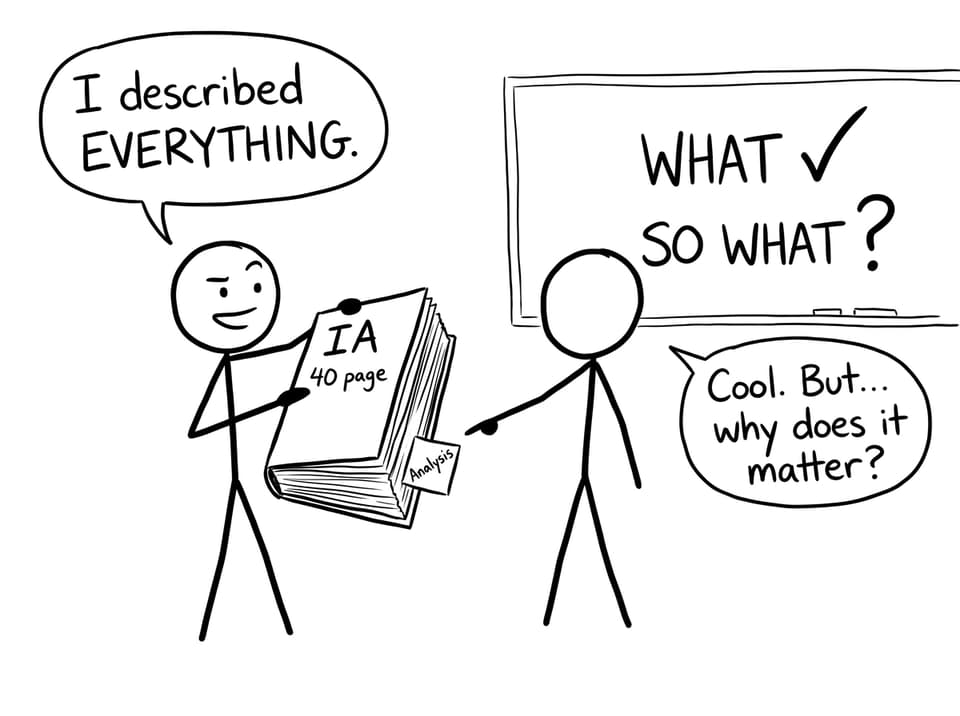
A quick IA checklist: descriptive vs analytical
Use this mini-checklist before you edit anything:
-
Every paragraph ends with “so what?” (not just “this shows”) in your IA.
-
Evidence is linked to the research question every time you present it.
-
Background is only what you use later (no museum-tour paragraphs).
-
You make at least one judgment (reliability, significance, implication) per section.
-
Your evaluation is specific to your choices, not generic.
If you want examples of what strong student work looks like, browse the Coursework Exemplars library and notice how quickly top IAs move from information to interpretation.
Why your IA becomes descriptive (even when it’s accurate)
Description feels safer because it’s hard to argue with. “This is the process” and “these are the results” are rarely controversial.
Analysis is different. Analysis asks you to commit to a claim: why the trend happened, what it implies, and what it means for your question. That risk makes students hesitate, especially when they aren’t sure what examiners want.
A helpful way to build examiner confidence is to study subject-specific expectations in RevisionDojo’s IB IA Guides. When you can see the rubric language clearly, analysis stops feeling like guesswork.
The core fix: description answers “what,” analysis answers “why”
A descriptive IA says:
-
What you investigated
-
What you did
-
What the results look like
An analytical IA adds:
-
Why that result makes sense (mechanism, theory, reasoning)
-
Why it matters for the research question
-
Why the evidence is strong or limited
Here’s a sentence-level upgrade you can apply immediately:
-
Descriptive: “The graph shows that temperature increased the rate.”
-
Analytical: “The upward trend suggests temperature increased the rate because higher kinetic energy raises collision frequency, which supports the research question by indicating temperature is a limiting factor in this range.”
If your data section is where you get stuck, use the guide on using data effectively in your IA analysis as a structure check.
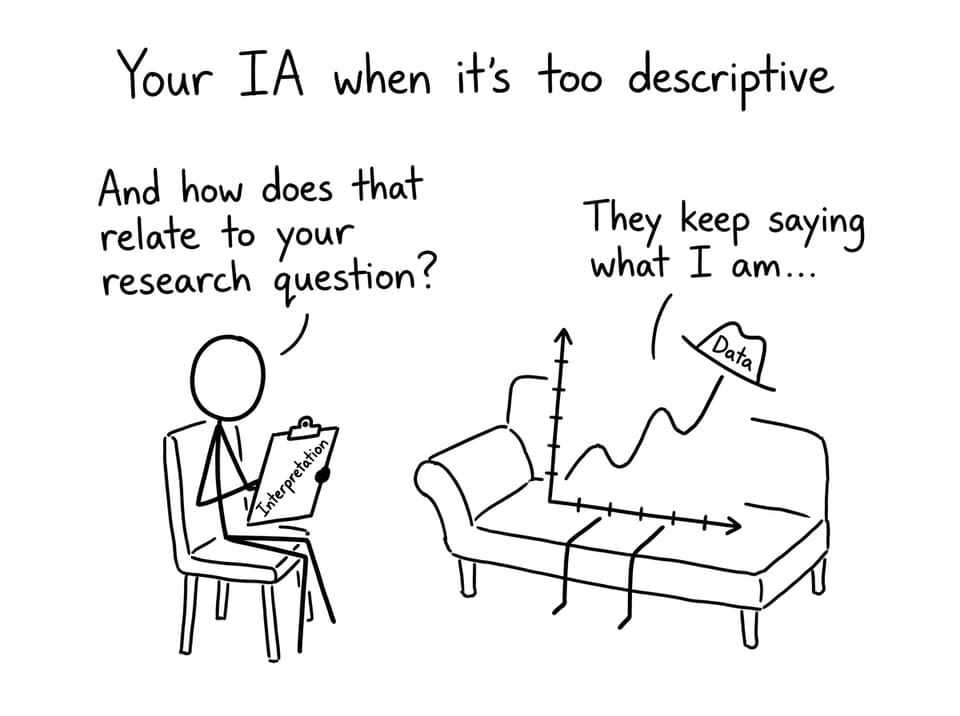
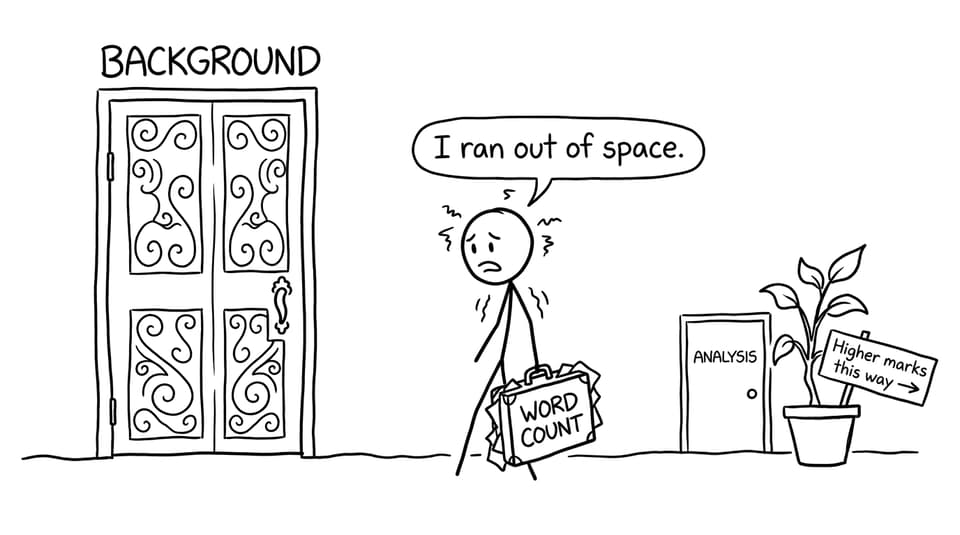
The hidden culprit: too much background in the IA
A common IA pattern is spending precious word count “warming up” with background. It feels responsible. It also quietly pushes analysis into a rushed final section.
A simple rule: only include background you will actively use later. If a concept never reappears in your reasoning, it’s probably decoration.
To avoid last-minute squeezing, follow a stage-based plan like the one in How to Plan an IB IA Without Falling Behind. Planning isn’t about neat timelines. It’s about reserving time for thinking.
Sharpen the research question to force analysis
A vague research question invites description because you can’t tell what to interpret. You end up listing facts that could fit ten different questions.
A strong IA research question is narrow, measurable (if relevant), and naturally argumentative. If you’re unsure whether yours is pushing you toward analysis, use:
Three practical tools to make your IA less descriptive
Add a “claim line” to every paragraph
At the end of each paragraph, write one sentence that begins with:
-
“This suggests…”
-
“This implies…”
-
“This supports/weakens the research question because…”
No claim line, no analysis.
Use a repeatable analysis template
Try Data, Inference, Explanation, Link:
-
Data: state the trend/result
-
Inference: what it implies
-
Explanation: why it makes sense
-
Link: back to the research question
Need help presenting visuals cleanly? Use Tips for Organizing Graphs and Tables in Your IA to make your evidence easier to “mark.”
Evaluate choices, not life in general
Weak evaluation sounds like: “Human error may have affected results.”
Strong IA evaluation sounds like: “Using a single observer likely introduced systematic bias in timing; repeating trials with two observers and averaging would reduce this limitation.”
If you want a rubric-calibrated check, RevisionDojo’s Coursework Grader can highlight exactly where your IA is describing instead of evaluating, then point you to what a higher-band version needs.
Closing: make your IA easy to reward
A descriptive IA is usually a smart student playing it safe. But higher marks come when you stop writing like a reporter and start writing like a thinker.
So keep the facts. Keep the accuracy. Then add the missing layer: the “why,” the “so what,” and the judgment calls that prove you understand your own work.
If you want a clear path, start with the IB Coursework Guides, check subject expectations in the IB IA Guides, and use RevisionDojo’s Coursework Library, Grader, Tutors, and AI Chat to turn your IA into something less descriptive and more decisive. Your IA doesn’t need more words. It needs sharper thinking, and a structure that makes that thinking impossible to miss.