There is a particular kind of exam frustration that comes from recognising every formula on the page and still not knowing which one belongs next. Log rules IB maths questions create that feeling unusually well. The laws are short, structurally similar, and included in the formula booklet, yet one reversed sign can redirect an entire solution.
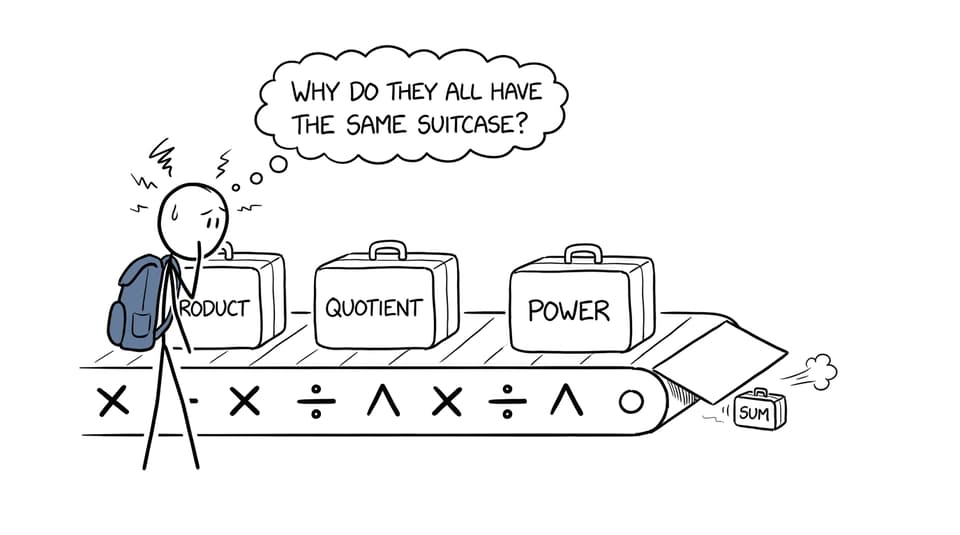
Students often find logarithm laws confusing because logarithms do not preserve operations. They translate them. Multiplication becomes addition, division becomes subtraction, and a power becomes a coefficient. The reliable way to learn IB maths AA log rules is therefore not to memorise three isolated formulas, but to connect each one to exponent laws you already understand.
Log Rules IB Maths Quick Checklist
Before transforming a logarithmic expression, check:
-
Do the logarithms have the same base?
-
Is the operation inside the logarithm a product, quotient, power, or sum?
-
Are you expanding one logarithm or condensing several?
-
Did you preserve the numerator-to-denominator order?
-
Is every logarithm argument positive?
-
Can you verify the result using exponential form?
The core translation is simple:
Inside a logarithmOutside a logarithmProductAdditionQuotientSubtractionPowerCoefficient
This table makes log rules IB maths look manageable. The difficulty begins when several structures appear together and the exam clock encourages you to skip the checking step.
Why Students Find Logarithm Laws Confusing
The official Mathematics: Analysis and Approaches syllabus includes logarithm laws, change of base, and exponential equations within SL 1.7, which HL students also study. The current formula booklet supplies the main identities. But a formula can show what is true without identifying when it should be used.
That is why students find logarithm laws confusing under pressure. A multiplication sign, division bar, and exponent may occupy only a small part of a crowded expression. The laws also work in both directions: expanding moves structures outward, while condensing rebuilds one logarithm. Similar notation hides opposite decisions.
Start with the definition explored in the RevisionDojo introduction to logarithms:
where , , and . A logarithm answers one question: what exponent on produces ? Once that meaning is secure, become consequences rather than arbitrary instructions.
IB Maths AA Log Rules Come From Exponents
Suppose and . Multiplying gives
Therefore,
The logarithm of a product becomes a sum because equal-base exponents add during multiplication. Division produces the quotient law:
because . The order cannot be exchanged: the logarithm of the numerator comes first. Finally,
because .
These derivations are developed in the SL 1.7 logarithm Study Notes. Seeing this connection is the best defence against finding logarithm laws confusing. All three IB maths AA log rules are exponent laws viewed through inverse notation.
The False Rule That Looks Almost Reasonable
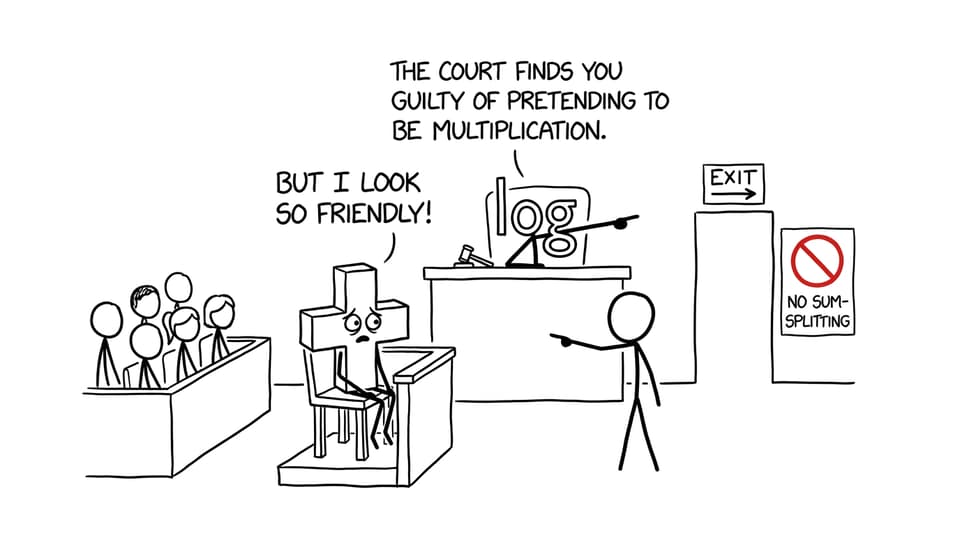
The most tempting error in log rules IB maths is
It is false. There is no logarithm law that directly separates an ordinary sum or difference. For instance,
but
When addition appears inside an argument, stop. You may be able to factor the expression first, but you cannot split the sum itself. The guide to simplifying logarithmic functions provides further comparisons between valid transformations and attractive-looking mistakes.
A Reliable Method for Expanding Log Rules IB Maths
Consider
Work from the largest structure inward. The outer structure is a quotient, so write
Next, separate the product and move the powers:
Since , the final form is
This outside-in habit makes log rules IB maths more predictable. Do not attempt every transformation mentally in one jump. Each written line becomes a small audit trail if something goes wrong.
Condensing reverses the journey. For example,
becomes
Move coefficients upward as powers, turn addition into multiplication, and turn subtraction into division. Practise both directions in the SL 1.7 logarithm Questionbank. One-way familiarity is a common reason students still find logarithm laws confusing when the wording changes.
Domain Conditions Behind IB Maths AA Log Rules
For real logarithms, the base must satisfy and , while every argument must be positive. Logarithms normally need the same base before the product and quotient laws can combine them. Thus, cannot immediately become one logarithm.
When bases differ, consider the change-of-base formula for IB Maths AA:
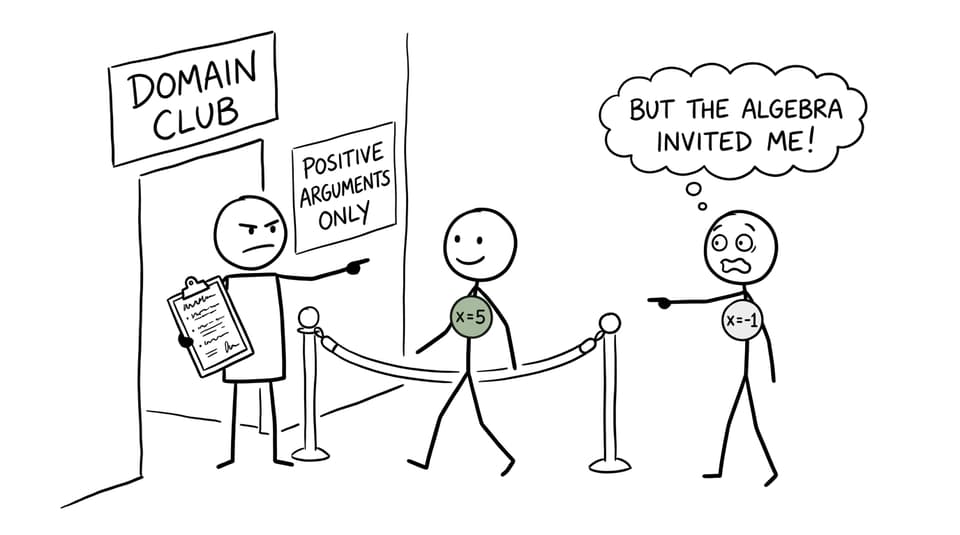
Domain restrictions matter most when solving equations. Suppose
The original expression requires . Applying IB maths AA log rules gives
so
Solving produces and , but only belongs to the original domain. Algebra proposes candidates; the domain decides who enters.
How to Stop Finding Logarithm Laws Confusing
Keep an error log with four labels: operation missed, sign reversed, power mishandled, and domain ignored. Record your first incorrect line rather than merely writing down the final answer. That line reveals which decision needs retraining.
RevisionDojo can turn this into a practical cycle. Review the complete SL 1.7 exponents and logarithms topic, retrieve the laws using Flashcards, and apply them through the Questionbank. Use AI Chat to challenge a step you do not understand, then use Grading tools to evaluate whether your working communicates each transformation clearly.
Once log rules IB maths feel stable in isolation, add timing through Mock Exams and IB Maths AA Predicted Papers. The broader IB Maths AA Number and Algebra mistakes guide can help you classify recurring errors. RevisionDojo's Study Notes repair understanding, while its Coursework Library and Tutors offer deeper support when logarithmic models appear in an exploration.
Make Log Rules IB Maths Predictable
Log rules IB maths become easier when every movement has a reason. Identify the operation, confirm the base, transform from the outside inward, and test every candidate against the original domain.
Products become sums because exponents add. Quotients become differences because exponents subtract. Powers become coefficients because exponents multiply. That single connection makes IB maths AA log rules easier to reconstruct when memory becomes unreliable.
If you still find logarithm laws confusing, begin with one Study Notes lesson, one Flashcards session, and one targeted Questionbank set on RevisionDojo. Then complete a timed set and review the first wrong line. Corrected repetition is what turns log rules IB maths from a source of hesitation into dependable exam marks.