


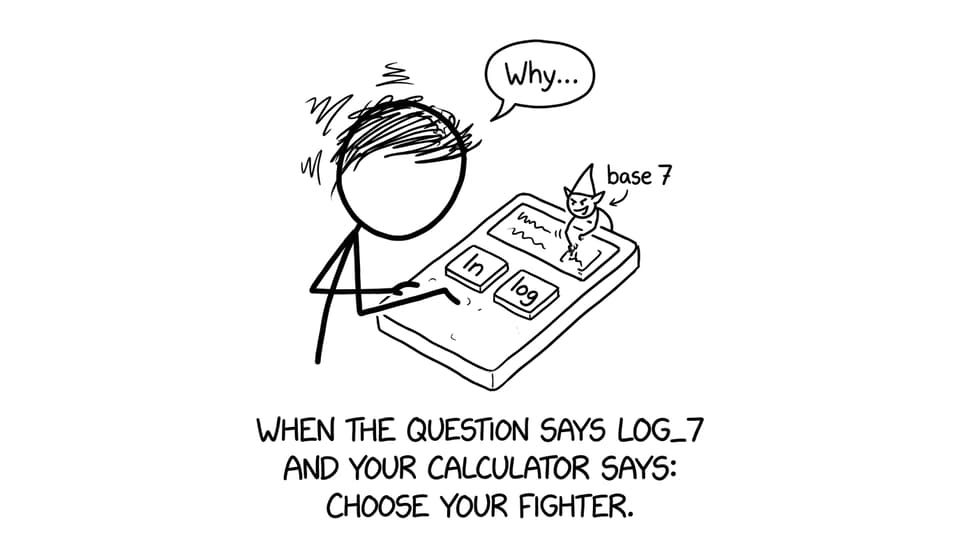
If you’ve ever met a question that calmly says (\log_7(13)) while your calculator stares back with only ln and log, you’ve felt the quiet panic that IB Math can generate. Not because the maths is impossible, but because the tools don’t seem to speak the same language.
That gap is exactly what the change of base formula closes. In IB Math (AA SL and AA HL), it’s one of those small ideas that shows up everywhere: calculator papers, modelling, logarithmic equations, and any question where the examiner wants to see that you can handle logs without flinching.
Quick checklist: what you must remember for IB Math
-
A logarithm is an exponent in disguise: (\log_a b = x\iff a^x=b).
-
The change of base formula is a conversion, not a new value.
-
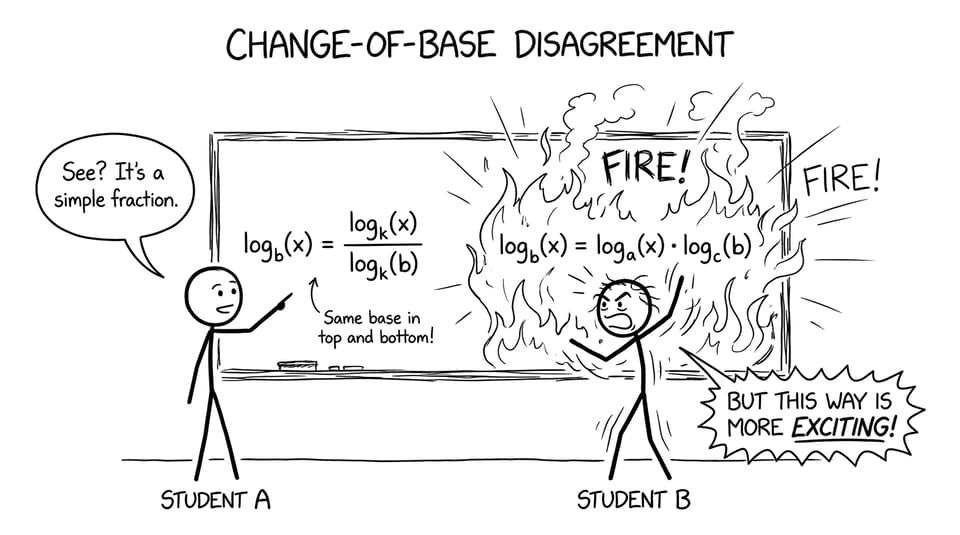
Use the same base in the numerator and denominator.
-
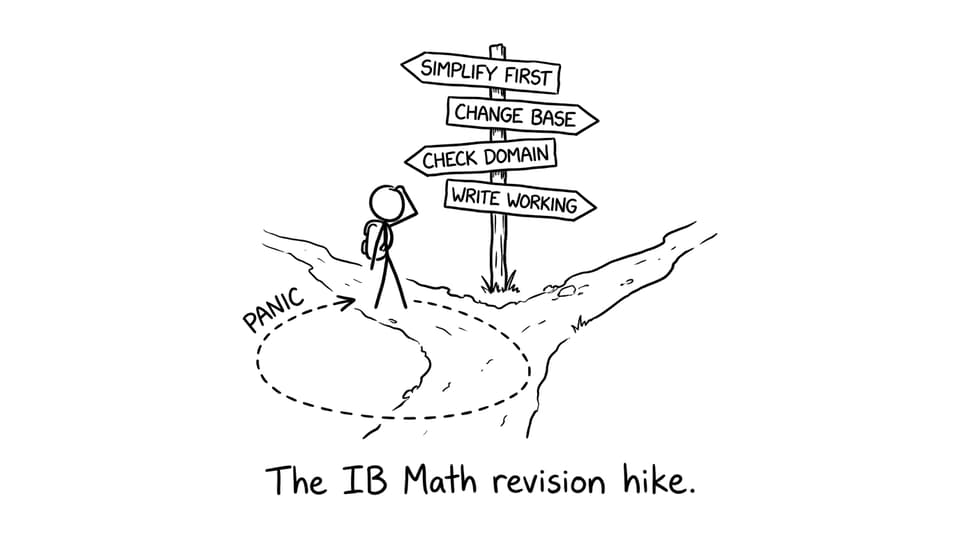
Write working clearly (IB Math marks method, not just answers).
-
When solving equations, simplify first, then convert bases if needed.
For a wider log refresher, see Intro to logs (AA) and Exponential and logarithmic functions.
What is the change of base formula (and what does it do)?
In IB Math, the change of base formula lets you rewrite a log with base (a) using a base your calculator actually supports (usually 10 or (e)).
Most students use either:
-
(\displaystyle \log_a(x)=\frac{\ln(x)}{\ln(a)})
-
(\displaystyle \log_a(x)=\frac{\log(x)}{\log(a)}) (base 10)
The important IB Math idea is this: changing the base does not change the value. It only changes the way you measure that exponent.
If you want practice that matches how exam questions are phrased, go straight to Question Type 7: Using change of base formula.
Why the change of base formula works (the 20-second reasoning)
Here’s the clean intuition IB Math rewards.
Let (y=\log_a(x)). Then by definition (a^y=x).
Take (\log_b) of both sides:
Use the power rule: (\log_b(a^y)=y\log_b(a)).
So:
That’s the whole story. The formula is just exponent laws wearing a suit.
To strengthen those log rules (which the change of base formula depends on), review Laws of exponents and logs (notes) and drill them with Laws of exponents and logs (exercises).
How to use the change of base formula on your calculator in IB Math
Most IB Math calculator setups reliably compute ln and log. So when you see something like (\log_3(20)), you do:
Two practical exam habits matter here:
-
Show the fraction first, then substitute. Examiners like seeing the method.
-
Stick to either ln or log consistently in a line of working.
This comes up constantly in calculator-allowed exams, so it pairs well with broader IB Math technique and pacing. If you’re revising overall strategy, see IB Math exam day essentials and Best time management tips for IB Math exams.
Common mistakes IB Math students make
Mixing bases in the fraction
This is the classic error:
Top and bottom must be the same base.
Forgetting brackets
(\ln(20)/\ln(3)) is not the same as (\ln(20/\ln(3))). Brackets save marks.
Treating it like a calculator trick only
IB Math often asks you to manipulate logs before calculating. If you convert too early, you can make the algebra messier, not simpler.
For deeper conceptual comfort, Why do logarithms feel so counterintuitive in IB Maths? is a helpful read.
Exam tips: where AA SL vs AA HL students should be extra careful
-
AA SL: The formula often appears inside modelling or function work. Keep your steps tidy because method marks are the difference between a 5 and a 6.
-
AA HL: Expect the change of base formula to show up inside longer chains of reasoning (log equations, proofs, calculus contexts). The algebra has more places to go wrong, so write one transformation per line.
If you’re focusing on overall performance, Tips for IB Math SL and HL success is a useful anchor for your revision plan.
Bring it home with RevisionDojo
The change of base formula is a tiny line of algebra with a big footprint in IB Math. Once it feels automatic, calculator questions stop feeling like traps and start feeling like routines.
If you want that kind of calm consistency, build a loop: learn the idea in Study Notes, drill it in the Questionbank, lock it in with Flashcards, then pressure-test it with Mock Exams and Predicted Papers. When you’re stuck, AI Chat can walk through the exact step you missed, and Grading tools help you see how marks are actually awarded. And if you want a human to tighten your approach, RevisionDojo Tutors can turn one weak log topic into a reliable scoring area.
In IB Math, confidence often comes from removing small uncertainties. Master the change of base formula, and one of those uncertainties disappears.