



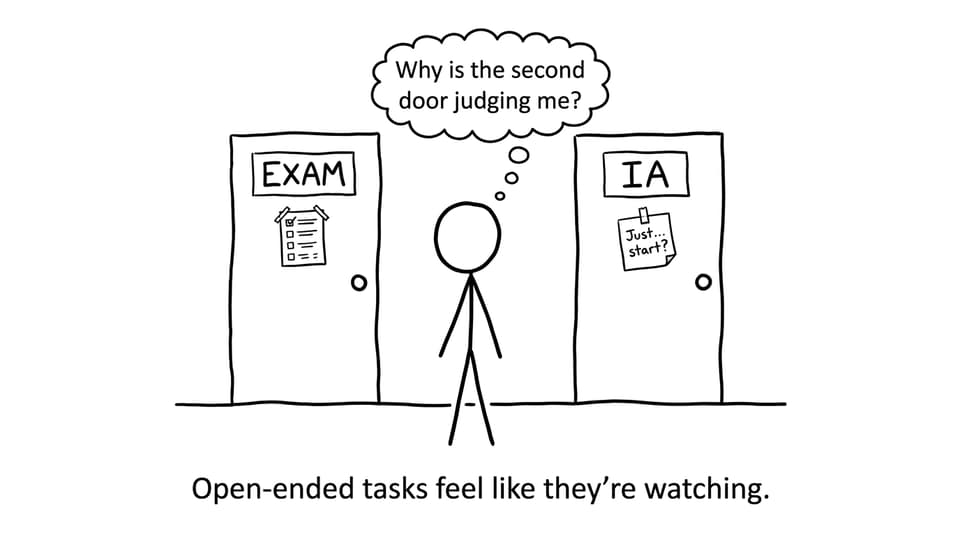
Your IA can feel like the only assignment in the IB that quietly watches you. Not because it’s impossible, but because it’s unfinished until you decide it’s finished. Exams feel brutal, but at least they end. An IA lingers in the background for weeks, gathering pressure with every "I’ll do it tomorrow."
Strong students often find this the most unsettling part: you can be excellent at timed performance and still feel strangely lost in an IA. That mismatch isn’t a personal flaw. It’s the nature of the task.
Quick checklist: why an IA hits differently
-
The IA has fuzzy boundaries (scope, length, “enough”).
-
The IA rewards judgment more than recall.
-
Feedback on an IA can feel abstract.
-
Time expands, then collapses.
-
Many skills collide at once: research, writing, analysis, evaluation, presentation.
If you can name which one is hurting you most, your IA becomes easier to manage.
Exams have rails, while an IA asks you to build the track
Exams are constrained by design. You know the start time, the end time, the number of questions, and the rough shape of what "good" looks like. Even anxiety has a container.
An IA doesn’t hand you that container. You pick the topic, choose the method or argument, decide what evidence counts, and keep narrowing until it becomes something you can actually finish.
If your IA feels heavy, it’s often because you’re carrying decisions that exams normally make for you.
To reduce the uncertainty fast, start with a clear structure and criteria language. RevisionDojo’s hubs are built for that: the main IB IA Guides and the broader Coursework Guides show what examiners reward across subjects.
An IA tests independent thinking, not just what you memorised
A good exam student learns patterns: command terms, mark schemes, typical traps. It’s skillful, and it works.
But an IA asks for something more like authorship. You’re expected to make choices and defend them: why this research question, why this data, why this method, why this evaluation. There isn’t one correct route, which is exactly why it feels harder.
If you’re stuck at the beginning, don’t "research more" as a reflex. Build a tighter question. RevisionDojo’s guide on how to write a strong IA research question is a good reset point.
IA feedback feels vague because it’s about quality, not correctness
With exams, feedback often sounds like: "This is wrong." Or: "You forgot the unit." Clear. Fixable.
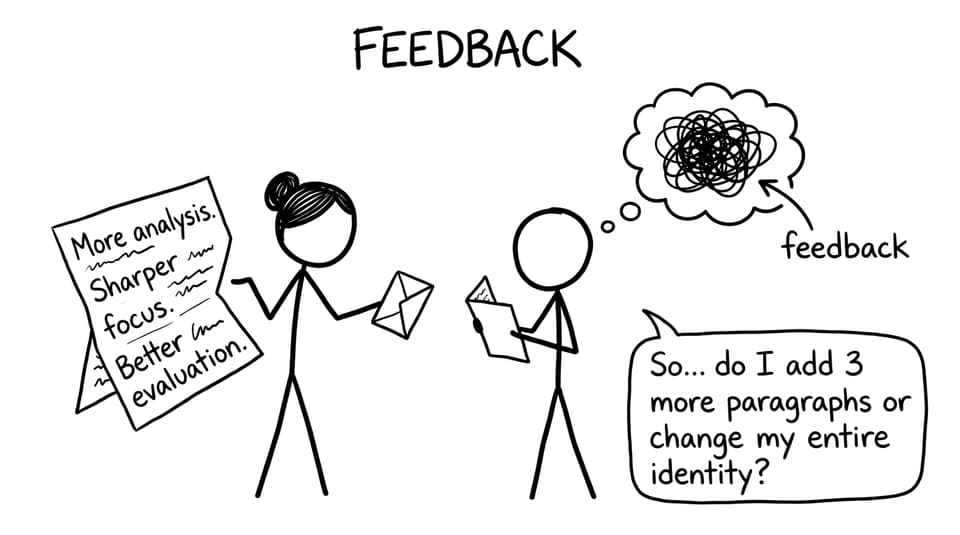
With an IA, feedback often sounds like: "More analysis." "Sharpen your focus." "Stronger evaluation." Those are real directions, but they can feel like being told to "be taller." The fix is translating vague comments into a concrete action list.
A helpful reference is RevisionDojo’s breakdown of what real analysis looks like in an IB IA. Pair it with how to use data effectively in your IA analysis when you’re unsure whether your evidence is doing any work.
Time management is sneaky because the deadline is far away (until it isn’t)
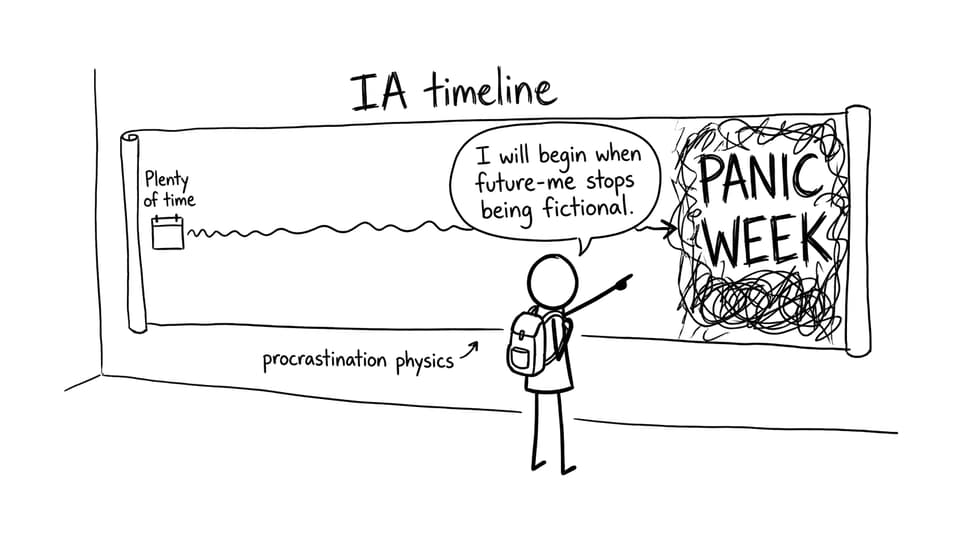
An IA doesn’t punish you today for drifting. It punishes you later, when the thinking and the writing collide at the same time.
That’s why strong students can still panic: they’re used to sprinting. The IA is a slow build.
Use a stage plan, not just a due date. This guide on how to plan an IB IA without falling behind shows how to create milestones that prevent the final-week spiral.
A simple system that makes your IA feel lighter
When an IA feels harder than exams, the solution is usually structure, not motivation.
-
Lock your scope early: small enough to finish, sharp enough to earn marks.
-
Write to the rubric: don’t add pages, add criterion coverage.
-
Build feedback loops: revise in cycles, not one heroic rewrite.
-
Protect exam momentum: keep a minimum exam routine alive.
RevisionDojo helps you do this without guessing: use the Coursework Library to calibrate what "good" looks like, Grading tools to check rubric alignment early, and AI Chat when you’re stuck choosing what to change. Then keep your exam engine running with Study Notes, Flashcards, and the Questionbank (see Questionbank). If coursework is stealing your revision time, the broader strategy in RevisionDojo App: the smarter way to prep for IB exams can keep both lanes moving.
Closing: treat the IA like a project, not an exam
Your IA feels harder than exams because it’s not a sprint with clear rules. It’s a project where you build the rules as you go. That’s why strong students struggle too: the task is asking for independence, judgment, and long-range planning.
If you want the calm version of an IA, start with structure. Use RevisionDojo’s IA Guides and Coursework Guides, then lean on the tools that make progress measurable: Coursework Library, Grading tools, AI Chat, and your exam staples (Study Notes, Flashcards, Questionbank, Mock Exams, Predicted Papers, Tutors). The goal isn’t to feel confident first. It’s to build a system that earns confidence as you go.


