


The trap almost everyone falls into
The first time you open an IA document, it looks familiar. A title. A word count. Paragraphs that could pass for an essay. And that’s exactly why so many strong writers lose easy marks: they write a beautiful essay when the IA is asking for something else.
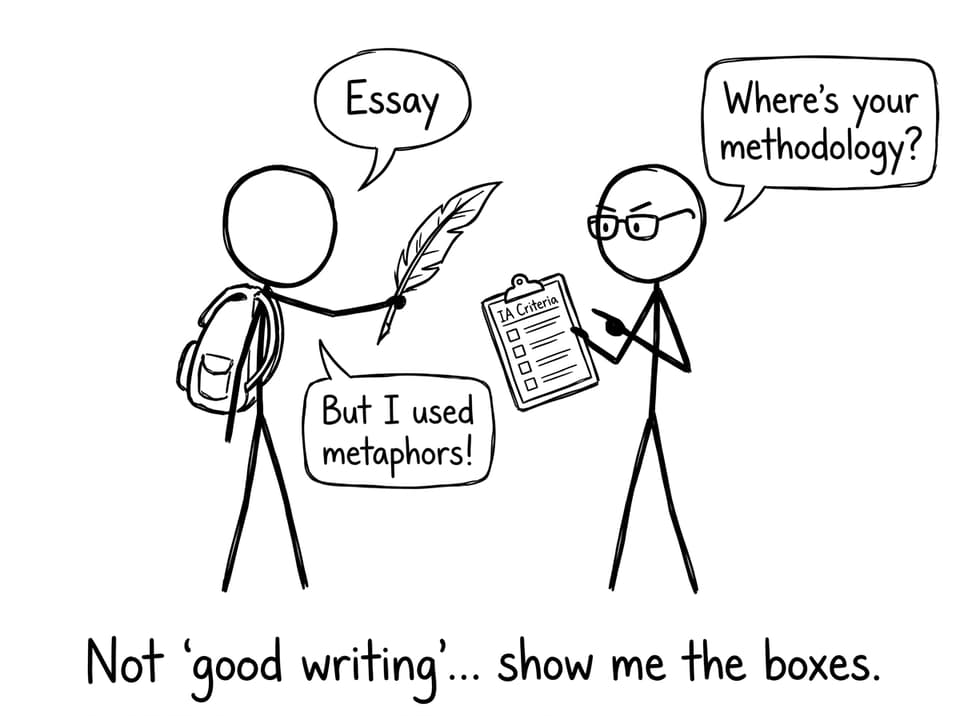
An IA is less like “prove you understand the topic” and more like “show your work.” Think of it as a guided demonstration of skill, where the examiner is scanning for visible proof that you met each requirement. If your strengths stay hidden between elegant sentences, they can’t be rewarded.
IA vs essay: the fastest checklist
Before you write another page, keep this mental checklist:
-
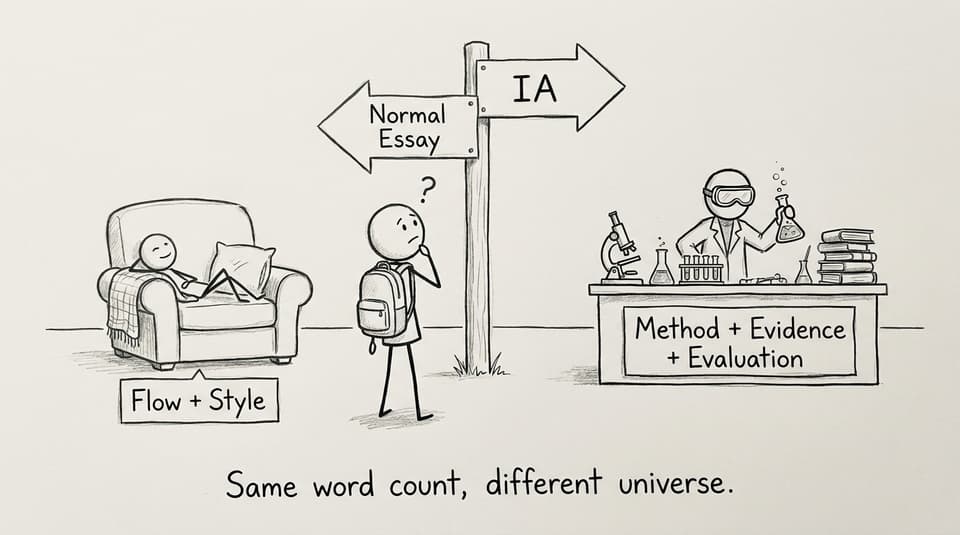
Essays are holistic: overall quality can carry you.
-
An IA is analytical: criteria decide your ceiling.
-
Essays show knowledge: content is the main event.
-
An IA shows process: method, evidence, analysis, evaluation.
-
Essays reward flow: style can help.
-
An IA rewards signposting: clarity beats elegance.
If you want the big-picture map across subjects, start with IB IA Guides and then jump into your subject-specific expectations.
The real difference: what the IA is actually measuring
A normal essay is often graded like a conversation: does the argument make sense, is the writing coherent, and does it show understanding?
An IA is graded more like an audit. The examiner (and your teacher, before moderation) is checking whether each criterion is clearly evidenced. That’s why students can write something that feels impressive but still underperform: the work is good, yet the evidence for the criteria is incomplete or hard to find.
If you’re unsure how moderation changes the stakes, read How IB Internal Assessment (IA) Moderation Works. It explains why “it sounded strong” is not a reliable strategy.
Process over prose: why signposting beats style in an IA
In an essay, you can imply. In an IA, you should label.
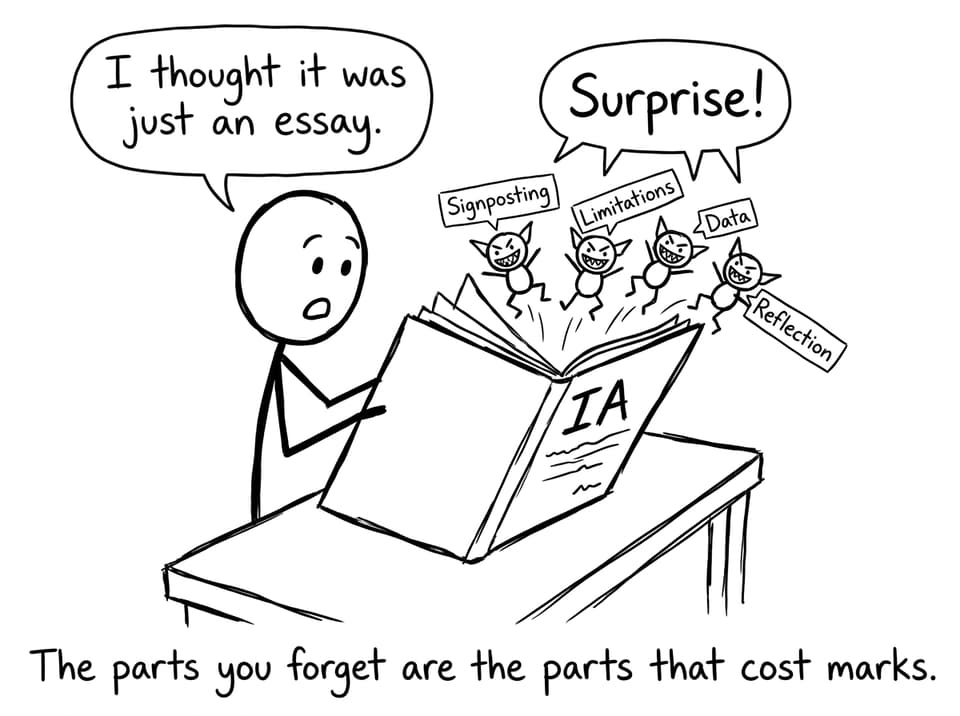
A high-scoring IA often feels almost “too clear” because it has:
-
explicit aims
-
a focused research question
-
a method that can be repeated
-
evidence presented cleanly (tables, graphs, citations)
-
analysis linked directly back to the question
-
evaluation that admits limitations without collapsing confidence
That’s also why research questions matter so much. If your question is vague, everything downstream becomes vague too. Use How to Refine Your IA Research Question to tighten it before you invest hours into writing.
The uncomfortable part: independence is part of the grade
A normal essay usually comes with guardrails: model paragraphs, close feedback, and a sense of what “good” looks like.
An IA quietly tests independence. Choosing what to include, what to cut, how to justify decisions, and how to evaluate your own work is part of the skill. If you’re waiting for someone to tell you the perfect structure, you may accidentally outsource the very thing being assessed.
A practical shortcut is to calibrate using examples. Spend 15 minutes with Coursework Exemplars (IA, EE and TOK) and notice what top work repeats: tight scope, visible reasoning, and evaluation that is specific.
How RevisionDojo helps you shift into “IA thinking”
When you’re stuck, the problem is rarely motivation. It’s usually uncertainty: “What does the criterion want from me?”
RevisionDojo is built for that moment. You can:
-
use the IB Coursework Guides to see what examiners expect
-
run your draft through the Coursework Grader to spot missing criterion evidence
-
use the Coursework Library via Coursework Exemplars to compare structure and level
-
ask AI Chat to pressure-test your research question and evaluation
And while coursework matters, exams don’t pause. Keep a light routine with Study Notes, Flashcards, Mock Exams, and Predicted Papers, then use the Questionbank for targeted practice when you need your brain back in exam mode.
The bottom line
A great essay can be persuasive. A great IA is provable.
Once you stop trying to “sound smart” and start trying to “show the criteria,” your IA becomes calmer to write and easier to score. Use IB IA Guides to anchor your structure, check Coursework Exemplars to calibrate your depth, and let RevisionDojo’s Questionbank, Flashcards, Study Notes, AI Chat, and Grading tools keep both coursework and exam prep moving in the same direction.


