




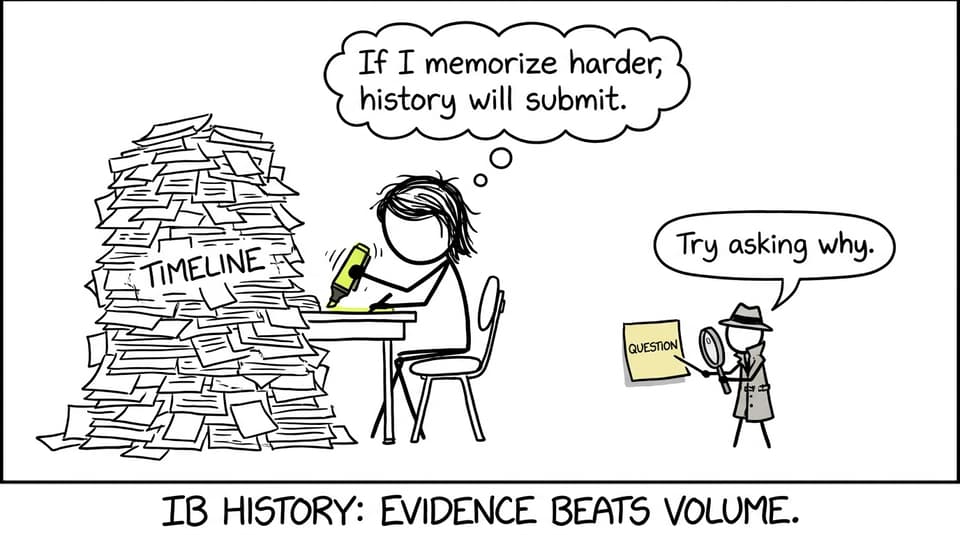
In the week before a big IB History test, most students do the same thing: they stack notes, highlight aggressively, and promise themselves that this time, they will “know everything.”
Then the question appears. It is narrower than expected. Stranger, too. And suddenly the best-prepared student in the room feels unprepared, because the exam is not asking, “What happened?” It is asking, “What can you prove?”
That is the quiet shift in the new course (first assessment 2028). IB History increasingly rewards students who think like historians: curious, selective, and comfortable making careful judgments.
Quick checklist: the historian mindset for IB History
Use this as a fast pre-practice routine for IB History under FA 2028:
-
Rephrase every prompt as a question you must answer, not a topic you must display
-
Decide the “job” of the response (explain causes, evaluate significance, compare, judge)
-
Select evidence like a lawyer: only what supports the claim
-
Build evaluation into the paragraph, not as an add-on at the end
-
Show perspective and limitation, especially in source work
If you want a broader roadmap of skills and papers, keep IB History Exam Prep: A Comprehensive Guide open alongside your revision.
IB History under FA 2028: content is the tool, not the target
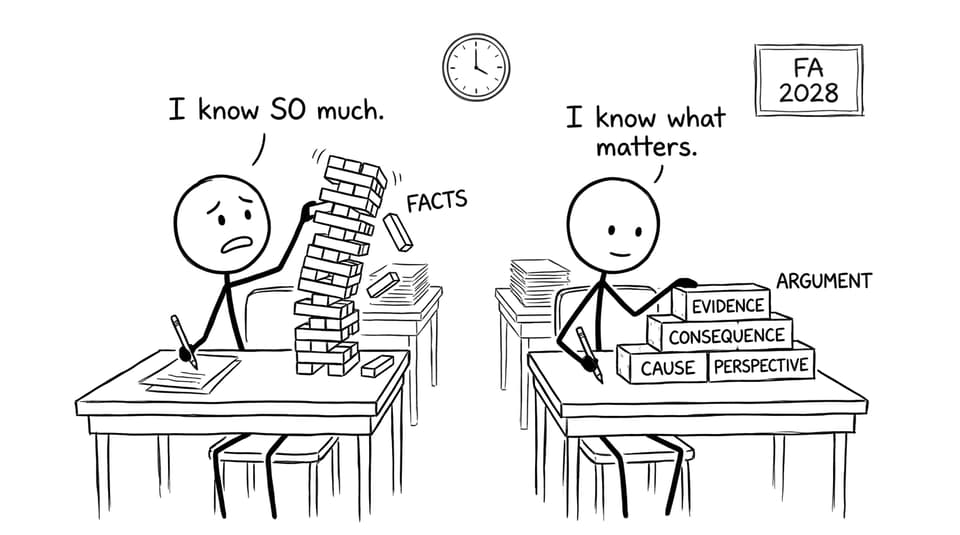
The new course design makes one message hard to ignore: knowledge matters, but only when you use it.
Under first assessment 2028, IB History is structured to reward inquiry--how you reason with evidence, not how much you can recite. That is why descriptive answers (accurate but unargued) tend to plateau.
If you have not yet seen how the new structure fits together, read IB DP History Explained: The New Curriculum Structure (First Assessment 2028). It clarifies why “contexts, concepts, content, and skills” are meant to be studied as one system.
What historians do (and what examiners reward)
A historian does not start with a timeline. They start with uncertainty.
In IB History, that looks like:
-
Framing a focused line of inquiry (“To what extent was X decisive?”)
-
Interpreting evidence (what it shows, what it cannot show)
-
Comparing explanations (why one argument fits better than another)
-
Weighing multiple factors without flattening complexity
-
Making a defensible judgment that matches the command term
This is exactly why RevisionDojo’s Questionbank is so useful for IB History: it pushes you into decision-making, not rereading. You cannot hide behind “I understand it” when you have to answer.
Think in questions, not chapters
Many students revise as if the exam will ask, “Tell me about authoritarian states.” But IB History questions rarely reward “everything I know.” They reward “everything relevant.”
A practical habit: turn each subtopic into three question stems and practise them:
-
Why did it happen? (causation)
-
How far did it matter? (significance)
-
Compared with what? (comparison)
When you write plans, treat the question as a filter. If a fact does not earn its place, cut it.
For essay-specific expectations under FA 2028, the clearest explanation is Why IB History Essays Are Different Under the New Specification (First Assessment 2028).
Use evidence like a historian: fewer facts, more force
Strong IB History students do something that feels almost unfair: they use fewer facts than everyone else, but each fact does more work.
Try this paragraph rule:
-
Claim (one sentence that answers the question)
-
Evidence (one or two precise pieces)
-
Analysis (explain how the evidence proves the claim)
-
Evaluation (limits, alternative factor, or why this matters more)
To build that skill quickly, practise with targeted prompts and then get feedback. RevisionDojo supports this loop with Grading tools, an AI Chat tutor for clarity, and Mock Exams that simulate pressure without wasting time.
To practise question styles by unit, start with the IB History Resources hub, then drill a specific path like IB History Paper 1 - Conflict and Intervention.
Perspectives are not decoration--they are the analysis
In IB History, “perspectives” are not a paragraph you tack on at the end. They are how you show you understand that the past is interpreted.
A simple way to earn marks:
-
Identify who benefits from an interpretation
-
Explain why it emerged (context, ideology, access to evidence)
-
Judge what it explains well--and what it obscures
This matters across assessments, including the IA. If you are doing your investigation soon, read IB History Internal Assessment Explained: The Historical Investigation (First Assessment 2028) and browse model work in the IB History Examples coursework library.
The most common trap: description that feels like analysis
Under exam stress, description can imitate thinking. You write more. You add dates. You explain the sequence.
But IB History marks are usually sitting in the verbs:
- “therefore,” “however,” “this suggests,” “this was limited by,” “more significant because”
A good self-check is to circle every sentence that makes a judgment. If you have mostly narrative, you are paying with time for very few marks.
If this is a recurring issue for you, Why Students Struggle With IB History (First Assessment 2028) names the patterns (and how to break them).
A simple practice loop that builds IB History thinking
If you want “think like a historian” to become automatic, do this twice a week:
-
Read one short section of Study Notes (fast)
-
Answer 2--3 IB History prompts from the Questionbank (timed)
-
Convert mistakes into Flashcards (what you missed and why)
-
Rewrite one paragraph with better evaluation (not the whole essay)
-
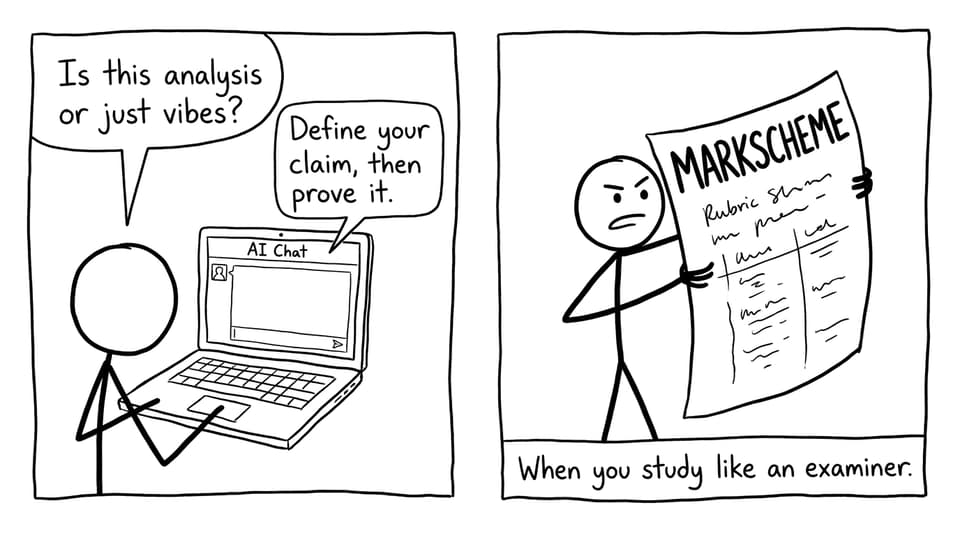
Use AI Chat to test your reasoning: ask it to challenge your claim
You can also add realism with History Predicted Papers and timed Mock Exams when you want exam stamina, not just skill drills.
Conclusion: IB History is a skill you can train
The new course (first assessment 2028) does not ask you to become a walking textbook. It asks you to become a careful thinker who can make a claim, support it, and weigh it honestly.
That is the heart of IB History: inquiry over memory, judgment over volume, evidence over vibes.
If you want a single place to practise that way every week, start at the IB History Resources hub and build your routine around RevisionDojo’s Questionbank, Study Notes, Flashcards, AI Chat, Grading tools, Predicted Papers, Mock Exams, and Coursework Library. The goal is not to revise more--it is to think better, on purpose.