

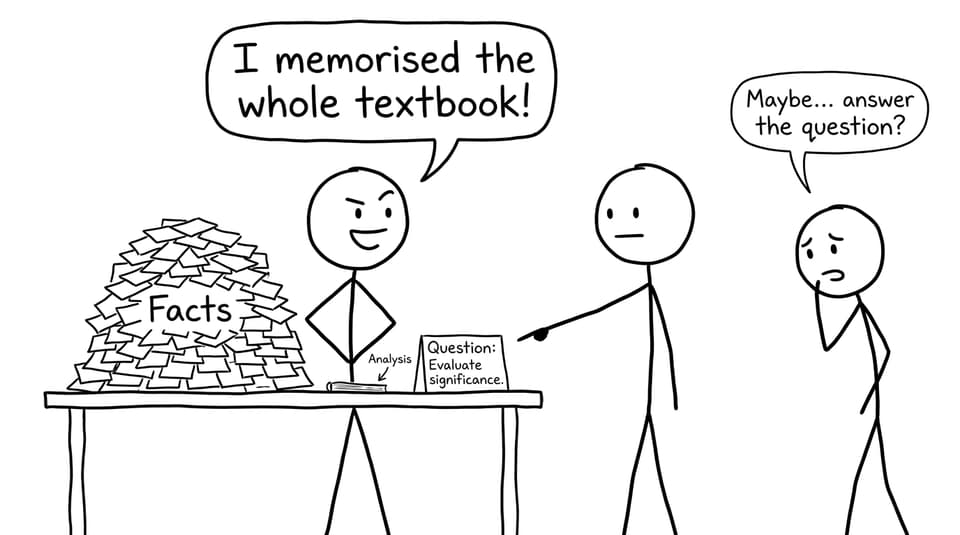
Some nights, IB History revision feels like stacking facts into a tower and hoping it stays upright on exam day. You can recite dates, leaders, treaties, and turning points. And still, Paper 2 can return an unsettling truth: the examiner wasn’t asking for more history. They were asking for more thinking.
Under first assessment 2028, IB History Paper 2 rewards students who can write concept-driven, analytical essays that keep the question in the driver’s seat. If your default style is narrative ("and then this happened"), you can work incredibly hard and still hover below the top markbands.
This guide breaks down what IB History Paper 2 is really testing, how to spot the concept behind the question, and how to write essays that feel calm, focused, and unmistakably relevant.
Quick checklist for IB History Paper 2 essays
Use this before every timed practice:
-
Identify the command term (evaluate, discuss, to what extent)
-
Name the concept driving the question (causation, change, significance, perspectives)
-
Pick 2--3 arguments you can prove (not 6 you can mention)
-
Attach precise evidence to each argument (select, don’t dump)
-
Add evaluation: weigh factors, limits, and relative importance
-
End with a judgement that directly answers the question
If you want the official page layout and topic map in one place, start at the IB History Resources hub.
What is IB History Paper 2 (FA 2028)?
IB History Paper 2 is the essay paper for both SL and HL students. You choose from set questions and write extended responses under time pressure. But the core skill isn’t speed or memory. It’s the ability to construct an argument that stays conceptually focused from the first sentence to the last.
On RevisionDojo, you can see how Paper 2 is organized and practiced through IB History Topic Paper 2 - Notes & Questions and drill the style directly using the IB History Topic Paper 2 Questionbank.
What examiners reward in IB History Paper 2
A strong IB History Paper 2 essay does four things consistently:
It answers the question, not the topic
Examiners can tell when you’re writing a “Cold War essay” instead of answering this Cold War question. Your job is relevance.
It uses evidence selectively
High scoring essays don’t include more facts. They include the right facts, placed where they prove a claim.
It explains causation, change, and significance
In FA 2028, concepts are not decoration. They are the logic of your paragraphs.
It evaluates
Evaluation is the moment you stop being a narrator and become a judge: which factor mattered most, under what conditions, and with what limitations?
If you want a deeper concept overview for IB History FA 2028, read IB History: The 4 Key Concepts for FA 2028.
How to decode Paper 2 questions (find the concept fast)
Most IB History Paper 2 prompts look content-heavy, but they’re concept-first. Train yourself to translate the question into a concept task:
-
“Evaluate the significance…” = significance + judgement criteria
-
“To what extent…” = argument + counterargument + final weighing
-
“Discuss the causes…” = causation + relative importance
-
“Compare and contrast…” = comparison + explanation of differences/similarities
A practical habit: underline the command term, circle the timeframe, and write the concept in the margin before you plan. That one small move changes your whole essay.
Why narrative writing stops you from reaching the top markbands
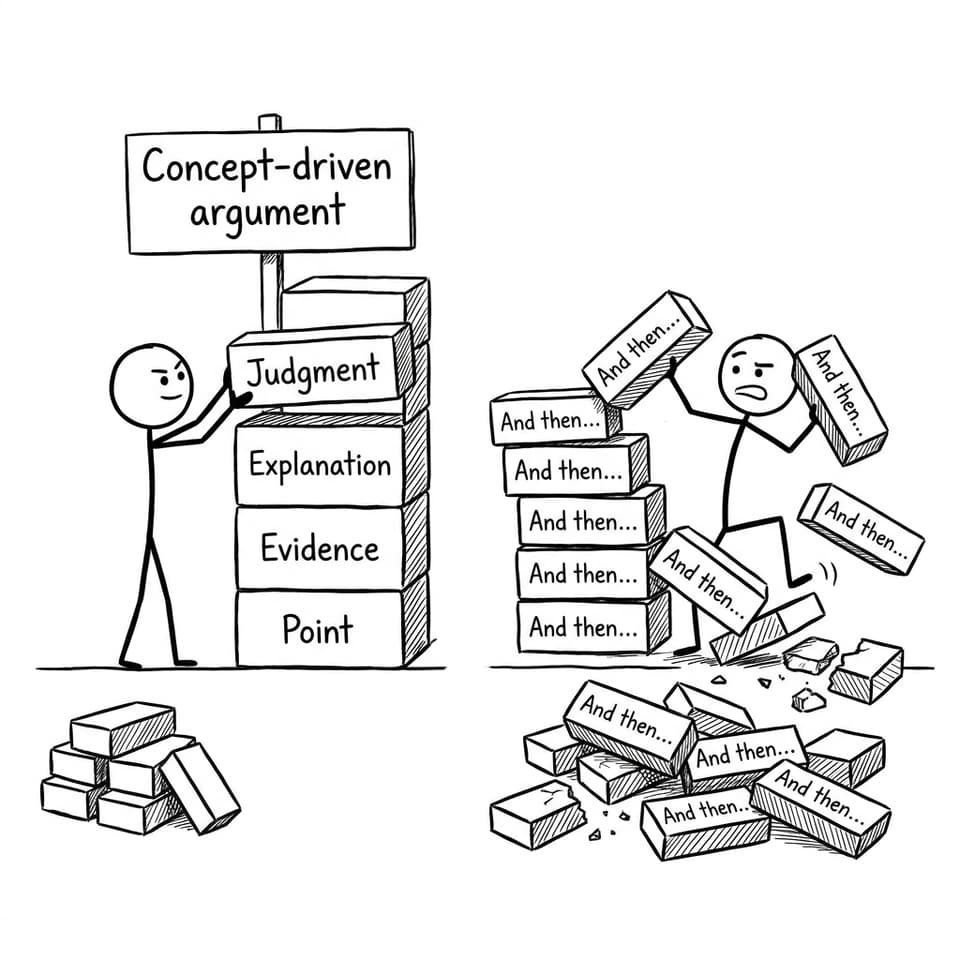
Narrative writing isn’t “bad writing.” It’s just writing that answers a different question: what happened next?
In IB History Paper 2 (FA 2028), the examiner is usually asking something tougher: why did it happen, how did it change, how important was it, and compared to what?
A narrative paragraph often looks like:
-
event sequence
-
detail after detail
-
minimal explanation of meaning
-
no explicit return to the question
A concept-driven paragraph looks like:
-
a claim that clearly answers the question
-
evidence that supports that claim
-
explanation that uses the concept language
-
a mini-judgement that links back to the thesis
To make this structure automatic, practise with IB History Essay Structure: Plan Fast, Write Better.
A simple concept-driven structure you can reuse
Here’s a repeatable frame for IB History Paper 2:
Introduction (5--6 lines)
-
define key terms in the question (briefly)
-
set scope (timeframe, region, actors)
-
thesis (your judgement)
-
preview 2--3 arguments
Body paragraphs (2--3 main arguments)
Each paragraph:
-
Point (argument)
-
Evidence (precise examples)
-
Explanation (how the evidence proves the point)
-
Evaluation (limits, comparisons, relative importance)
-
Link (back to the question)
Conclusion (4--5 lines)
-
restate judgement using the question language
-
weigh arguments (not a summary list)
-
finish with a clear, concept-based final line
How RevisionDojo helps you write better IB History Paper 2 essays
When IB History gets stressful, students tend to reread notes and hope confidence appears. RevisionDojo makes improvement feel more concrete, because it turns writing into a feedback loop.
-
Use Study Notes to clarify content fast via the IB History Resources hub.
-
Use Flashcards to retain key evidence so your paragraphs stay precise, not vague.
-
Use the Questionbank to practise real Paper 2 phrasing and command terms: IB History Paper 2 Questionbank.
-
Use AI Chat when you can’t see what the question is really asking.
-
Use Grading tools to get rubric-based feedback on your writing: IB History Paper 2 15 Marker Grader.
-
Use Predicted Papers and Mock Exams to rehearse timing and decision-making with realistic pressure: IB History Predicted Papers and IB Predicted Papers by IB Examiners.
FAQ
How many essays do I write in IB History Paper 2?
It depends on the current assessment format for your level, but the deeper point is consistent: Paper 2 rewards sustained argument more than output. Many students lose marks by racing to write “more” and ending up with weaker structure and thinner evaluation. In IB History, one well-argued essay where every paragraph earns marks is safer than a longer essay that drifts. Practise timing with realistic conditions so you learn what your best pace feels like. RevisionDojo’s Mock Exams and Predicted Papers help you build that stamina without guessing. Over time, you want your process to feel repeatable rather than heroic.
Do I need to use every concept in every IB History Paper 2 essay?
No, and trying to force every concept often damages clarity. In IB History, the concept is chosen by the question, not by your preference. If the prompt is about significance, lean into criteria and relative importance, rather than trying to bolt on change and perspectives just to show range. Examiners reward depth of analysis within the relevant conceptual frame. A clean, consistent line of reasoning will almost always outperform a concept checklist paragraph. When in doubt, write the concept word at the top of your plan and check every paragraph against it. If a paragraph doesn’t serve that concept, it’s probably a distraction.
Can I reuse the same examples across different IB History Paper 2 questions?
Yes, as long as the examples are doing real work for the argument you’re making. In IB History, evidence is not just proof that you studied; it’s the tool that makes your explanation credible. The same event can support different arguments depending on the question, the timeframe, and the comparison you set up. The risk is reusing examples in a memorised way, where you describe them the same each time and forget to evaluate. To reuse evidence well, change the angle: what does this example show about significance, causation, or change? RevisionDojo’s Questionbank is useful here because it gives you multiple prompts on similar content, forcing you to adapt rather than repeat.
Closing thought: treat IB History Paper 2 like a judgement, not a story
The students who score highest in IB History Paper 2 are rarely the ones who know the most facts. They’re the ones who can stay concept-driven when the clock is loud and the page is empty.
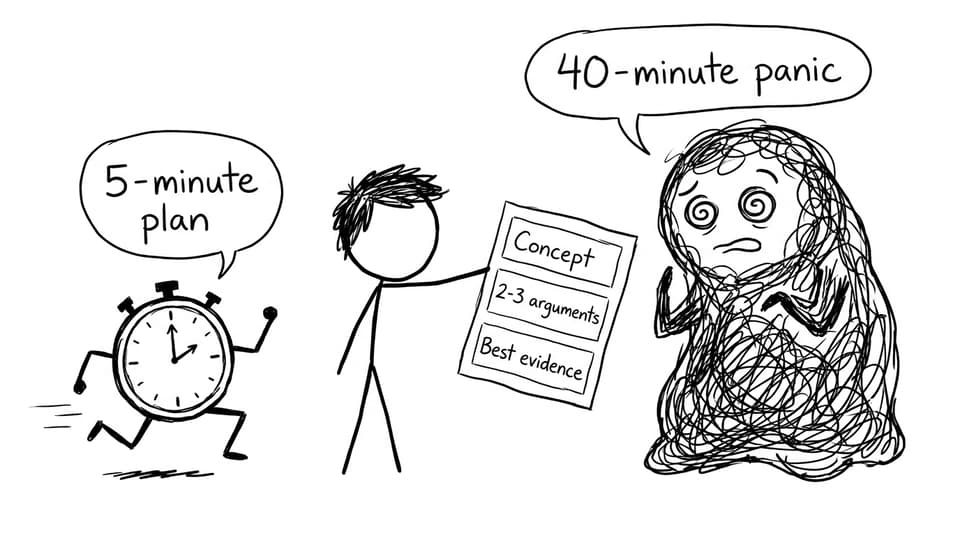
Build that habit now: plan for five minutes, choose 2--3 arguments, select evidence with intent, and evaluate like someone is actually going to challenge your conclusion. Then practise the loop with RevisionDojo’s Study Notes, Flashcards, Questionbank, AI Chat, Grading tools, Predicted Papers, Mock Exams, Coursework Library, and Tutors until the method becomes automatic.
When you’re ready, start with the IB History Resources hub and run one timed Paper 2 set from the IB History Paper 2 Questionbank. Your future self will feel the difference.