
Why Students Struggle With IB History -- And How RevisionDojo Helps (First Assessment 2028)
Somewhere between your third color-coded mind map and your fifth “perfect” set of notes, IB History can start to feel like a strange bargain: you give it hours, it gives you uncertainty. You remember the treaties, the leaders, the dates. Then the essay comes back and the comment stings -- “too descriptive,” “limited evaluation,” “loses focus.”
Under the new IB DP History course (first assessment 2028), that feeling gets sharper. Not because students suddenly became less capable, but because IB History is quietly testing a different skill than most people revise for.
This guide breaks down why IB History students struggle, what the FA 2028 shift changes, and how RevisionDojo helps you turn effort into marks with a reliable, repeatable system.
Quick checklist: what actually moves your IB History grade
If you want a fast diagnostic before you read further, check whether your revision plan includes these:
-
You practice question interpretation (command terms + focus) as much as content
-
You plan answers around arguments, not timelines
-
You use evidence selectively (few facts, high relevance)
-
You evaluate throughout the response, not only at the end
-
You rehearse under time pressure with feedback and refinement
If any of those feel fuzzy, IB History will feel unpredictable. The goal is to make it predictable again.
The hidden problem: IB History is not a memory contest
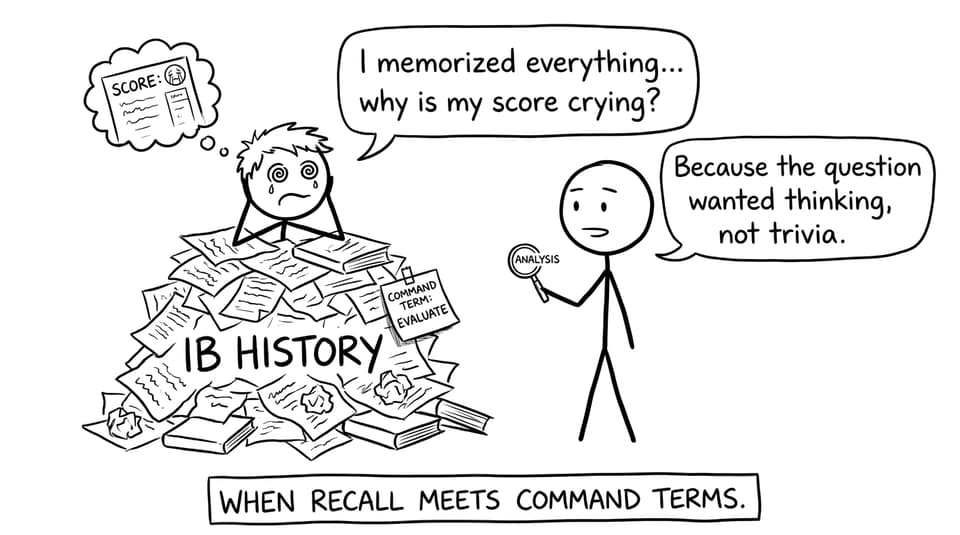
The most common trap in IB History is revising as if the exam rewards coverage. Many students build enormous notes and feel prepared because the material looks complete.
But in FA 2028, the scoring logic is even more unforgiving toward “I know a lot” answers. IB History rewards historical thinking: analysis, synthesis, and judgment. That means your notes are only raw ingredients. The marks come from what you do with them.
If you want a clear overview of how each assessment component tests different skills, keep this open while you plan your week: IB History Assessment Explained: Papers and IA (First Assessment 2028).
On RevisionDojo, students usually start at the subject hub because it forces the right mindset: IB History resources.
Why questions feel “unfair”: you answer the topic, not the task
In IB History, a question is not a polite invitation to share everything you know. It is a tight set of instructions.
Students lose marks when they:
-
Identify the topic but miss the angle (significance, causes, extent, comparison)
-
Ignore the command term and default to narrative
-
Start strong, then drift into “what happened next”
-
Write paragraphs that are true, but not useful to the question
A painful truth of IB History: you can write a fluent essay that is 70% irrelevant.
RevisionDojo helps here in two practical ways:
-
The Questionbank gives exam-style prompts that force precision, not comfort: Questionbank
-
AI Chat (Jojo) can be used like a tutor for command terms: paste a question and ask “What would a top-band thesis look like?” and “What would be off-task?”
That is the difference between “I studied this unit” and “I can answer this question.”
Description isn’t neutral in IB History -- it’s expensive
Students often assume description is a safe base layer: set the scene, show knowledge, then analyze later. In IB History, that approach burns time and limits marks.
Descriptive writing becomes a problem when it:
-
Explains events but not mechanisms (why it happened)
-
Lists factors but doesn’t weigh them
-
Uses chronology instead of an argument structure
-
Treats detail as proof of understanding
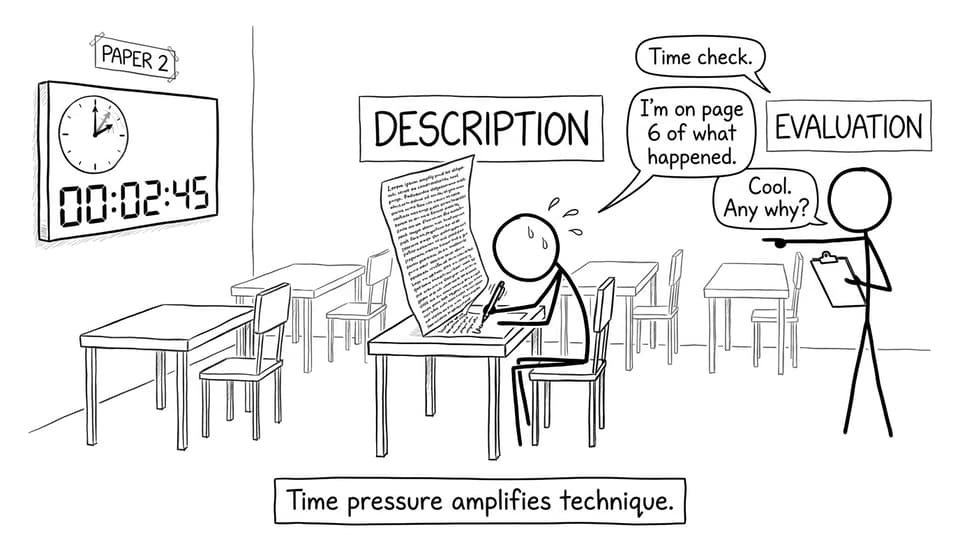
The exam is not asking, “Do you know what happened?” It is asking, “Can you explain and judge what mattered?” That is why IB History essays need evaluation woven into the body paragraphs, not saved for a rushed conclusion.
Evaluation feels awkward because it’s a skill, not a personality trait
Many students think evaluation means having a strong opinion. In IB History, evaluation means making a defensible judgment that is:
-
Based on evidence
-
Sensitive to context
-
Aware of counterarguments
-
Explicit about criteria (what you value and why)
This is learnable, but it needs practice with feedback. RevisionDojo’s Grading tools and AI feedback help students see the gap between what they intended to argue and what the examiner can actually reward.
If you also want models for how top students sustain evaluation (especially for longer writing tasks), the coursework side matters too: IB History Examples.
Comparison and synthesis: the leap most students don’t train
The FA 2028 framing pushes students toward broader thinking: connecting themes, comparing cases, and synthesizing arguments rather than writing isolated stories.
But comparison is not “Country A did X, Country B did Y.” Strong IB History comparison is about why the difference exists and what it changes about the judgment.
A simple upgrade that often lifts marks:
-
Choose 2--3 comparison criteria (state capacity, ideology, economic conditions)
-
Compare within the paragraph, not in separate halves
-
End each paragraph with a mini-judgment that answers the question
RevisionDojo supports this through Study Notes that are built around concepts and exam thinking, not just narrative content: Study Notes. Pair them with IB Flashcards with Spaced Repetition (SRS) to keep key terms and themes active, so you have mental bandwidth for synthesis.
Time pressure doesn’t create weakness -- it reveals it
Most students don’t “panic randomly” in IB History exams. They panic at the moment their method fails.
Common time-pressure patterns:
-
You spend too long on context, then rush the argument
-
You write everything you know because you can’t select evidence
-
You leave evaluation for last and run out of minutes
-
Your structure collapses, so the examiner can’t find your best ideas
RevisionDojo is built around a calmer alternative: timed practice, fast feedback, and targeted repair.
-
Use the Questionbank for focused drills (one paper skill at a time)
-
Then use Mock Exams and Predicted Papers to rehearse full performance under time
-
Use analytics to decide what to fix next, instead of guessing
For realistic timed practice sets, see: History Predicted Papers (Free). (These are not official predictions of the future, but high-quality exam simulations designed for rehearsal.)
How RevisionDojo turns “more work” into “better marks”
A student once told a teacher, “I revised all weekend, so I deserved a 7.” It’s a very human sentence. It’s also not how IB History works.
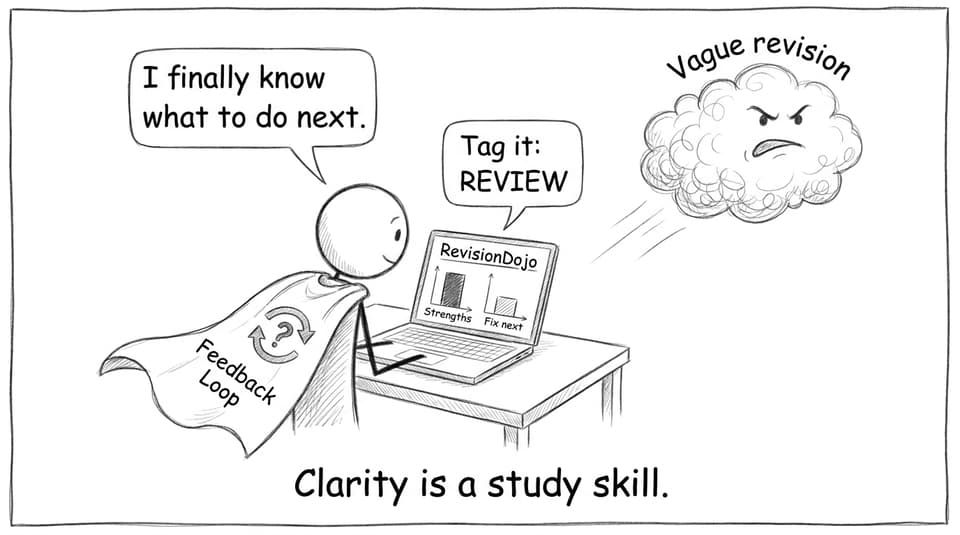
RevisionDojo helps because it doesn’t just add resources -- it adds a feedback loop:
-
Questionbank practice to build technique, not just knowledge
-
Study Notes and Flashcards to keep content efficient and retrievable
-
AI Chat (Jojo) to unblock misunderstandings instantly
-
Grading tools to learn what earns marks in essays and source work
-
Mock Exams and Predicted Papers to make timing familiar
-
Coursework Library to model what quality looks like
-
Tutors for students who want expert guidance and accountability
If you want the broader strategy for planning your revision by paper skills, not just topics, read: IB History Exam Prep: A Comprehensive Guide.
Closing: make IB History feel fair again
IB History is tough because it asks for disciplined thinking under pressure. Under first assessment 2028, that demand is clearer: analysis over recall, judgment over narrative, and focus over volume.
If your effort hasn’t been showing up in your marks, it’s usually not a character flaw. It’s a strategy mismatch. Start building a feedback loop that trains what the exam is actually rewarding.
Begin here: IB History resources. Then use RevisionDojo’s Questionbank, Study Notes, Flashcards, AI Chat, Grading tools, Predicted Papers, Mock Exams, Coursework Library, and Tutors to turn your next week of IB History revision into something you can measure -- and trust.
