


When you first hear that splitting a single uranium nucleus can release millions of times more energy than a chemical reaction, it feels like a magic trick. But in IB Physics, it’s not magic. It’s bookkeeping. Nature is simply cashing in an energy difference that was already “hidden” in the nucleus.
In this post, we’ll answer the core question: Why does splitting a heavy nucleus release so much energy? And we’ll do it in a way that helps you write the kind of explanation examiners love.
The IB Physics checklist (what to mention in exam answers)
-
Use binding energy per nucleon as your stability measure.
-
State that heavy nuclei have lower binding energy per nucleon than medium nuclei.
-
Explain the competition: strong nuclear force vs electrostatic (Coulomb) repulsion.
-
Connect energy release to mass defect and E = mc^2.
-
Mention where energy goes: kinetic energy, gamma, and neutrons (chain reactions).
If you want a syllabus-aligned reference while revising, keep the Topic E hub open: Topic E: Nuclear and quantum physics.
Binding energy per nucleon: the quiet reason fission works
In IB Physics, stability isn’t a vibe. It’s a number. The number is binding energy per nucleon: how much energy, on average, is “locking” each nucleon into the nucleus.
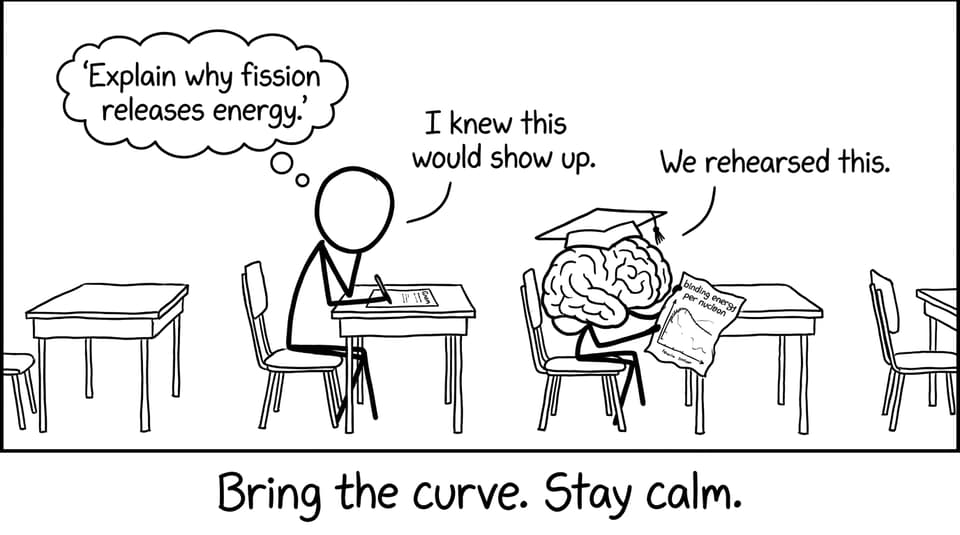
Heavy nuclei (think uranium and plutonium) sit on the less-stable side of the binding energy curve. When a heavy nucleus splits, the daughter nuclei are typically medium-mass nuclei, which have a higher binding energy per nucleon. That means the products are more tightly bound than the original.
The key idea: the final state has lower total energy. The “extra” energy doesn’t vanish. It shows up as released energy.
To tighten this concept for exam writing, revise the exact definitions and phrasing here: IB Physics key definitions and the dedicated notes page: E.3.1 Stability and Binding Energy Notes.
Why heavy nuclei are inherently stressed: strong force vs Coulomb repulsion
Here’s the part students often explain too vaguely in IB Physics: why heavy nuclei start off with relatively lower binding energy per nucleon.
-
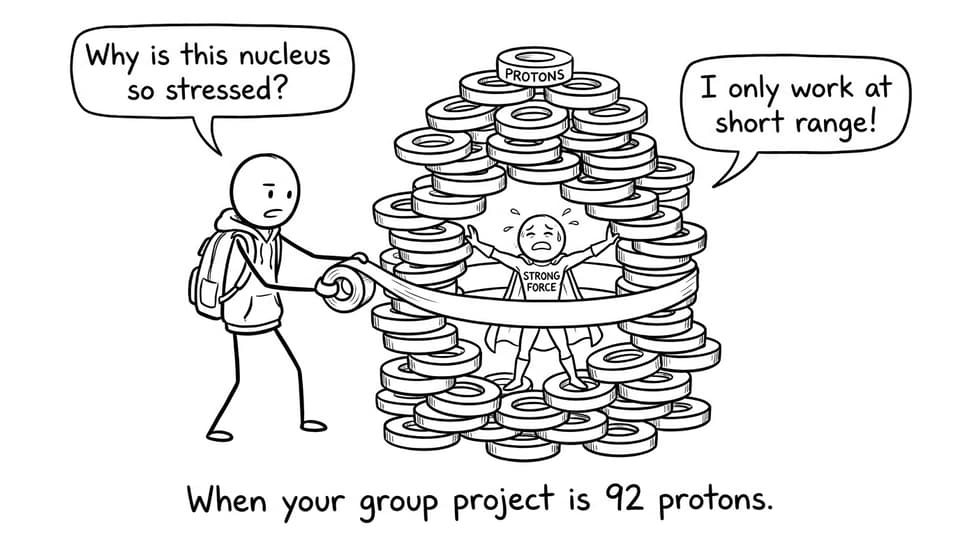
The strong nuclear force is extremely strong but short-range. It only “helps” nucleons that are close neighbors.
-
The electrostatic repulsion between protons is long-range and grows as proton number increases.
So in a large nucleus, many protons are far enough apart that the strong force can’t fully compensate for their repulsion. The nucleus becomes energetically “expensive” to keep together.
Fission reduces that problem instantly: each fragment has fewer protons, so the Coulomb repulsion drops, and the strong force becomes more effective within each smaller nucleus. Stability rises. Energy is released.
For the fission mechanism itself (what triggers splitting, what comes out), use: IB Physics E.4 Fission Notes & Questions and the shorter page: IB Physics E.4 Fission Notes.
Why the energy is so large: mass defect and E = mc^2
The scale of fission energy feels unreal because you’re used to chemistry, where energies come from rearranging electrons. Nuclear energies come from rearranging nucleons and nuclear forces.
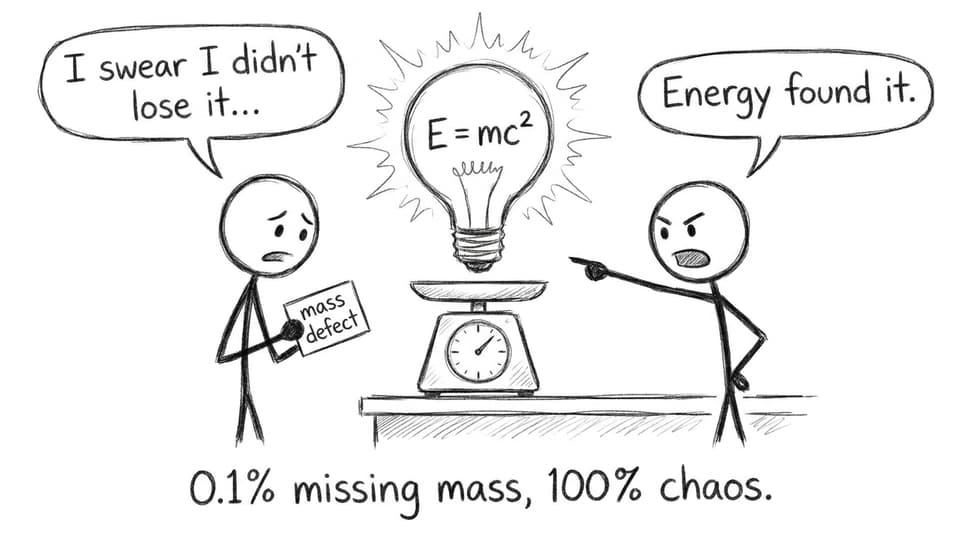
In a typical fission event, roughly 0.1% of the original mass ends up as released energy. That sounds tiny until you apply E = mc^2. The factor of (c^2) is enormous, so even a small mass defect corresponds to a huge energy release.
In exam terms, you don’t need dramatic language. Just clean logic: difference in binding energy (\Rightarrow) mass defect (\Rightarrow) energy via (E = mc^2).
Where does the released energy go in IB Physics terms?
In fission, released energy usually appears as:
-
Kinetic energy of the fission fragments (often the largest share)
-
Kinetic energy of emitted neutrons
-
Gamma radiation
A key detail: the two positively charged fragments repel strongly, so they accelerate apart quickly. That repulsion becomes kinetic energy, and in a reactor it ends up as heat in surrounding material.
If you’re revising reactors (moderators, control rods, why chain reactions can be controlled), this page is gold: E.4.2 Nuclear reactors Notes.
Quick practice path on RevisionDojo (to make this stick)
Understanding fission in IB Physics is one thing; scoring marks is another. A reliable loop is:
-
Read and annotate: IB Physics Revision Notes (SL/HL)
-
Drill exam-style items: E.4 Fission Questionbank (use AI feedback to spot weak explanations)
-
Sit timed practice: Physics Predicted Papers
RevisionDojo pulls it together with Study Notes, Flashcards, the Questionbank, AI Chat for alternate explanations, Grading tools for structured feedback, plus Predicted Papers, Mock Exams, a Coursework Library, and Tutors when you want a human walkthrough.
Conclusion: the simplest way to remember it for IB Physics
Splitting a heavy nucleus releases so much energy because it turns a loosely bound, highly repulsive system into smaller nuclei that are more tightly bound. The increase in binding energy per nucleon becomes released energy, visible through mass defect and calculated with E = mc^2.
If you want this explanation to become automatic under exam pressure, practise it with RevisionDojo’s IB Physics resources: start with the notes, drill the Questionbank, then test yourself with Predicted Papers and Mock Exams until your wording is calm, precise, and repeatable.