


A business rarely wakes up and thinks, “Let’s move.” It usually happens after months of quiet friction: deliveries take longer than they should, good staff keep leaving, rent creeps up, and the customer base slowly shifts somewhere else. In IB Business Management, that tension is your clue. Relocation is not a random event; it’s a strategic response to changing internal and external pressures.
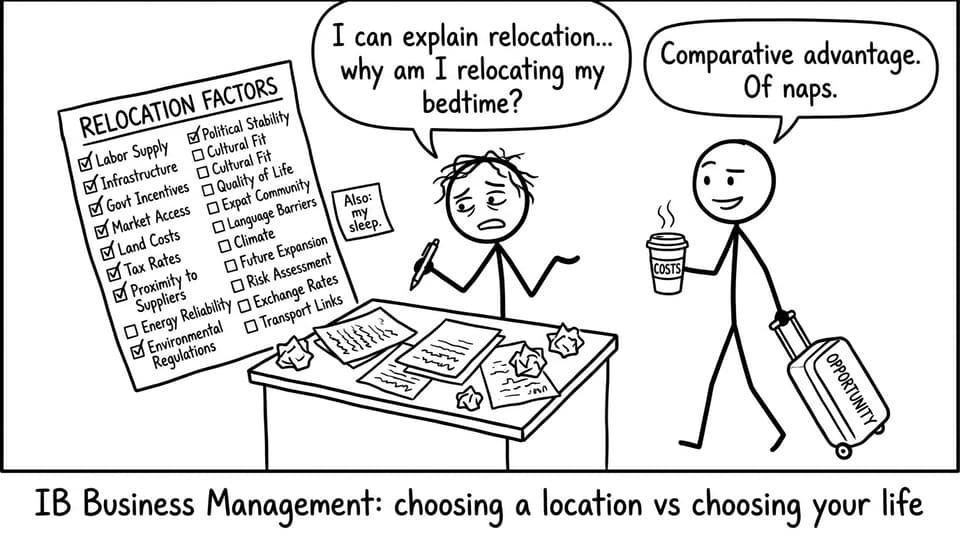
If you’re revising Unit 5, connect this topic to the syllabus hubs for 5.4 Location and the deeper 5.4 Location notes; they turn “common sense reasons” into exam language.
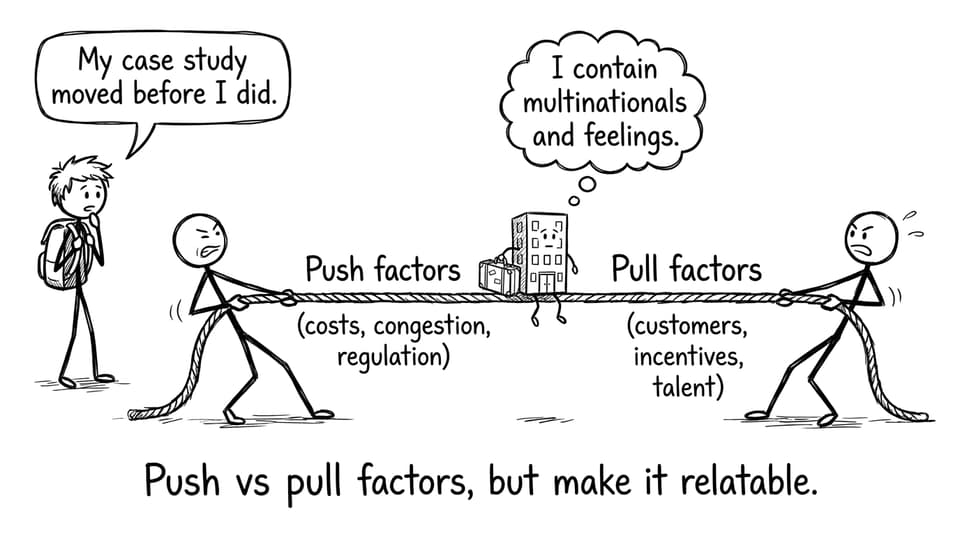
A quick IB Business Management checklist (push vs pull)
Before you write any response, sort factors into:
-
Push factors (problems at the current site)
-
Pull factors (advantages of the new site)
-
Short-term costs vs long-term gains (your evaluation)
For exam practice, drill this with the 5.4 Location Questionbank so you can apply factors to a case, not just list them.
Cost reduction: when the numbers stop making sense
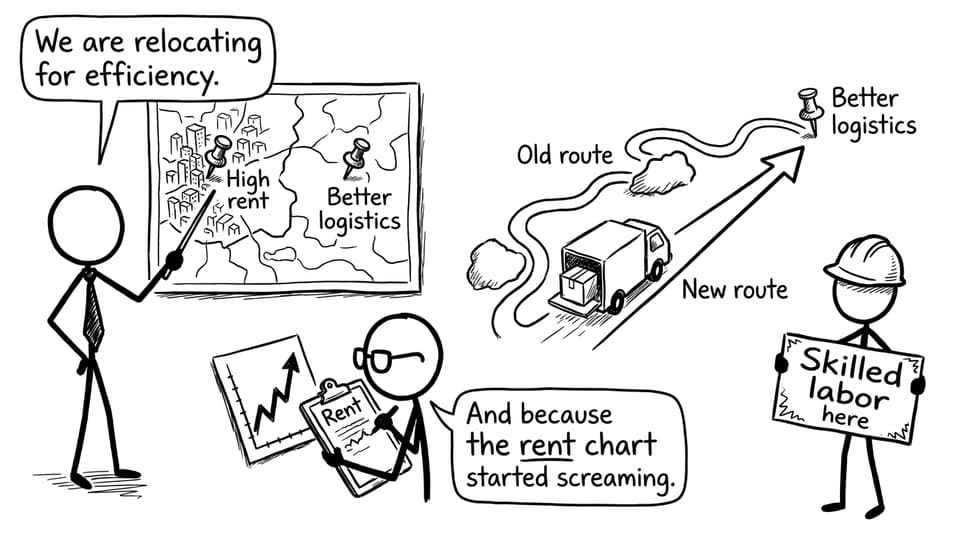
Many relocations start with basic arithmetic: rent, taxes, utilities, and wage rates rise, while revenue stays flat. In IB Business Management, you can frame this as improving profit margins and operational efficiency. Strong answers mention relocation costs too (moving equipment, temporary downtime, redundancy payments) to show balanced judgement.
Proximity to customers: following demand, not tradition
Customer patterns change. A retailer might move closer to new housing developments; a service business might relocate to reduce journey time and increase convenience. Link this to market research: firms often spot geographic demand shifts using tools from 4.4 Market Research.
Labour availability: skills, costs, and retention
Some locations simply cannot supply the right talent. Others can, but only at a wage that breaks the business model. In IB Business Management, you can evaluate labour as both a quantitative factor (wage levels) and a qualitative one (work culture, retention, training needs). Relocation can be a long-term investment in productivity, not just a cost cut.
Logistics and infrastructure: time is money
For manufacturers and distributors, being near motorways, ports, airports, suppliers, or reliable internet can reduce lead times and improve customer satisfaction. This fits neatly into operations thinking: fewer delays, lower transport costs, smoother inventory flow. If you need a structured syllabus phrasing, use 5.4.1 Reasons for a Specific Location of Production and the supporting 5.4.1 notes.
Expansion, incentives, competition, and brand image
Sometimes the building is the constraint: not enough capacity for people, storage, or machinery. Other times, governments create pull factors via tax relief or grants. Competitive pressure matters too: relocating can mean entering a less saturated market or positioning closer to a cluster (suppliers, skilled labour, complementary firms). And don’t ignore brand image: the “right” district can signal quality and trust.
Conclusion: turn relocation into easy marks
Relocation decisions are really about fit: fit with costs, customers, labour, logistics, growth plans, and the brand the business wants to project. In IB Business Management, your edge comes from organizing these factors into push vs pull, then judging the trade-offs with calm evaluation. For fast, exam-ready revision, use RevisionDojo’s Study Notes, Flashcards, AI Chat, Grading tools, Predicted Papers, Mock Exams, Coursework Library, and Tutors, and lock in this topic with targeted practice from the Location unit.


