

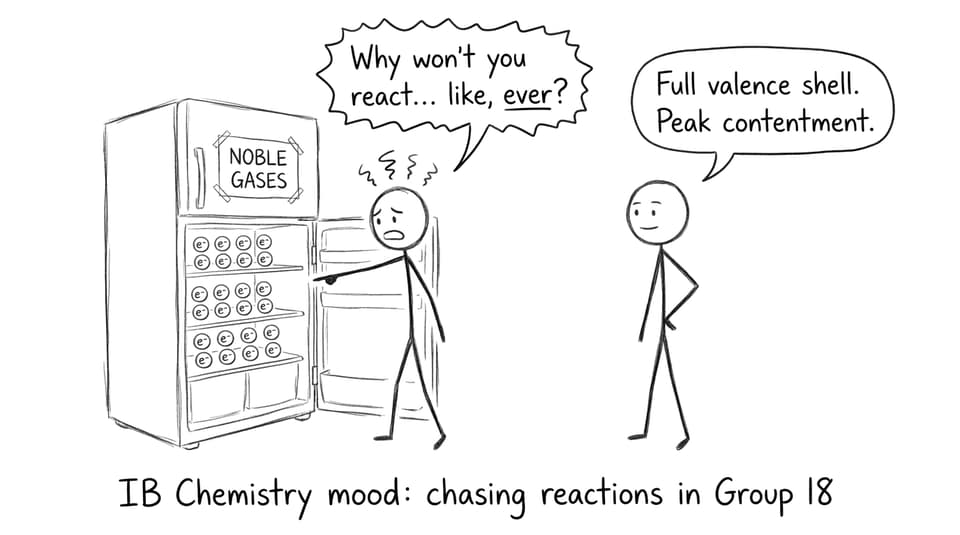
If you have ever tried to “make” a noble gas react in a homework question, you know the feeling: you add heat, pressure, a dramatic arrow, maybe even a hopeful catalyst… and nothing happens. In IB Chemistry, noble gases are the calm students at the back of the class. They are not lazy. They are already finished.
That quiet stability is exactly why examiners love them. Noble gases let you explain periodic trends, bonding, and a few famous exceptions (hello, xenon) with one clean idea: atoms react to reach a lower-energy electron arrangement, and Group 18 is already there.
Quick checklist for IB Chemistry answers
When a question asks why noble gases are inert in IB Chemistry, hit these points:
-
Full valence shell (He has a duet; the rest have an octet)
-
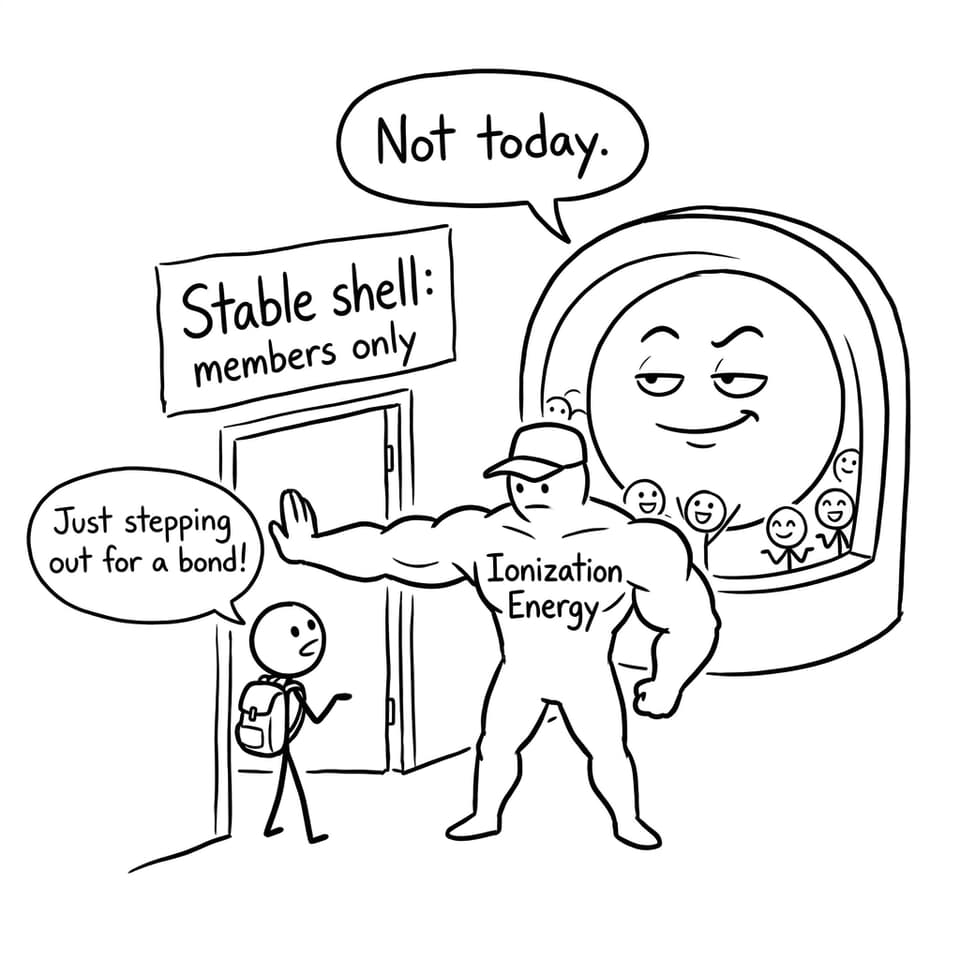
Very high ionization energy (hard to remove an electron)
-
Low tendency to gain electrons (little incentive to form bonds)
-
Monatomic gases with weak London dispersion forces
-
Reactivity increases down the group, so a few heavier ones form compounds under extreme conditions
If you want to sharpen the “trend + reasoning” style examiners reward, pair this with Periodicity Explained Simply.
The real reason noble gases are inert: full shells
In IB Chemistry, “stable” has a specific meaning: the electron configuration is already at a low-energy arrangement.
-
Helium: 1s² (a full first shell -- the duet rule)
-
Neon: 2s²2p⁶
-
Argon: 3s²3p⁶
With a complete outer shell, there is no strong energetic payoff for gaining, losing, or sharing electrons. Most reactions are basically negotiations about electrons. Noble gases show up to the negotiation already satisfied.
This connects directly to the big bonding story in Why Do Atoms Form Bonds Instead of Remaining Isolated?.
High ionization energy: electrons are expensive to remove
A lot of reaction pathways begin with electron loss or electron rearrangement. Noble gases resist that because their first ionization energies are extremely high.
Two reasons you can write fast in IB Chemistry language:
-
Removing an electron breaks a full valence shell (energetically unfavorable).
-
The nucleus holds the electrons strongly, so you need lots of energy input.
When you practice explaining this under timed conditions, the “definition + trend + reasoning” pattern is exactly what RevisionDojo drills through its Questionbank and AI Chat feedback.
For related trend language, see How Nuclear Charge Affects Electron Arrangement and How to Use the IB Periodic Table in Exams and Revision.
“They don’t attract electrons much” (and why that matters)
A useful exam phrasing in IB Chemistry is that noble gases have little tendency to gain electrons. For many of them, electronegativity values are not commonly used in the same way as other groups because they do not usually form bonds.
What the examiner is really asking: “Is there a driving force for covalent bonding?” For most noble gases, the answer is no. They do not “need” electron density, and they do not “want” to disrupt their stable arrangement.
To tighten your trend explanations across a period, use Electronegativity Trend Across a Period: IB Chemistry Guide.
Monatomic gases and weak forces: inert and slippery
Noble gases exist as monatomic gases (single atoms), not molecules like N₂ or O₂. In IB Chemistry, this helps explain their physical properties:
-
Very low melting and boiling points
-
Weak London dispersion forces (only temporary dipoles)
-
They stay gaseous easily and separate easily
That does not just sound nice -- it is a common Paper 2 explanation: weak intermolecular forces mean less energy is needed to separate particles.
If you want extra practice connecting particle behavior to the gas topic, use the syllabus notes on IB Chemistry S1.5 Ideal Gases.

The exception that proves the rule: xenon (and friends)
IB exam questions love a twist: “If noble gases are inert, why do compounds like XeF₄ exist?”
Key points for IB Chemistry:
-
Reactivity increases down Group 18.
-
Heavier noble gases have lower ionization energies than the lighter ones.
-
Under extreme conditions and with strong oxidizers (especially fluorine), xenon and krypton can form compounds.
Common examples to recognize: XeF₂, XeF₄, XeF₆.
For HL students, it also helps to understand when atoms can exceed the octet rule. RevisionDojo’s Expanded Octet of Electrons Notes (HL) is a solid reference.
Conclusion: turn “inert” into exam marks
Noble gases are considered inert in IB Chemistry because they have full valence shells, very high ionization energies, and little incentive to form bonds. Their monatomic nature and weak London dispersion forces explain their physical behavior, while xenon reminds you that trends can have exceptions.
If you want to convert these explanations into consistent marks, build the habit of practicing “why” questions, not just definitions. RevisionDojo makes that easier with syllabus-aligned Study Notes, rapid Flashcards, targeted Questionbank sets, Mock Exams, Predicted Papers, and examiner-style Grading tools. When you get stuck, AI Chat and RevisionDojo Tutors help you fix the exact sentence that would have lost you the mark -- before the real exam does.