A tiny idea that makes chemistry measurable (IB Chemistry)
If you have ever tried to imagine 6.022 × 10²³ of anything, your brain probably did what mine did: quietly closed the tab. Yet in IB Chemistry, that impossible number is the reason chemistry becomes doable.
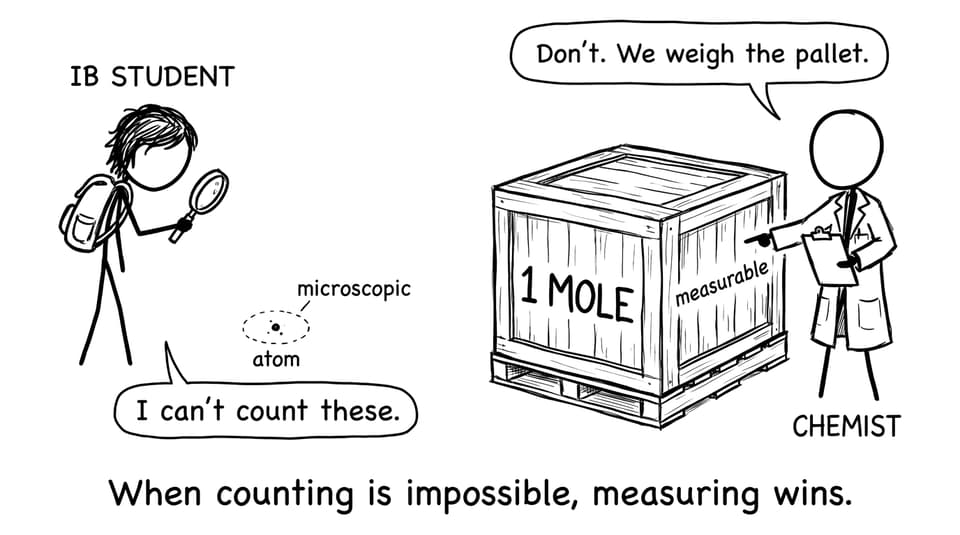
In the lab you cannot count atoms one by one. But you can weigh powders, measure gas volumes, and read a burette. The mole is the bridge between those two worlds. It turns “invisible particles” into “measurable amounts” without pretending we can do microscopic counting.
The mole in one exam-ready definition
A mole is a counting unit. Just like “a dozen” means 12 items, 1 mol means 6.022 × 10²³ particles (Avogadro’s constant). In IB Chemistry, those particles might be atoms, molecules, ions, or formula units.
Quick checklist you can apply to almost any IB Chemistry calculation:
-
Identify what you are counting (atoms? molecules? ions?).
-
Convert what you measured into moles.
-
Use ratios from a balanced equation (stoichiometry).
-
Convert moles back into what the question asks for (mass, volume, concentration, particles).
For a clear refresher, see The mole explained clearly for IB Chemistry.
Why IB Chemistry needs the mole: mass becomes “particle counting”
The real magic is molar mass. Every substance has a molar mass (g mol⁻¹), which tells you the mass of 1 mole of that substance. So your balance becomes a particle-counting machine.
That is why this relationship is everywhere in IB Chemistry:
- n = m/M
When you can go from grams to moles, you can connect to particles using Avogadro’s constant, and suddenly chemical equations stop being symbolic and start being practical.
If molar mass still feels slippery, use Molar mass explained and practice with How to calculate moles from mass and molar mass.
The mole makes equations scale up to the real world
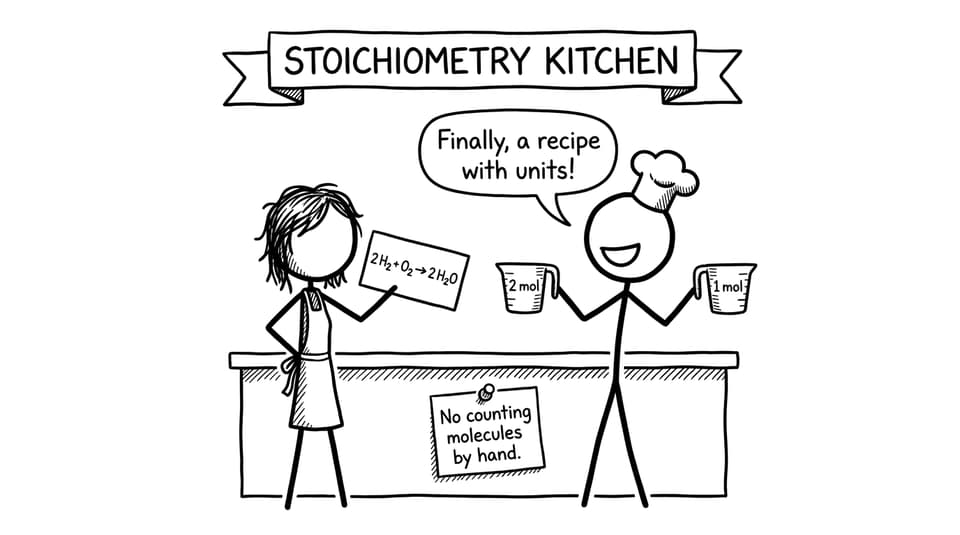
A balanced equation is a set of mole ratios. For example, when you see:
2H₂ + O₂ → 2H₂O
IB Chemistry is telling you: for every 2 moles of hydrogen, you need 1 mole of oxygen, producing 2 moles of water. No microscopic counting required. Just convert your given data to moles, apply the ratio, then convert back.
For syllabus-aligned support, try:
Where the mole shows up beyond stoichiometry (IB Chemistry)
The mole quietly holds together multiple units you will use under time pressure:
-
Gases: volume is linked to moles (see What is Avogadro’s Law? IB Chemistry explained and S1.4.6 Avogadro’s law notes).
-
Solutions: concentration uses moles per dm³ (see What is the unit for concentration?).
-
Core definition work: revisit Avogadro’s constant explained for IB Chemistry.
The takeaway (and how RevisionDojo helps)
The mole helps chemists relate atoms to measurable amounts because it converts the uncountable into the weighable. In IB Chemistry, that single bridge supports molar mass, stoichiometry, gas relationships, and concentration, the exact skills exam questions keep returning to.
If you want to turn the mole from “concept” into “reflex,” RevisionDojo makes it systematic: targeted Questionbank practice with feedback, concise Study Notes, high-recall Flashcards, an AI Chat for stuck steps, plus Predicted Papers, Mock Exams, Grading tools, a Coursework Library, and on-demand Tutors when you need a human explanation.



