


If you’ve ever stared at your subject selection form and felt your stomach drop, you’re not alone. Choosing between IB Biology and IB Chemistry can feel like picking a door without knowing what’s behind it. And because IB Sciences sit at the intersection of grades, university plans, and your weekly stress level, the decision becomes personal fast.
Here’s the quiet truth: most students don’t struggle because they can’t do science. They struggle because they don’t know which kind of difficulty they handle best. Biology can feel like a vast library of living detail. Chemistry can feel like a puzzle box where every topic clicks into the next. Both reward effort. Both punish vague revision.
This guide compares IB Biology vs IB Chemistry through the lens that matters most to IB students preparing for exams: how the learning feels day-to-day, what the assessments demand, and what study methods actually work. And throughout, we’ll anchor the discussion in what makes RevisionDojo a practical home base for IB Sciences revision.
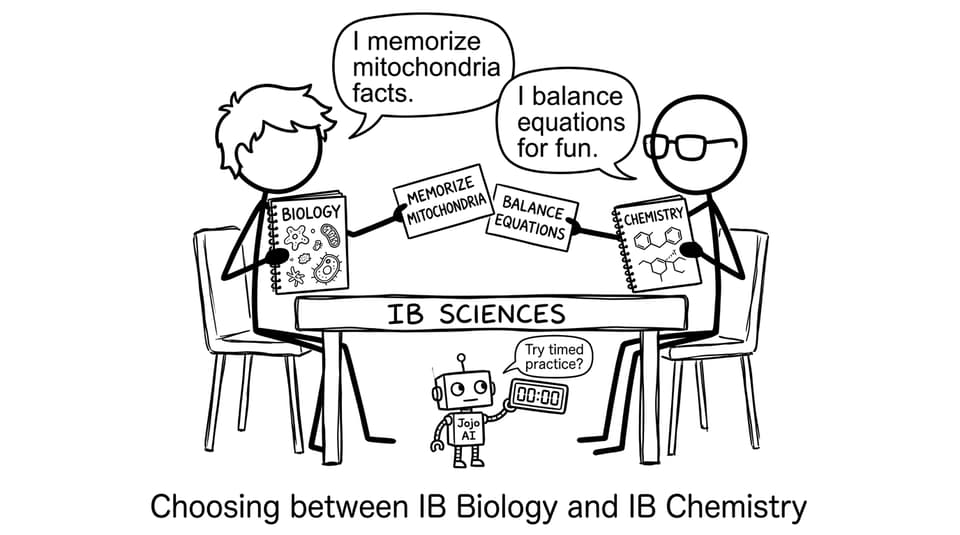
Quick decision checklist for IB Sciences
If you want a fast way to decide between these two IB Sciences, start here. Give yourself a point for every statement that feels true.
You might prefer IB Biology if you:
-
enjoy learning systems (cells, organs, ecosystems) through concepts plus terminology
-
don’t mind memorising definitions and steps, then applying them to scenarios
-
like reading, diagrams, and explaining processes in words
-
want a science that often rewards steady recall practice
You might prefer IB Chemistry if you:
-
like problem-solving where each line follows logically from the last
-
enjoy maths-light calculations and symbolic thinking (equations, models, data)
-
want a subject that strongly rewards application practice
-
feel energised by “hard but fair” questions that test understanding
If it’s close, you’re in the normal zone. Most strong students can succeed in either of these IB Sciences if they choose the right revision loop.
What IB Biology feels like (and who it suits)
IB Biology is the science of stories hiding inside structure. A membrane isn’t just a boundary; it’s a decision-maker. An enzyme isn’t just a catalyst; it’s a shape with consequences. Over time, Biology builds a big map: from molecules to cells to organisms to ecosystems.
For many students, the challenge is volume. The content can feel wide, and revision can drift into rereading. The students who thrive usually do two things:
-
They turn content into recall: definitions, pathways, key comparisons.
-
They practise explaining processes clearly, because IB mark schemes love precise language.
If that sounds like you, start with the IB Biology Resources hub. It’s a clean way to see the course parts in one place, then move between Study Notes, lessons, and targeted practice.
A helpful deep dive is What is IB Biology: Complete Guide, which clarifies how the syllabus is organised and what the assessments reward. It’s the kind of overview that prevents you from revising the wrong thing for weeks.
How to revise Biology efficiently for IB Sciences exams
Biology revision is rarely about “more hours.” It’s about better retrieval.
-
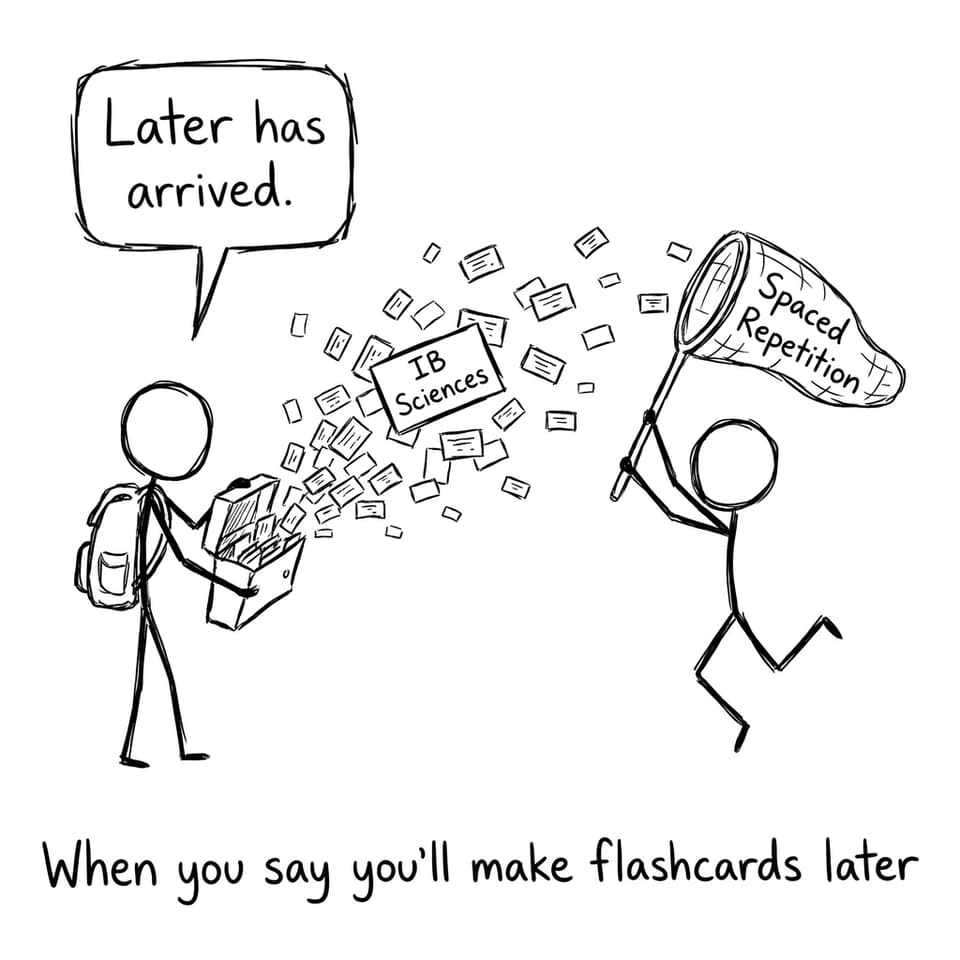
Use IB Flashcards with Spaced Repetition (SRS) for definitions, processes, and comparisons. Small daily sessions beat occasional marathons.
-
Pair that with How to Use Flashcards for IB Biology Revision so you’re not just collecting decks but actually building memory.
-
Then move to exam-style practice through the Questionbank, where you can force recall under pressure and get feedback.
This is a key point for IB Sciences: memorisation isn’t the enemy, but memorisation without testing is. RevisionDojo’s Questionbank plus Flashcards makes Biology feel less like a foggy forest and more like a marked trail.
What IB Chemistry feels like (and who it suits)
IB Chemistry is the science of invisible rules. You can’t “see” equilibrium the way you see a leaf. But you can predict it. That’s the hook. Chemistry trains you to trust models, track variables, and defend each step.
Many students find Chemistry harder at first because memorising alone doesn’t scale. You can know definitions perfectly and still freeze when a question combines ideas: stoichiometry plus redox plus equilibrium logic. But once you build the habit of structured problem-solving, Chemistry becomes strangely satisfying.
A good starting point is the IB Chemistry Resources hub, where you can rotate between notes, practice sets, and timed papers.
Chemistry also rewards having the right reference habits. The IB Chemistry Data Booklet - Formula Reference is worth treating like a daily tool, not a last-minute PDF you glance at during panic week.
How to revise Chemistry efficiently for IB Sciences exams
If Biology revision is “recall and explain,” Chemistry revision is “apply and reflect.”
Here’s a simple loop that works well for IB Sciences students aiming for consistency:
-
Learn the concept once with clean notes and examples.
-
Do a small set of questions immediately in the Questionbank.
-
Mark hard questions, then use AI Chat (Jojo) to ask why your method failed.
-
Return 48 hours later and redo similar questions.
When you need speed and structure, a quick reference-style summary helps. RevisionDojo’s IB Chemistry Cheatsheets: Simplify Complex Concepts in Minutes is designed for that “I understand it, but I can’t recall it fast enough” stage.
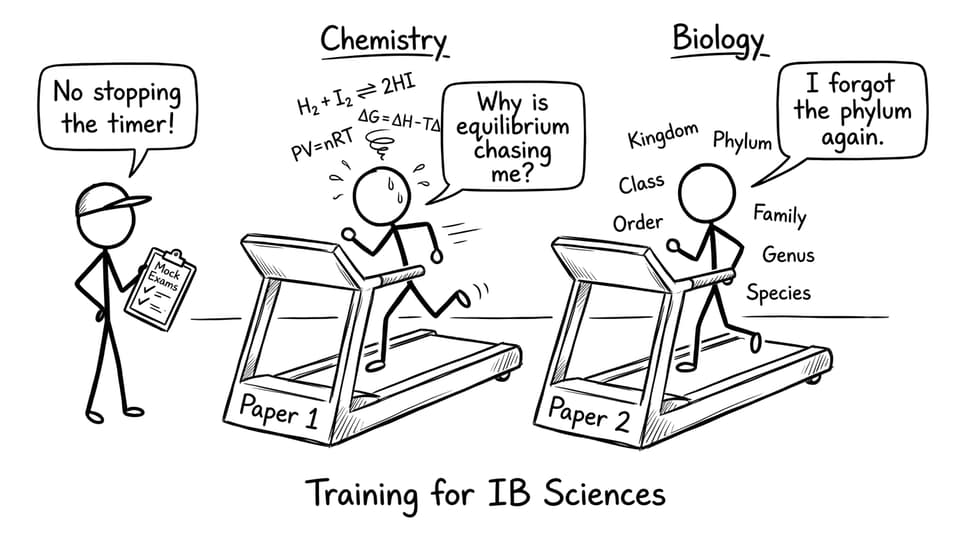
IB Sciences exams: memorisation vs application (the real difference)
Students often ask which is “easier.” The better question is: which type of difficulty suits your brain?
-
IB Biology tends to reward accurate terminology, clear process explanations, and familiar application in context.
-
IB Chemistry tends to reward method, multi-step reasoning, and comfort moving between representations (equations, data, particle models).
Both subjects punish passive revision. And both improve quickly when you simulate exam conditions.
To build that exam realism, use RevisionDojo’s Predicted Papers and Mock Exams features. A good starting point is IB Predicted Papers by IB Examiners (Free), then pick your subject set.
For Biology specifically, you can jump into Biology Predicted Papers (Free). For Chemistry, the subject hub includes paper practice and structured learning routes: IB Chemistry Predicted Papers - RevisionDojo.
The overlooked factor: your teacher and your time budget
Two students can take the same IB Sciences course and live in different realities.
If your teacher explains clearly and gives good feedback, the subject feels lighter. If they rush, skip reasoning, or mark vaguely, you’ll have to self-teach more. That doesn’t mean you shouldn’t take the subject. It just means you need a stronger external structure.
This is where RevisionDojo becomes more than “extra practice.” Students often use:
-
Study Notes to replace missing clarity
-
Lessons to rebuild topic logic step-by-step
-
Flashcards for daily recall (especially helpful for Biology)
-
Questionbank to learn what exam questions actually look like
-
AI Chat to get unstuck without losing an hour
-
Grading tools to understand mark scheme expectations
-
Predicted Papers and Mock Exams to train timing and stamina
-
Coursework Library to lower IA anxiety
-
Tutors when you need targeted support fast
When your schedule is tight, the “right” science is the one you can revise consistently.
Choosing your IB Sciences path (and what to do next)
Choosing between IB Biology and IB Chemistry isn’t about picking the “best” subject. It’s about picking the science where your effort turns into marks most reliably.
If you want a practical next step, do this: spend 30 minutes exploring both hubs, then attempt a short Questionbank set from each and notice how it feels. Do you enjoy recall-and-explain, or method-and-apply? That emotional signal matters.
Start with:
Whatever you choose, RevisionDojo is built to make IB Sciences feel less like survival and more like training: clear content, daily recall, exam practice, instant feedback, and support when you need it.