


If you have ever stared at a data table in IB Chemistry and thought, “These boiling points look like a prank,” you are not alone. Two substances can have similar molar masses, yet one is a gas and the other stubbornly stays liquid. The difference is often not inside the molecule, but between molecules, the quiet pull of intermolecular forces that decides how matter behaves when you heat it, pour it, or try to dissolve it.
For exam questions, this topic is a gift. Once you see the pattern, physical properties stop being random facts and start feeling predictable.
A fast IB Chemistry checklist for intermolecular forces
Use this mini-checklist whenever IB Chemistry asks you to link structure to properties:
-
Identify polarity (is there a permanent dipole?)
-
Check for hydrogen bonding (H bonded to N, O, or F)
-
Estimate London dispersion strength (more electrons, larger surface area)
-
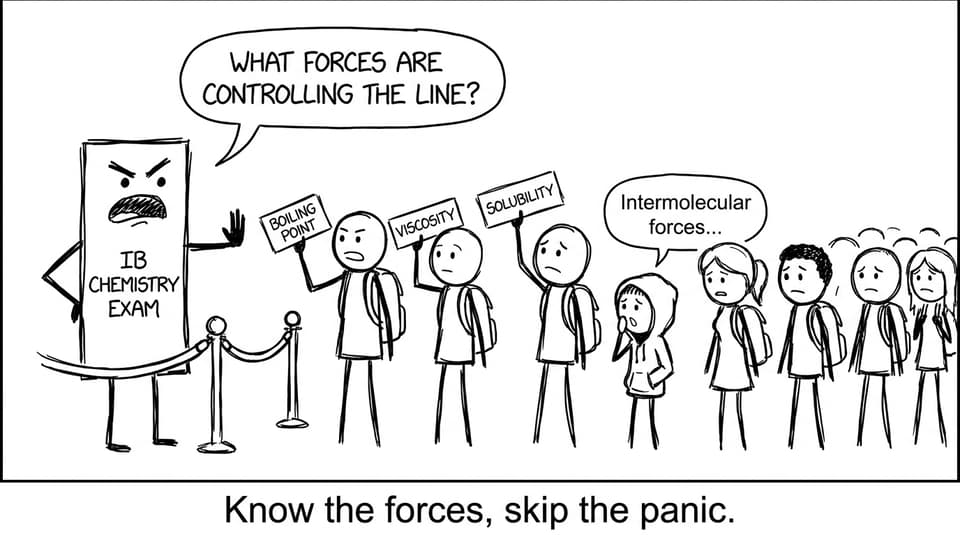
Predict which property changes: boiling/melting point, volatility, viscosity, surface tension, solubility
If you want a syllabus-aligned refresher, start with 4.4 Intermolecular forces and then test it using the 4.4 Intermolecular forces Questionbank.
Why intermolecular forces change melting and boiling points
In IB Chemistry, melting and boiling are basically energy stories. You are not breaking covalent bonds inside molecules; you are overcoming attractions between molecules.
-
Stronger intermolecular forces mean particles cling together more tightly, so you need more energy to separate them, leading to higher melting and boiling points.
-
Weaker intermolecular forces mean molecules escape more easily, resulting in lower melting and boiling points.
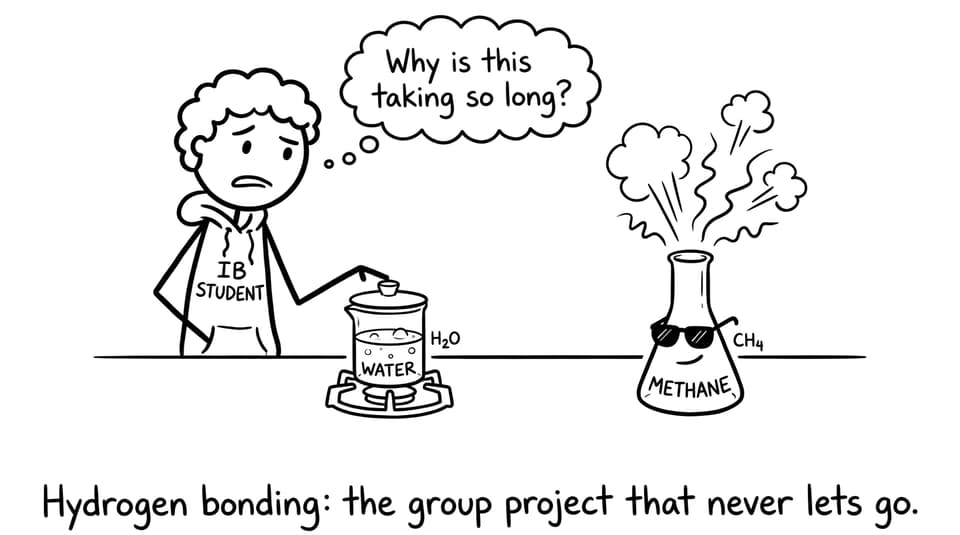
A classic comparison is water vs methane: water is small but forms extensive hydrogen bonds, while methane relies only on London dispersion forces. That is why water’s boiling point is dramatically higher.
To lock in the definitions and the “why,” use Intermolecular Forces Explained alongside the deeper syllabus notes in Notes for S2.2.8 Intermolecular forces.
Why intermolecular forces affect solubility ("like dissolves like")
Solubility questions in IB Chemistry reward calm logic. Dissolving is not “disappearing.” It is swapping interactions: solute-solute and solvent-solvent attractions get replaced by solute-solvent attractions.
-
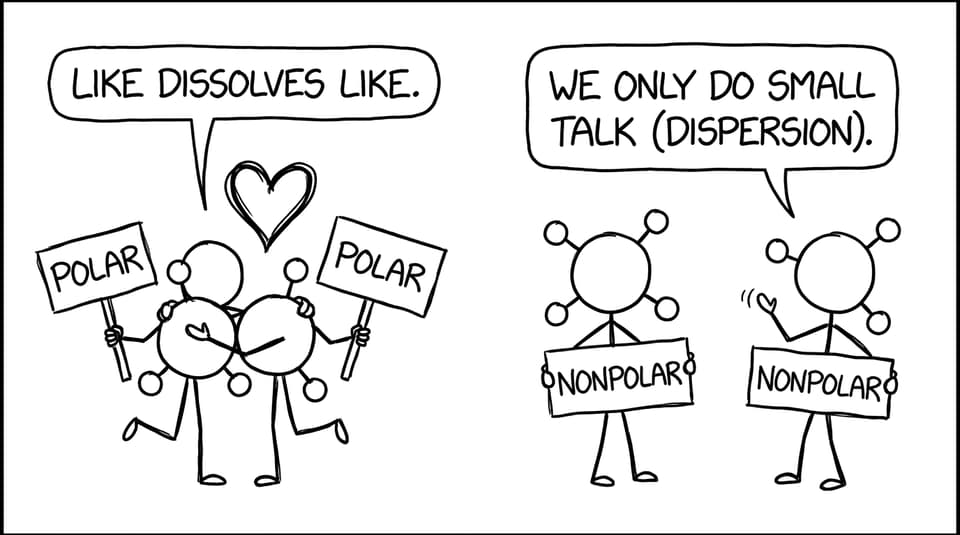
Polar solutes tend to dissolve in polar solvents because dipole-dipole attractions and hydrogen bonding can form.
-
Nonpolar solutes tend to dissolve in nonpolar solvents because London dispersion forces are the main game available.
When you write explanations, be explicit about the forces present before and after mixing. That is usually where marks live.
For practice in the exact examiner style, try S2.2.9 Intermolecular forces and physical properties Questionbank.
Why intermolecular forces control viscosity, surface tension, and volatility
These properties are where IB Chemistry starts to feel like real life.
-
Viscosity increases when molecules resist flowing past each other (stronger intermolecular forces, more entanglement, stronger attractions).
-
Surface tension increases when molecules at a surface are pulled inward strongly by neighbors (again, stronger attractions).
-
Volatility increases when molecules can escape easily into the gas phase (weaker attractions).
A good exam sentence is: “Stronger intermolecular forces increase viscosity and surface tension, and decrease volatility, because more energy is required for molecules to separate or move independently.”
How to turn this into marks on the IB Chemistry exam
The fastest way to improve is to answer in a repeatable structure:
-
Name the dominant intermolecular force(s).
-
Compare strength (hydrogen bonding > dipole-dipole > London dispersion, with LDF increasing with size/polarizability).
-
Link to the property using energy and particle separation language.
Then do enough questions that the structure becomes automatic. RevisionDojo helps you do that with a loop that feels like real preparation: Study Notes for clarity, Flashcards for recall, Questionbank for exam-style repetition, AI Chat when you get stuck, and Grading tools to show what an examiner would reward. When you are ready to simulate pressure, build Mock Exams and use Predicted Papers to sharpen timing. If coursework is stealing revision time, the Coursework Library and Tutors can help you rebalance.
A helpful starting hub is IB Chemistry Resources.
Conclusion: make IB Chemistry feel predictable
Intermolecular forces affect physical properties because they decide how hard it is for molecules to separate, slide, or swap partners in solution. Once you train yourself to identify the dominant force and talk in energy language, IB Chemistry questions on boiling point, solubility, viscosity, and volatility become consistent rather than surprising.
If you want that consistency under exam conditions, use RevisionDojo’s 4.4 Intermolecular forces learning path, drill with the S2.2.9 Questionbank, and keep your recall sharp with the Intermolecular forces Flashcards.


