

A small “impurity” that changes everything
In IB Chemistry, alloys are one of those topics that look simple until you try to explain them under exam pressure. A metal is a metal… right? Then you meet steel, brass, and stainless steel and realise tiny changes in composition can flip a material from bendy to stubborn, from shiny conductor to “good, but not copper-good.”
The secret is not magic. It’s structure. In IB Chemistry, we care about what atoms are doing in the lattice, and what the delocalised electrons can (and can’t) get away with.
Quick exam checklist (what to mention)
When a question asks why alloys have different properties than pure metals, hit these points:
-
Pure metals have a regular lattice of identical atoms/ions
-
Metallic bonding involves positive ions + delocalised electrons
-
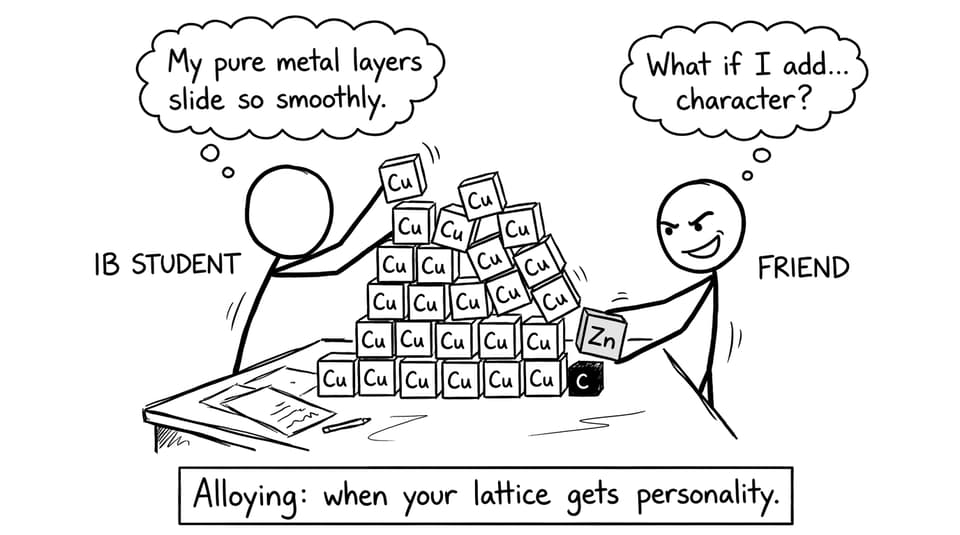
Adding different atoms distorts the lattice
-
Distortion makes layers harder to slide (strength/hardness increases)
-
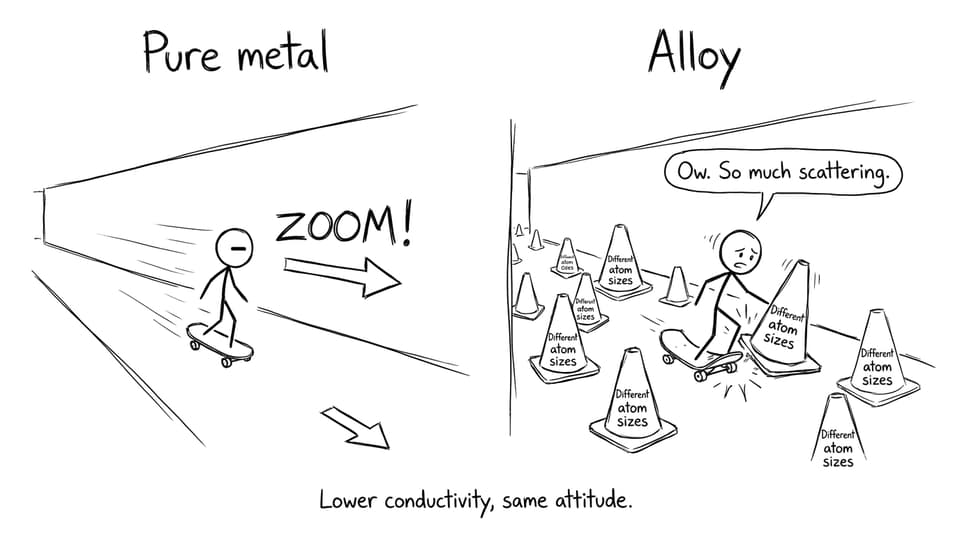
Distortion causes more electron scattering (conductivity decreases)
-
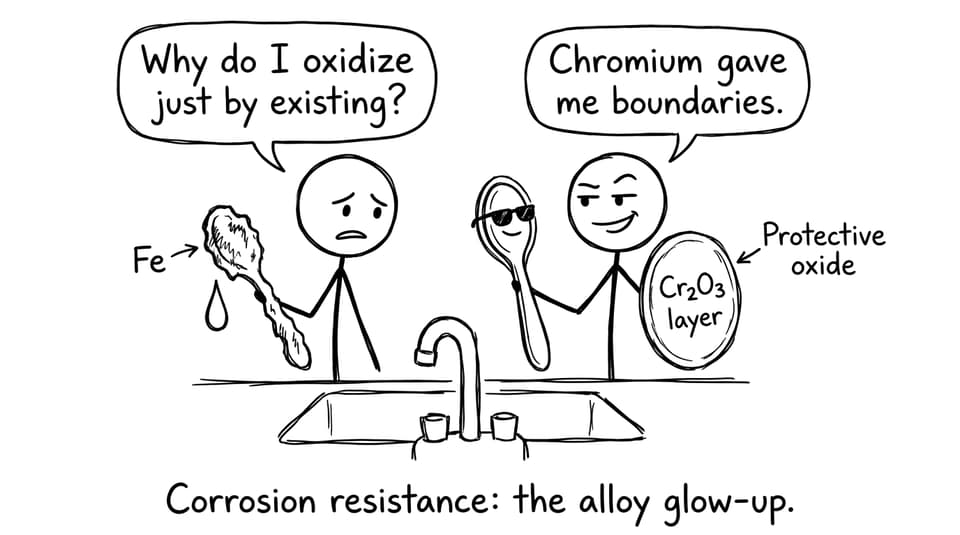
Some alloying elements form protective oxide layers (corrosion resistance)
For a refresher on the metallic model itself, use S2.3 The Metallic Model.
The lattice story: why sliding matters in IB Chemistry
In a pure metal, the ions sit in neat, repeating layers. Because metallic bonding is non-directional, those layers can slide past each other while staying “glued” by the sea of delocalised electrons. That’s the core reason many pure metals are relatively malleable and ductile.
Now add a second element.
In IB Chemistry, we describe this as disrupting the regularity of the lattice. If the new atoms are a different size, they create local strain: too big and they crowd the layer; too small and they leave awkward gaps. Either way, the layers don’t glide anymore. They catch.
That mechanical “catching” is why alloys are often harder and stronger than the pure metal they’re based on.
If you want the syllabus-aligned wording and definitions, RevisionDojo’s S2.4.3 Alloys Notes is the cleanest version to memorise.
Substitutional vs interstitial alloys (the two patterns examiners love)
Substitutional alloys
A similar-sized atom replaces a metal atom in the lattice (but not perfectly). Classic example: brass (Cu + Zn). Even “similar” sizes still disrupt the tidy stacking, which blocks sliding and increases strength.
Interstitial alloys
A much smaller atom sits in the gaps between metal atoms. Classic example: steel (Fe + C). Carbon is small enough to fit into interstices and acts like a physical barrier, making it far harder for layers to move.
To connect this back to bonding strength ideas, review S2.3.2 Strength of Metallic Bonds Notes.
Why alloys usually conduct less well
Pure metals are great conductors partly because electrons can move through a relatively uniform environment. In an alloy, the irregular arrangement increases collisions and scatters electrons more frequently. So electrical (and thermal) conductivity usually drops, even though the material still conducts.
To practice these explanations in exam style, go to the IB Chemistry Resources hub and use the Questionbank to drill “explain” questions until the phrasing becomes automatic.
Corrosion resistance: the stainless steel “upgrade”
Some alloys change properties because they enable new surface chemistry. Stainless steel resists rusting because chromium helps form a thin, protective oxide layer that blocks further oxidation.
Bring it home with RevisionDojo
If you can explain alloys as “a distorted metallic lattice that resists sliding and scatters electrons,” you’re already thinking like IB Chemistry markschemes. Turn that understanding into marks by practising with RevisionDojo’s Questionbank, locking definitions with Flashcards, and checking your explanations with AI Chat and Grading tools. When you’re ready to simulate exam conditions, build timed practice with Mock Exams and Predicted Papers on the IB Chemistry Resources hub.