


In IB Business Management, leadership styles can feel like a trick question. You revise neat definitions, then the case study drops a messy, human situation on your desk: a new manager, a nervous team, a deadline that won’t move, and a decision that needs to be made yesterday.
So which leadership style is most effective?
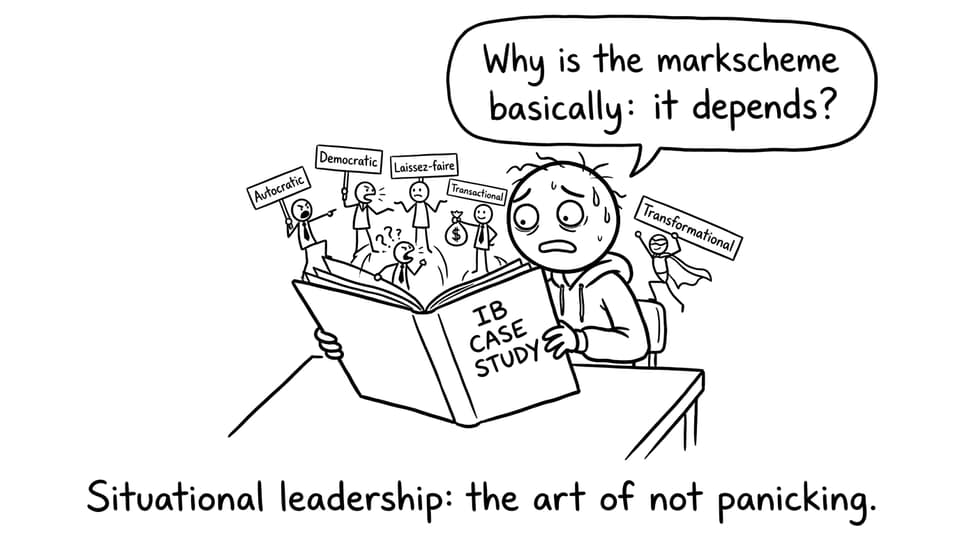
The honest, high-scoring answer in IB Business Management is: the most effective style is the one that fits the situation. Not because examiners love vague answers, but because real organizations are built on trade-offs.
The quick exam checklist (what to compare)
When you evaluate leadership in IB Business Management, compare styles using the same lenses every time:
-
Speed of decision-making (urgent vs flexible)
-
Quality of decisions (one brain vs many)
-
Motivation and morale (control vs voice)
-
Creativity and innovation (rules vs freedom)
-
Capability of the workforce (inexperienced vs expert)
For syllabus-aligned definitions, keep IB Business Management Key Definitions open while you practise.
Why different situations require different approaches in IB Business Management
A leadership style is like a tool. A hammer is “effective” right up until you need to tighten a screw.
Situations change because:
-
Risk changes (safety, reputation, money)
-
Time pressure changes (crisis vs long-term planning)
-
People change (new hires, experts, burnout)
-
Culture changes (trust, expectations, communication)
This is the logic behind situational leadership: leaders adapt their behaviour to the context.
If you want the full syllabus view, revise 2.3 Leadership and management alongside 2.3.3 Leadership Styles.
Leadership styles, when they work best, and the trade-off you must mention
Autocratic leadership: clarity when time is expensive
Autocratic leadership is strongest when the case study signals urgency, high risk, or inexperience. It can reduce confusion and keep execution tight. In your IB Business Management answer, add the cost: lower morale, fewer ideas, and weaker long-term commitment if it becomes the default.
Democratic leadership: better decisions when you can afford time
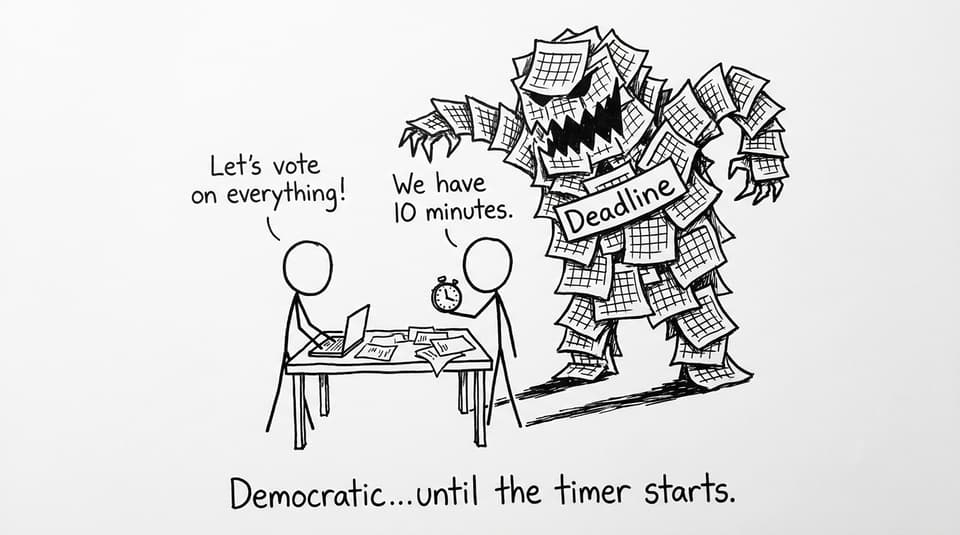
Democratic leadership works when problems benefit from diverse input: planning, problem-solving, or improving processes. It often boosts motivation because employees feel valued. But in IB Business Management, you should flag the limitation: consultation takes time, and decisions can stall.
Laissez-faire leadership: autonomy for highly skilled teams
Laissez-faire leadership can be effective with experienced, self-motivated specialists, especially in creative or technical work. The downside is control: without clear goals, teams may drift, duplicate work, or produce inconsistent outcomes.
Transformational leadership: momentum for change
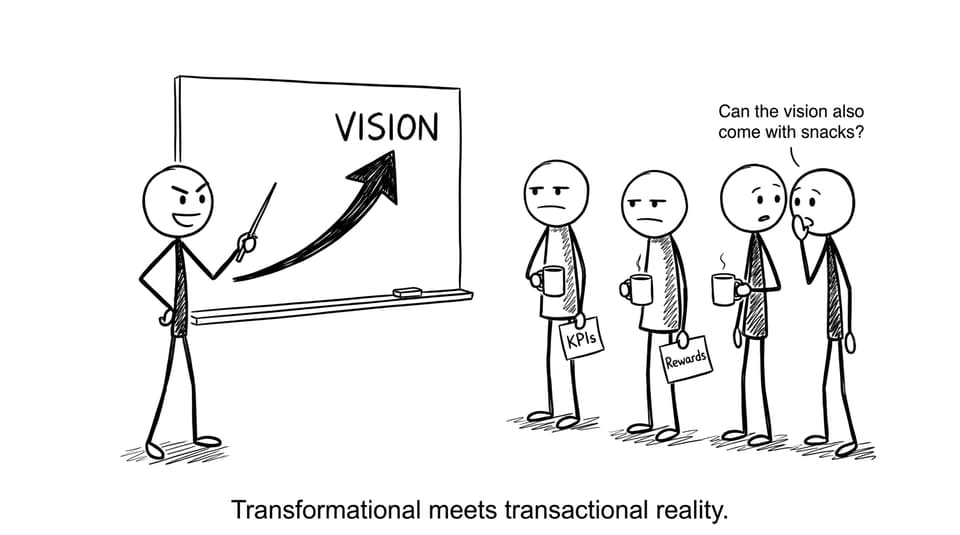
Transformational leaders inspire through vision and purpose, which is powerful during change, growth, or innovation. The risk is execution: vision without structure can frustrate teams, especially if they need training, systems, or clear short-term targets.
Transactional leadership: reliable performance for routine tasks
Transactional leadership uses rewards and consequences to drive measurable performance. It suits routine, standardized roles. In IB Business Management, the evaluation point is predictable: it may not build creativity, intrinsic motivation, or deep engagement.
How to turn this into marks (fast)
If you’re preparing for exams, practise applying leadership to mini-scenarios. RevisionDojo makes this loop simple:
-
Learn with 2.3.3 Leadership Styles Notes and Flashcards for Leadership Styles
-
Drill application using the 2.3 Leadership and management Questionbank
-
Use AI Chat to test your evaluation wording, and Grading tools to tighten your structure
-
Build timed practice with Mock Exams and sharpen weak areas with Study Notes and Flashcards
For a broader hub of practice and tools, start at IB Business Management Resources.
Conclusion: the “best” leadership style is the one you can justify
In IB Business Management, leadership is not a personality label. It’s a decision about what to optimize: speed, buy-in, creativity, control, and what to risk.
If you want to score higher, practise choosing a style, defending it with context, and evaluating the trade-off. RevisionDojo brings that whole cycle together with a Questionbank, Study Notes, Flashcards, AI Chat, Grading tools, Predicted Papers, Mock Exams, a Coursework Library, and Tutors when you want human feedback at the final stretch.