



If you’ve ever stared at an IB History essay question and thought, “How did we get from philosophers to revolutions so fast?” you’re already halfway to understanding the Enlightenment.
The Enlightenment is not just a list of famous names. It’s a shift in how people thought about power, truth, and the individual. In IB History, that shift becomes a kind of intellectual domino effect: reason challenges tradition, arguments challenge authority, and eventually entire political systems start to wobble.
What was the Enlightenment in IB History terms?
In IB History, the Enlightenment refers to an intellectual and philosophical movement that peaked in 18th-century Europe and emphasized reason, science, and individual rights over inherited tradition and religious authority.
It’s often called the “Age of Reason” because thinkers argued that society should be organized by rational principles rather than unquestioned hierarchy. This matters in IB History because Enlightenment ideas sit behind later topics you actually get examined on: revolutions, liberalism, constitutionalism, and rights-based political movements.
If you want one hub to keep open while revising, start at the IB History Resources page.
Quick checklist (use this before you write)
Before you build an IB History paragraph on the Enlightenment, check that you can:
-
Define the Enlightenment as a movement grounded in reason and reform.
-
Explain why absolutism and religious authority were questioned.
-
Name 2-3 key thinkers and match each to one clear idea.
-
Link at least one Enlightenment idea to a revolution or constitutional change.
-
Use one piece of evidence (a quote or a policy consequence) rather than just description.
For exam practice, pair your notes with timed questions in the Questionbank.
The roots of Enlightenment thinking
The Enlightenment didn’t appear out of nowhere. In IB History, it’s best explained as an acceleration of earlier developments.
Scientific Revolution and a new confidence in reason
Thinkers were watching science produce results. Observation, experimentation, and logic were turning mysteries into explanations. The implication was unsettling: if nature follows laws we can understand, maybe politics should too.
Humanism and the individual
Renaissance humanism had already made the individual feel important again: education, potential, and debate mattered. Enlightenment writers inherited that optimism and pushed it into politics.
War, absolutism, and fatigue with unquestioned authority
Europe’s experience of religious conflict and heavy-handed monarchy created space for a radical question: What makes authority legitimate? In IB History, this question is the doorway to social contract theory, natural rights, and constitutional limits.
Key Enlightenment thinkers (and the exam-friendly idea to remember)
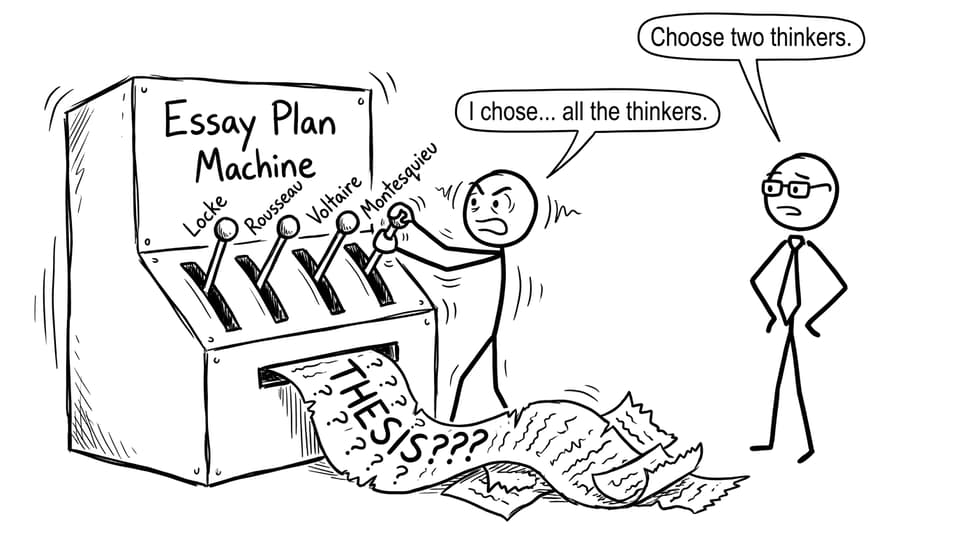
You don’t need a biography. You need a usable idea that links to political change. Here are the staples of IB History exam answers.
John Locke: natural rights and consent
Locke argued people possess natural rights (often summarized as life, liberty, property) and that governments exist to protect them. If government fails, people have a right to resist. This is a clean bridge to revolutionary justification.
To connect those ideas to political documents, see Declaration of Independence Notes.
Voltaire: criticism of intolerance and arbitrary power
Voltaire attacked censorship and intolerance and mocked institutions that claimed unquestionable authority. In IB History, he’s useful for arguments about civil liberties, freedom of speech, and the cultural delegitimization of absolutism.
Rousseau: the social contract and popular sovereignty
Rousseau’s central exam value is popular sovereignty: legitimate authority comes from the people. That idea can be used to explain revolutionary rhetoric and later nationalist movements.
Montesquieu: separation of powers
Montesquieu argued that political liberty requires a system where power checks power. In IB History, this connects neatly to constitutional design and the fear of tyranny.
Diderot and Wollstonecraft: knowledge and inclusion
Diderot’s Encyclopédie symbolizes a belief that knowledge can reform society. Wollstonecraft is your link to early rights arguments about women and education. Both help you push beyond “politics only” and score better evaluation.
Want a fast way to memorize thinker-to-idea pairings? Build a spaced repetition routine with IB Flashcards with Spaced Repetition (SRS).
Major themes of the Enlightenment (use these as paragraph frames)
When IB History essays ask about influence, significance, or causes, these themes help you structure paragraphs:
-
Reason over superstition: truth should be tested, not inherited.
-
Rights and liberty: individuals possess claims against the state.
-
Progress and reform: society can improve through education and debate.
-
Secularism: political legitimacy should not depend on religious authority.
Effects: why Enlightenment ideas mattered
In IB History, effects are best written across political, social, and long-term dimensions.
-
Political change: Enlightenment arguments helped justify revolutions and constitutional experiments (especially in the late 18th century).
-
Social and cultural change: publishing expanded, literacy grew, and public debate moved into salons, pamphlets, and informal spaces.
-
Long-term legacy: liberal democracy and modern rights discourse drew heavily on Enlightenment assumptions about legitimacy and the individual.
To practise turning “ideas” into evaluative claims, use examiner-style prompts in the IB History predicted papers.
How to use the Enlightenment in IB History essays
A strong IB History response doesn’t say “the Enlightenment caused revolutions.” It shows how ideas became political action.
Try this pattern:
-
Claim: One Enlightenment idea challenged a specific form of authority.
-
Evidence: Name the thinker and the concept (natural rights, popular sovereignty, separation of powers).
-
Link: Explain how that concept appears in a revolution, constitution, or political movement.
-
Evaluation: Add a limit: ideas alone rarely topple regimes without social and economic pressures.
If you’re building full exam technique, keep How To Ace IB History Paper 1 And Paper 2 Exams alongside your topic notes.
Conclusion: make Enlightenment revision feel usable
The Enlightenment can feel like a cloud of names until you treat it like a toolkit. In IB History, it’s the toolkit that helps you explain why revolutions sounded the way they did, and why modern states started justifying power differently.
To revise it efficiently, build a loop: learn the core ideas with IB History Resources, drill recall with Flashcards, test yourself in the Questionbank, and refine under pressure with IB History predicted papers. When you’re ready, RevisionDojo’s AI Chat and grading tools can help you tighten thesis statements and evidence selection so your IB History paragraphs land with confidence.