
It usually happens in the same quiet moment: you’re halfway through a stoichiometry question, the numbers look friendly, and then the exam asks for the empirical formula… but your brain writes the molecular formula.
In IB Chemistry, that small swap can cost marks even when your method is solid. The good news is the difference isn’t complicated. It’s just easy to blur when you’re rushing, rounding, or guessing what the compound “probably is.”
This guide makes the distinction crisp, shows you how exam questions connect the two, and gives you a simple routine you can repeat under pressure.
Quick checklist for IB Chemistry formula questions
Use this quick scan before you touch your calculator (seriously, it saves time in IB Chemistry):
-
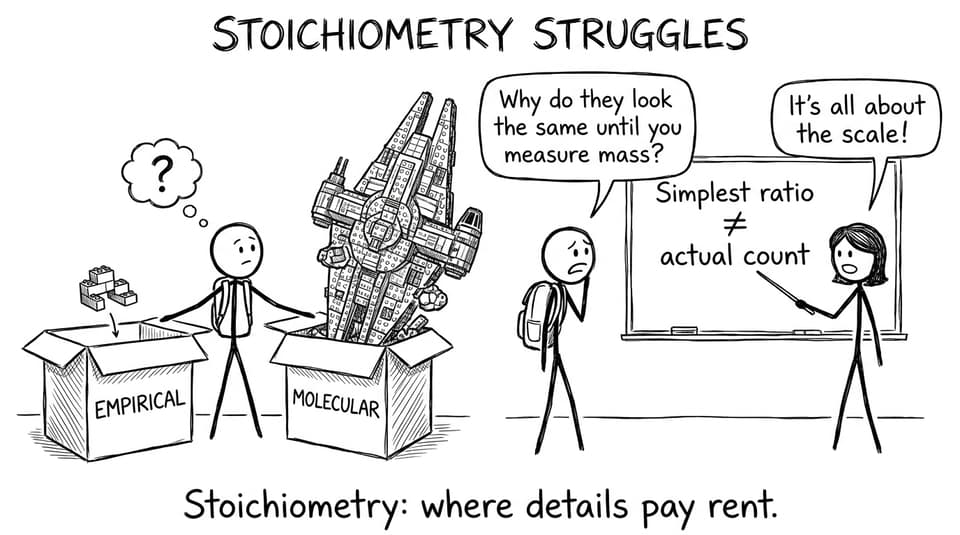
Empirical formula = simplest whole-number ratio of atoms (like simplifying a fraction).
-
Molecular formula = actual number of each atom in one molecule.
-
Molecular formula = (empirical formula) × n, where n is a whole number.
-
You find n using molar mass.
-
Ionic compounds are typically written as empirical formulas (ratios), not “molecules.”
If your calculations feel shaky, it helps to build the lab-to-exam foundation too: Tips to Improve Your Lab Skills for IB Chemistry.
What is an empirical formula in IB Chemistry?
In IB Chemistry, the empirical formula tells you the simplest ratio of atoms in a compound. That’s it. No promise that it matches a real molecule size. It’s the chemistry version of reducing 6/12 to 1/2.
Examples you’re expected to recognise quickly:
-
Hydrogen peroxide: H₂O₂ has an empirical formula of HO.
-
Glucose: C₆H₁₂O₆ has an empirical formula of CH₂O.
Most exam prompts that lead to an empirical formula give you percentage composition, masses, or combustion data. If you want a dedicated walkthrough for the calculation routine, use Empirical Formula Explained Simply.
And if you’re revising by syllabus points, the S1.4.4 hub is the cleanest anchor: S1.4.4 Empirical and molecular formulas.
What is a molecular formula in IB Chemistry?
The molecular formula gives the actual number of each atom in a molecule. In IB Chemistry, it’s the version that identifies the substance more precisely.
Examples:
-
Glucose: C₆H₁₂O₆
-
Ethanol: C₂H₆O
-
Benzene: C₆H₆
Notice something important: each of these could be simplified into a smaller ratio (its empirical formula), but the molecular formula is the real count.
For fast memorisation and recall practice, RevisionDojo has targeted decks like Flashcards for S1.4.4 Empirical and molecular formulas.
How empirical and molecular formulas connect (the only relationship you need)
In IB Chemistry, the relationship is always written like this:
Molecular formula = (Empirical formula) × n
Where n is a whole number you compute from molar masses:
n = (molar mass of compound) ÷ (molar mass of empirical formula)
If molar mass is the part that makes you hesitate, keep a reference page open while you practise: Molar Mass Explained.
And for broader quantitative practice around the same skill set, this topic hub helps you stack skills efficiently: R2.1 How much? The amount of chemical change.
An IB Chemistry worked example (the exam-style flow)
A compound contains 40.0% C, 6.7% H, and 53.3% O by mass. Its molar mass is 180 g/mol.
Step 1: Assume 100 g (if percentages)
So you have: 40.0 g C, 6.7 g H, 53.3 g O.
Step 2: Convert to moles
-
C: 40.0 ÷ 12.0 = 3.33 mol
-
H: 6.7 ÷ 1.0 = 6.7 mol
-
O: 53.3 ÷ 16.0 = 3.33 mol
Step 3: Divide by the smallest
Smallest is 3.33.
-
C: 3.33/3.33 = 1
-
H: 6.7/3.33 ≈ 2
-
O: 3.33/3.33 = 1
Empirical formula = CH₂O
Step 4: Use molar mass to scale up
Molar mass of CH₂O = 12 + 2(1) + 16 = 30 g/mol.
n = 180 ÷ 30 = 6
Molecular formula = (CH₂O) × 6 = C₆H₁₂O₆
That’s the exact reasoning rhythm that shows up across IB Chemistry stoichiometry. If you want extra structure for timed work, pair this with RevisionDojo’s broader strategy guides like How to Avoid Common Mistakes in IB Chemistry Exams.
Common mistakes that lose marks in IB Chemistry
These are the predictable slips markers see all the time in IB Chemistry:
-
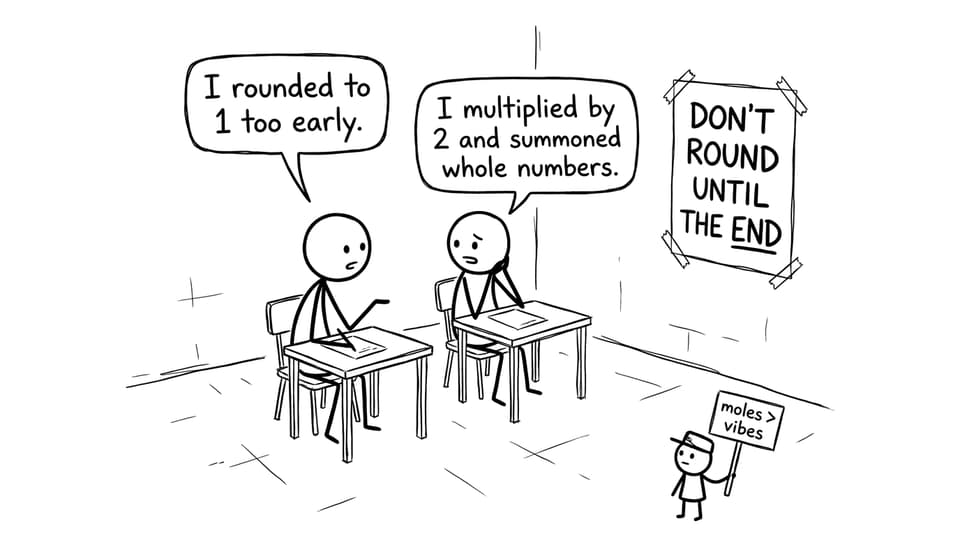
Rounding too early and forcing the wrong ratio.
-
Forgetting that percentages must become moles before you can compare elements.
-
Not checking whether a ratio like 1.5 or 2.33 needs multiplying to become whole numbers.
-
Assuming empirical and molecular formulas are always the same.
-
Using “molecular formula thinking” on ionic compounds.
A useful way to train consistency is to practise in short sets using RevisionDojo’s Questionbank, then review errors with AI Chat and re-try with stricter working. Add Flashcards for definitions, and you’ve got a loop that actually changes your accuracy.
Conclusion: the difference you can bank marks on
In IB Chemistry, the empirical formula is the simplest ratio, and the molecular formula is the actual count. The bridge between them is always molar mass and a whole-number multiplier n. If you practise that flow until it feels boring, you’ll stop losing marks to rounding, ratio slips, and “molecule vs lattice” confusion.
When you’re ready to turn understanding into consistency, RevisionDojo is built for it: drill this skill in the Questionbank, lock definitions with Flashcards, check reasoning with AI Chat, and sharpen exam timing with Mock Exams and Predicted Papers. Add Study Notes, Grading tools, the Coursework Library, and Tutors when you want feedback that’s specific, not generic. That’s how IB Chemistry stops feeling like a guessing game and starts feeling like pattern recognition.