
If you have ever stared at a burner flame and felt oddly judged by it, you are not alone. In IB Chemistry, combustion looks simple until the question asks for “products,” “conditions,” and “evidence,” all in one breath. The good news is that complete combustion of hydrocarbons is one of the most predictable ideas in the syllabus. Once you see the pattern, you stop guessing and start scoring.
In this IB Chemistry guide, you will learn what the main products of complete combustion of hydrocarbons are, why oxygen supply changes everything, and how to balance any combustion equation quickly under exam pressure.
Quick answer (with an IB Chemistry mindset)
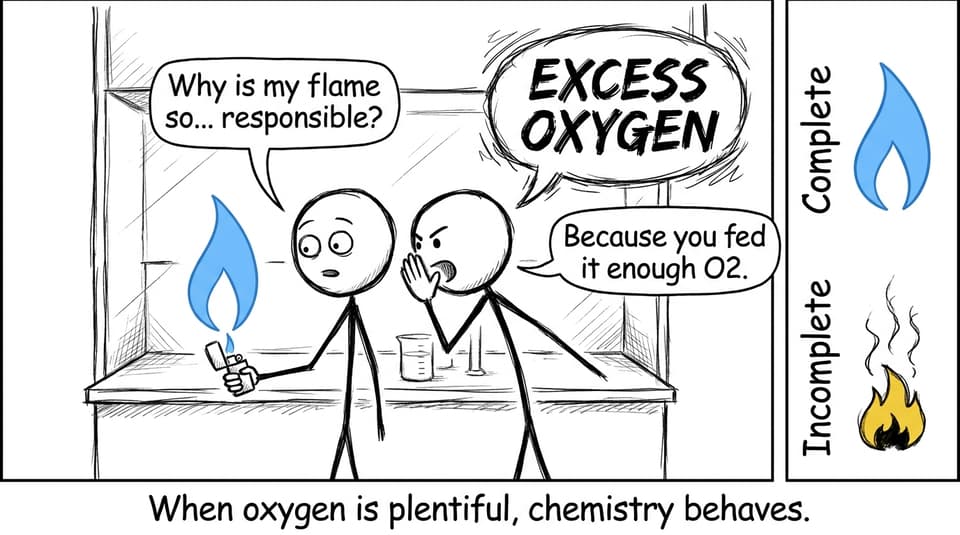
For complete combustion of a hydrocarbon (a compound made only of carbon and hydrogen), the products are always:
-
Carbon dioxide (CO₂)
-
Water (H₂O)
That is the core fact IB Chemistry examiners want you to recognize instantly: hydrocarbon + excess oxygen -> CO₂ + H₂O.
Checklist for full marks:
-
State excess oxygen (or oxygen is not limiting)
-
Name both products: CO₂ and H₂O
-
If asked, include state symbols and balance the equation
What “complete combustion” actually means
Complete combustion means the fuel reacts with enough oxygen for every carbon atom to become CO₂ and every hydrogen atom to become H₂O. In IB Chemistry language, oxygen is in excess, so the hydrocarbon is the limiting reactant.
This links directly to syllabus skills you practise in stoichiometry: balancing equations and identifying limiting reagents. If you want a clean refresher, use Chemical equations and stoichiometry (R2.1.1) and then test yourself with the R2.1.1 Questionbank.
The main products of complete combustion of hydrocarbons
Here is the rule that should feel almost boring (because it is so reliable):
Carbon dioxide (CO₂) is the main carbon product
All carbon in the hydrocarbon is fully oxidized. That is why CO₂ appears in every complete combustion equation, whether the fuel is methane, propane, or octane.
Water (H₂O) is the main hydrogen product
All hydrogen becomes H₂O. In IB Chemistry, this is also why state symbols matter: in standard enthalpy of combustion, the water is typically written as H₂O(l).
For topic-aligned notes, see Combustion fuels (R1.3.1) notes.
IB Chemistry examples you should recognize instantly
These are classic patterns that show up in Paper-style questions:
-
Methane: CH₄ + 2O₂ -> CO₂ + 2H₂O
-
Propane: C₃H₈ + 5O₂ -> 3CO₂ + 4H₂O
-
Ethene: C₂H₄ + 3O₂ -> 2CO₂ + 2H₂O
Notice what never changes: complete combustion always lands on CO₂ + H₂O.
Why oxygen supply changes the products (complete vs incomplete)
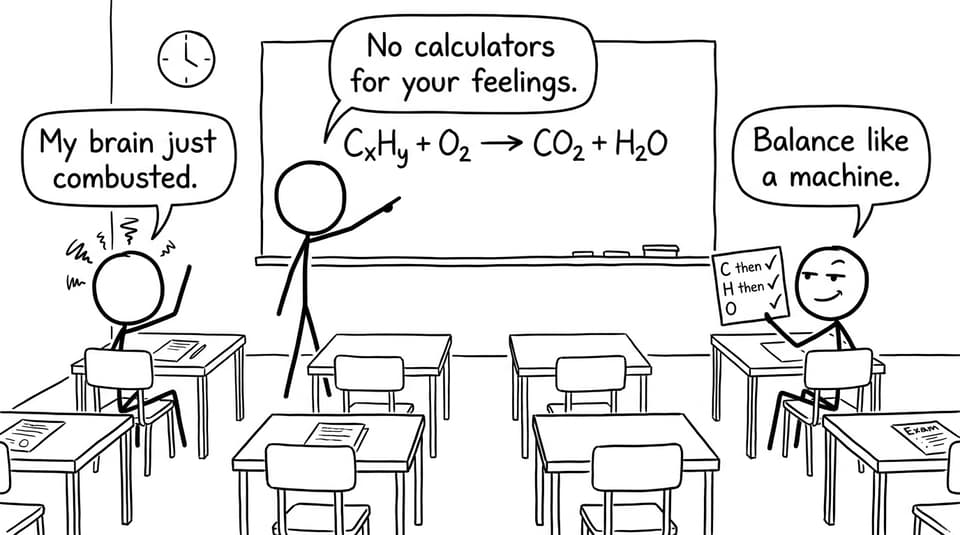
In real burners and engines, oxygen can become the limiting reactant. When that happens, combustion becomes incomplete, and IB Chemistry expects you to know the likely alternatives:
-
CO (carbon monoxide) forms when carbon is partially oxidized
-
C(s) (soot) can form when oxidation is even less complete
This is also why flame color is such a popular data point:
-
Blue flame suggests more complete combustion
-
Yellow, smoky flame suggests incomplete combustion (glowing soot particles)
To revise this comparison properly, use Incomplete combustion (R1.3.2) and the matching R1.3.2 notes.
The fast method to balance any complete combustion equation
For a hydrocarbon CₓHᵧ:
-
Balance carbon: write x CO₂
-
Balance hydrogen: write y/2 H₂O
-
Balance oxygen: count O atoms on the right, then divide by 2 for O₂
This is a high-frequency IB Chemistry skill, and RevisionDojo’s Flashcards for stoichiometry (R2.1.1) make the steps stick when you are tired.
Energy and IB Chemistry: why combustion is so exothermic
Complete combustion releases lots of energy because the products contain very stable bonds (especially C=O in CO₂ and O-H in H₂O). In IB Chemistry, this idea connects to:
-
Enthalpy change (ΔH) explanations
-
Standard enthalpy of combustion (ΔHc°) definitions and data
If you are revising energetics, read Enthalpy of combustion explained and keep the IB Chemistry data booklet close for values and standard-state conventions.
Environmental significance (a frequent IB Chemistry angle)
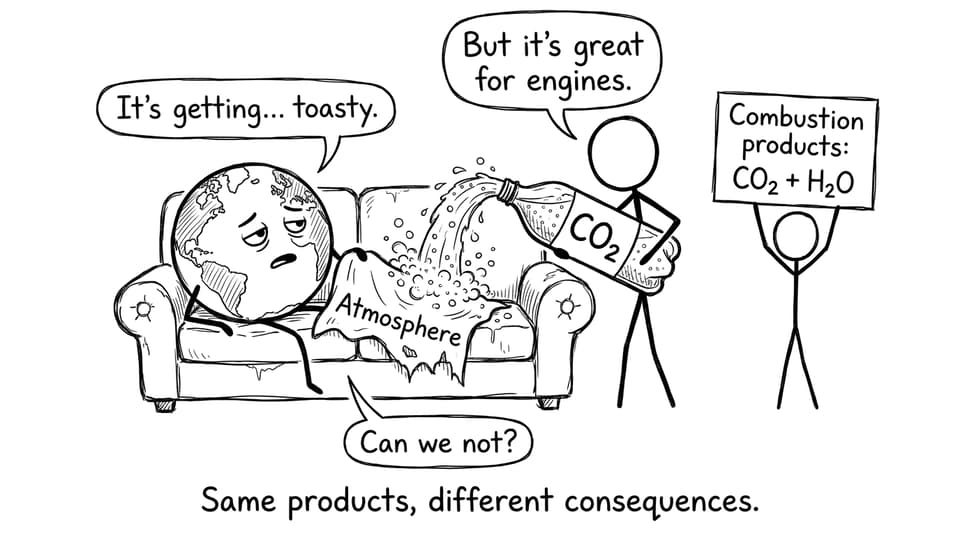
The same neat products that make combustion easy to predict also make it easy to connect chemistry to climate:
-
CO₂ is a major greenhouse gas
-
H₂O vapor is also a greenhouse gas (and drives feedback effects)
When a question pivots from equation-writing to evaluation, you are often being invited to discuss greenhouse gases. A clear overview is in Greenhouse effect explained.
Final takeaway for IB Chemistry students
The main products of complete combustion of hydrocarbons are always carbon dioxide (CO₂) and water (H₂O), provided oxygen is in excess. Once you lock that into memory, you can spend your exam time on the higher-value skills: balancing quickly, explaining energetics, and spotting when a question is actually about incomplete combustion.
When you are ready to practise this the IB Chemistry way, use RevisionDojo’s Questionbank for exam-style repetition, Study Notes and Flashcards for recall, and AI Chat when an explanation still feels fuzzy. Add Mock Exams and Predicted Papers closer to test day, then use the Grading tools to tighten your wording. That is how “CO₂ + H₂O” becomes not just a fact you know, but a mark you never lose.