
If you’ve ever looked at a CO₂ graph and felt your brain quietly exit the room, you’re not alone. The carbon cycle sounds like “one more diagram to memorize,” but in IB Biology it’s really a story about balance: how a single carbon atom can move from air, to leaf, to lion, to ocean, and back again. Once you see it as movement between stores (where carbon sits) and fluxes (how it moves), the topic becomes much easier to explain in data questions and longer responses.
Carbon cycle quick checklist (IB Biology)
Before you revise, make sure you can do these without guessing:
-
Define the carbon cycle as movement between atmosphere, biosphere, hydrosphere, and geosphere
-
Name the core processes: photosynthesis, respiration, decomposition, combustion, ocean exchange
-
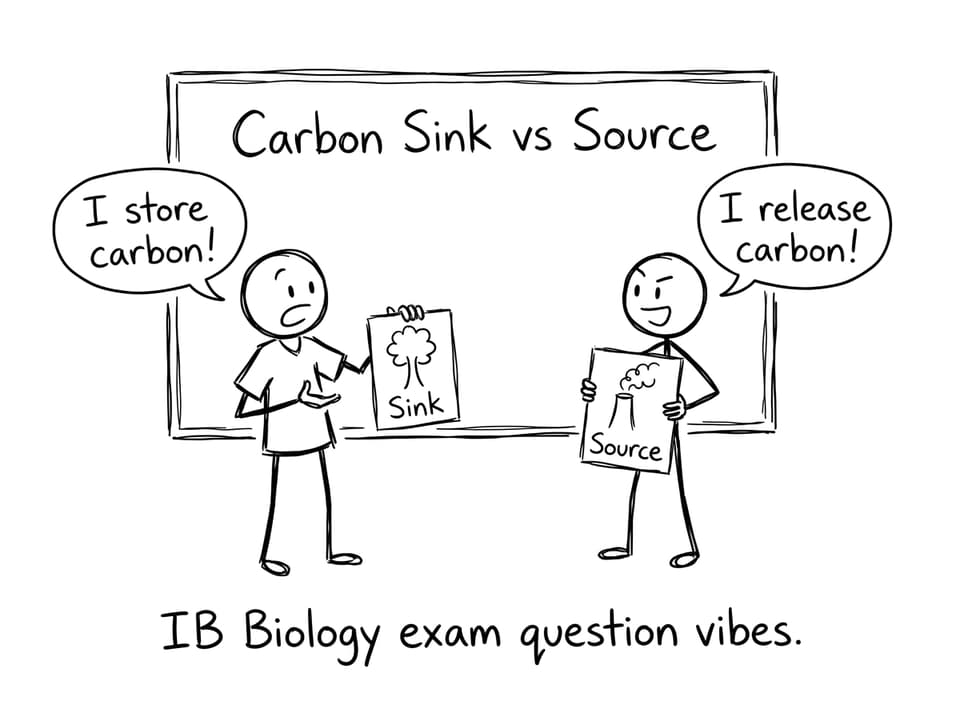
Distinguish a carbon sink from a carbon source
-
Link human activity to rising atmospheric CO₂ and climate feedbacks
-
Practise an IB-style diagram and one data-based question
For the syllabus-aligned pathway, start with IB Biology Topic Ecology and zoom into carbon cycling from there.
What is the carbon cycle?
The carbon cycle is the continuous recycling of carbon atoms through Earth’s systems. In IB Biology, you describe carbon moving through four major compartments:
-
Atmosphere (mostly CO₂)
-
Biosphere (carbon in living things and organic molecules)
-
Hydrosphere (dissolved CO₂ and carbonates in water)
-
Geosphere (carbon in rocks, sediments, and fossil fuels)
A helpful exam framing is: carbon is conserved, but its form and location keep changing. When examiners ask about “carbon flux,” they’re asking about the transfers between these stores.
If you want a tight, exam-ready explanation with definitions like residence time and equilibrium, use IB Biology 4.3 Carbon Cycling Notes.
Key processes you must explain in IB Biology
Photosynthesis: pulling carbon into the biosphere
Producers (plants, algae, cyanobacteria) take in CO₂ and convert it into organic compounds like glucose. In IB Biology, this is the main pathway that moves carbon from the atmosphere/hydrosphere into living biomass.
Respiration: sending carbon back out
All organisms respire. Cellular respiration releases CO₂ as organic molecules are broken down for ATP. One common exam trap is forgetting that plants also respire, so they both absorb and release CO₂.
Decomposition: the quiet return
When organisms die or produce waste, decomposers (bacteria and fungi) break down that organic matter. Their respiration returns CO₂ to the atmosphere, and some carbon also becomes part of soils.
Combustion: fast-tracking stored carbon
Burning biomass or fossil fuels releases CO₂ quickly. In IB Biology, combustion matters because it shifts carbon from long-term stores (especially fossil fuels) into the atmosphere on human timescales.
Ocean uptake and release: the carbon sink with attitude
Oceans absorb CO₂, making them a major carbon sink. CO₂ dissolves, and some carbon becomes carbonates used by marine organisms. But increased CO₂ can also drive ocean acidification, which often appears in linked data questions.
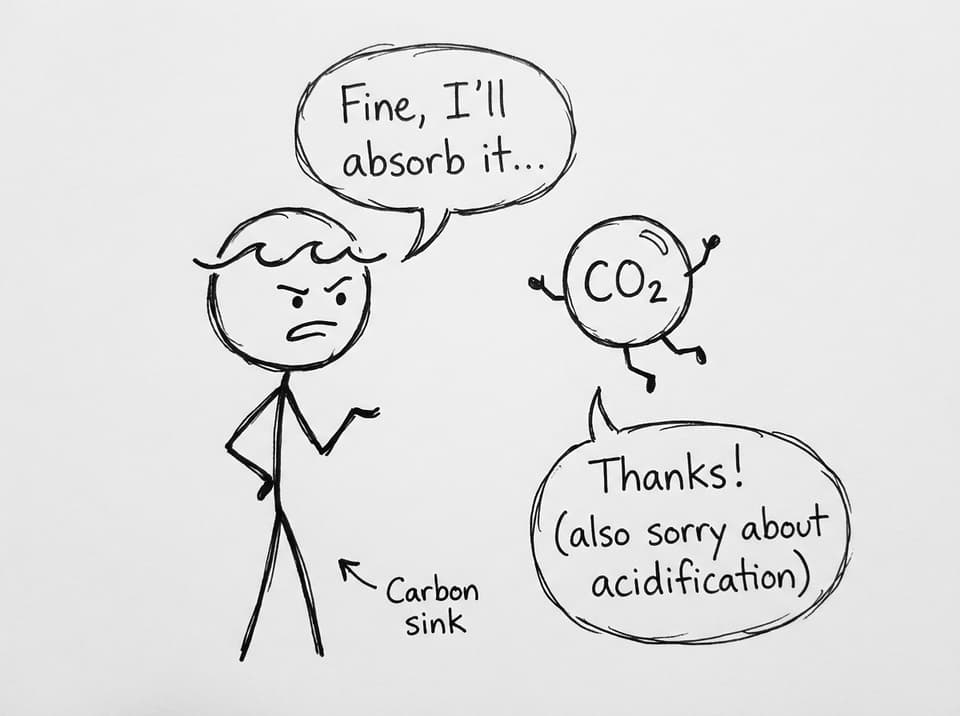
For carbon sink/source wording that scores, see Ecosystems as carbon sinks and carbon sources.
Carbon cycle, climate change, and the exam link
The natural carbon cycle tends toward balance: uptake roughly matches release. Human activity disrupts that balance by increasing combustion and reducing photosynthetic uptake through deforestation. The result is higher atmospheric CO₂, a stronger greenhouse effect, and knock-on effects across ecosystems.
In IB Biology, this is where marks hide: not just naming processes, but explaining direction of change. If CO₂ rises, what happens to ocean uptake? What happens to producers? What happens to long-term stores? Those “so what?” chains are what examiners reward.
To practise in the exact exam style, use IB Biology 4.3 Carbon Cycling Questionbank and the broader IB Biology Topic Ecology Questionbank (SL/HL).
A fast way to revise carbon cycle diagrams
When you draw the carbon cycle for IB Biology, label:
-
Stores (atmosphere, biomass, ocean, sediments/fossil fuels)
-
Arrows with verbs (photosynthesis, respiration, decomposition, combustion, diffusion)
-
One human-impact arrow that is thicker (combustion) or one store that shrinks (forests)
Then test yourself with Constructing carbon cycle diagrams.
Bringing it home to RevisionDojo
The carbon cycle is only “hard” when it’s treated like a poster you must memorize. In IB Biology, it’s really a set of predictable transfers you can explain like a story: capture, release, store, and disrupt.
If you want that story to stick under exam pressure, RevisionDojo brings the whole toolkit together: Study Notes for clarity, Flashcards for recall, a syllabus-aligned Questionbank for repetition, AI Chat to fix misconceptions fast, and Grading tools to sharpen your written explanations. Add Mock Exams and Predicted Papers for timing practice, and you’ve got a complete carbon-cycle-to-exam pipeline in one place. Start with IB Biology Resources and make the carbon cycle one of your easiest marks, not your loudest panic.