



Terminal velocity has a funny way of showing up right when you are tired: a long mechanics question, a messy graph, a paragraph about “a body falling through a fluid,” and suddenly every arrow in your free-body diagram looks suspicious.
In IB Physics, terminal velocity is one of those ideas that feels small, until you realise it is really a story about how nature dislikes unbalanced forces. Gravity starts the drama. Drag escalates. And eventually everything settles into a calm, constant speed.
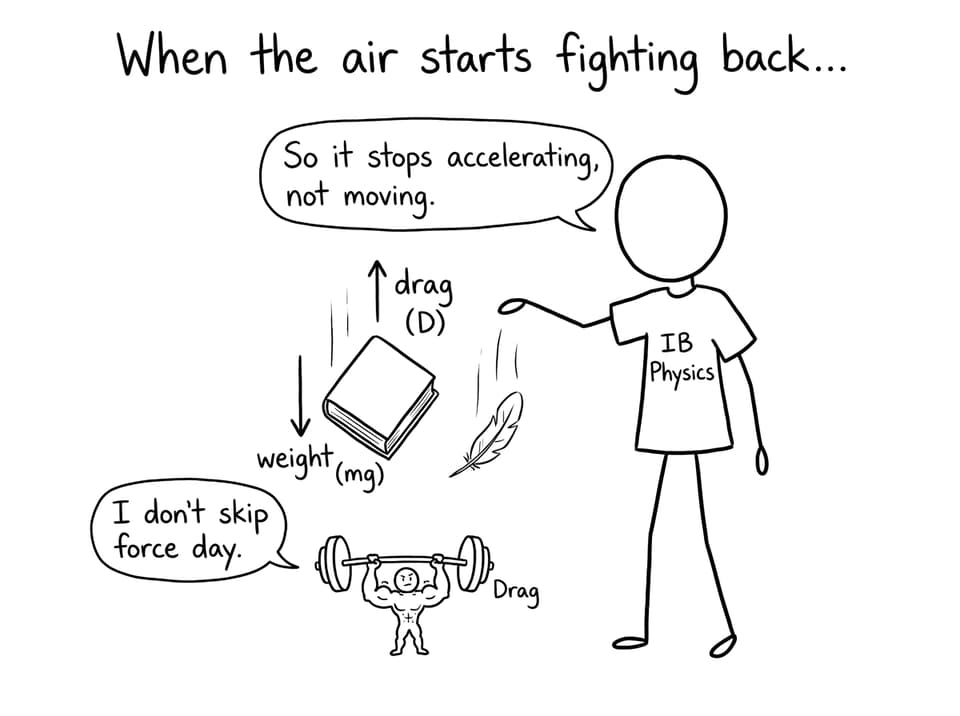
Terminal velocity in IB Physics (the definition you actually use)
In IB Physics, terminal velocity is the constant speed an object reaches while moving through a fluid (air, water, oil) when:
-
Weight (downward force) equals drag (upward resistive force)
-
Net force becomes zero
-
Acceleration becomes zero
The object does not stop. It just stops speeding up.
If you want the official phrasing you can quote cleanly in explanations, keep the IB Physics Key Definitions bookmarked.
A quick checklist for exam questions
Use this mini-checklist whenever terminal velocity appears in an IB Physics problem:
-
Draw a free-body diagram with weight (mg) down and drag (D) up
-
Decide whether the object is before terminal velocity (mg > D) or at terminal velocity (mg = D)
-
Use Newton’s Second Law: (\sum F = ma)
-
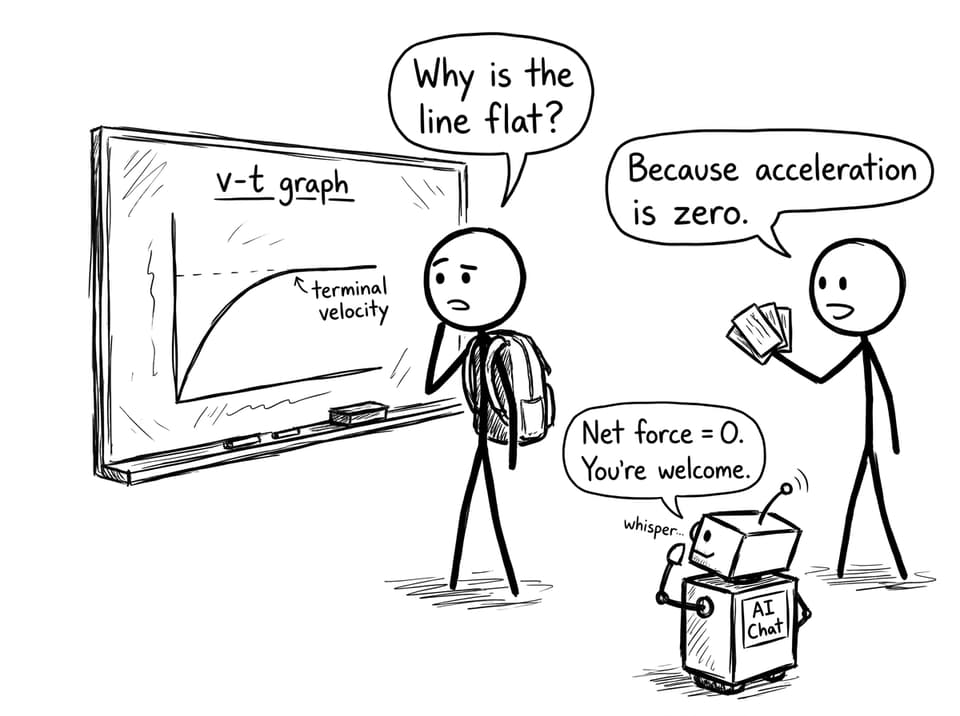
Translate force balance into graph features (flat v-t line, zero a)
For force language and diagram habits that examiners reward, revise with Forces and motion notes and Newton’s laws notes.
How terminal velocity happens (the story of competing forces)
At the start of a fall, gravity wins easily. Weight is basically constant near Earth’s surface: (mg).
But drag is different. Drag depends on speed, and it grows as the object moves faster. So the timeline looks like this:
Right after release
-
Speed is small
-
Drag is small
-
Net force is downward
-
Acceleration is close to (g)
As speed increases
-
Drag increases (often roughly proportional to (v) at low speeds, and closer to (v^2) at higher speeds)
-
Net force shrinks
-
Acceleration decreases
At terminal velocity
-
Drag equals weight: (D = mg)
-
Net force is zero
-
Acceleration is zero
-
Velocity is constant at (v_t)
That “drag depends on speed” detail is where many IB Physics explanations earn or lose marks. If you want a crisp qualitative + mathematical overview, use Fluid resistance (drag force) notes.
What affects terminal velocity?
Terminal velocity is not a single magic number. In IB Physics, you are expected to explain how changing conditions changes (v_t). Key factors include:
-
Mass: more weight can mean a higher terminal velocity (but only if shape/area stay comparable)
-
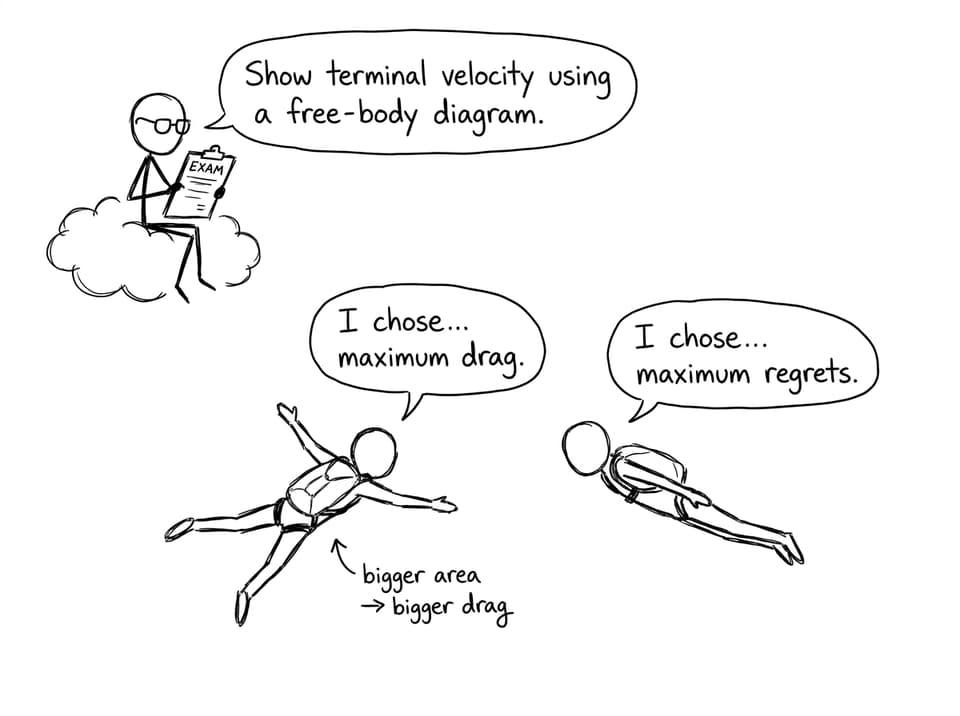
Cross-sectional area: larger area usually increases drag, lowering terminal velocity
-
Shape and orientation: streamlined shapes reduce drag; spread-out shapes increase it
-
Fluid density and viscosity: falling in water is not falling in air
-
Surface texture: roughness can change flow behaviour and drag
That is why a skydiver can “choose” a lower terminal velocity by spreading out, and a higher one by going head-first.
Terminal velocity on graphs (what the examiner is really asking)
Graph questions in IB Physics often test whether you can translate force balance into motion.
Velocity-time graph
-
Starts increasing (positive slope)
-
Slope decreases as drag grows
-
Levels off to a horizontal line at terminal velocity
Acceleration-time graph
-
Starts near (g)
-
Drops toward zero
-
Becomes zero at terminal velocity
Force sketch over time
-
Weight stays constant
-
Drag rises until it matches weight
If your graph skills feel shaky, pair your reading with targeted practice from the IB Physics Topic Mechanics Questionbank or the broader IB Physics resources hub.
A practical IA-style angle (without overcomplicating it)
Terminal velocity is also a friendly idea for investigations because it produces repeatable patterns and clear graphs.
A classic approach is dropping objects (like coffee filters) and using video analysis to estimate when the velocity becomes constant. A more advanced version uses motion sensors or light gates and then fits curves to your data.
If you want to see how strong coursework is written in this area, browse the IB Physics coursework exemplars or a specific sample like The relationship between mass and terminal velocity in water.
Common misconceptions (easy marks if you avoid them)
Students lose marks in IB Physics when they:
-
Say terminal velocity means the object stops (it does not)
-
Forget that acceleration is zero at terminal velocity
-
Assume heavier objects always have higher terminal velocity (shape and area matter)
-
Draw drag in the wrong direction (drag opposes motion)
-
Write “net force is zero” but still calculate a non-zero acceleration
Cleaning these up is not just accuracy; it is confidence.
Bringing it back to RevisionDojo
Terminal velocity is one of those IB Physics topics that becomes easy once your brain starts thinking in forces first, graphs second, formulas last. RevisionDojo is built for that sequence: start with clear IB Physics revision notes, test yourself with the Questionbank, reinforce definitions with Flashcards, and use AI Chat to diagnose why a free-body diagram is not balancing.
When you are ready to push exam performance further, combine Mock Exams, Grading tools, and Predicted Papers with short, focused mechanics sessions. Terminal velocity will stop feeling like a trap and start feeling like a signal: “net force is going to zero, and I know exactly what happens next.”


