

The first time most students feel “betrayed” by an IA, it’s not because they didn’t work hard. It’s because they worked hard in the wrong direction.
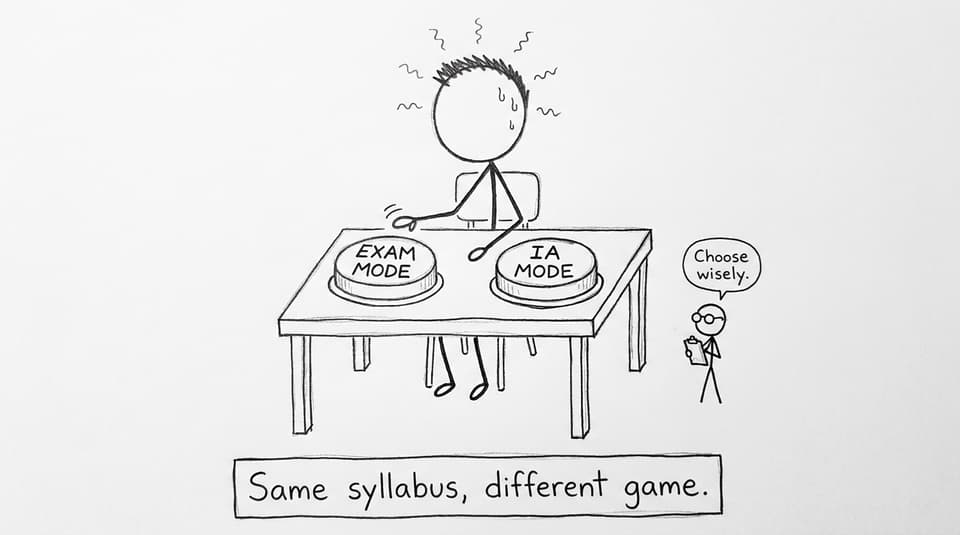
In an exam, effort converts neatly into marks: learn content, practise questions, repeat. In an IA, effort can disappear if it isn’t attached to the things the rubric quietly rewards. That’s why two students can know the same syllabus and still land in very different bands.
Below is what an IA actually tests, the skills that sit just outside the exam spotlight, and how to practise them while you’re still preparing for finals.
A quick checklist: what your IA is really measuring
If you remember nothing else, remember this. A strong IA shows that you can:
-
Make good academic choices (focus, scope, methods, evidence)
-
Build structure without being hand-held
-
Turn information into analysis (meaning, implications, significance)
-
Evaluate limitations and justify decisions
-
Communicate clearly so an examiner can follow your thinking fast
For subject-specific criteria and exemplars, start at IB IA Guides and browse IB Coursework Guides.
Exams test recall; your IA tests judgment
Exams are designed to be comparable. Everyone gets the same question, the same time pressure, the same boundaries. Your job is to execute.
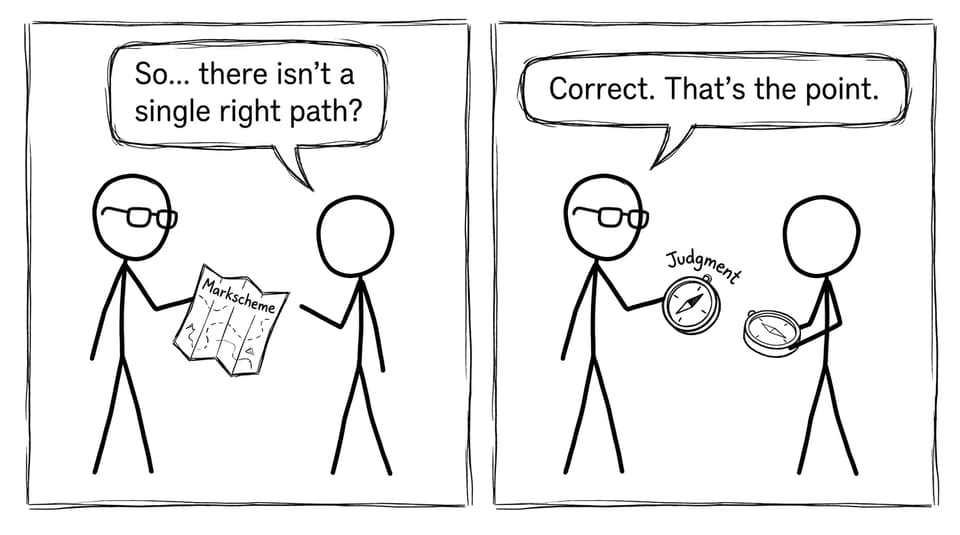
An IA is the opposite: it asks whether you can choose what matters. That means selecting a question that’s narrow enough to finish, deciding what to include (and what to cut), and committing to depth over breadth.
If you want a practical way to tighten that decision-making early, use the checklist in Refine Your IA Research Question for Clarity and Focus or the step-by-step breakdown in How to Write a Strong IA Research Question.
Your IA tests independent thinking and self-made structure
In exams, structure is built into the paper. In an IA, you create the roadmap.
That’s why messy organisation costs more in coursework than it does in timed answers. Examiners aren’t just looking for correct ideas; they’re looking for whether you can guide a reader through a longer argument without losing them.
A helpful calibration trick is to read high-scoring samples and notice how often they are simple, not fancy. You can do that in the Coursework Exemplars library, then compare your draft against the relevant rubric inside RevisionDojo’s IB Coursework Grader.
Your IA rewards analysis over “knowing a lot”
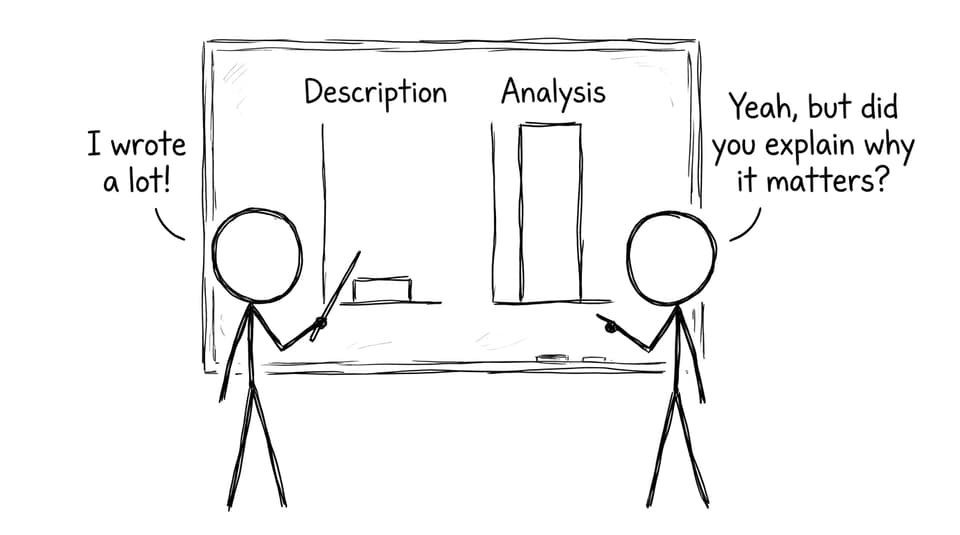
A high-mark IA usually contains less “background” than students expect. Not because context is bad, but because context is cheap. Analysis is expensive.
Analysis is when you explain what the evidence shows, why it matters, and how it changes the answer to your question. Description lists. Analysis argues.
If you’ve been told to “analyse more” but it still feels vague, read What Real Analysis Looks Like in an IB IA and then try a simple rule: after every key result, add two sentences that start with “This suggests…” and “This matters because…”.
Your IA tests evaluation: the courage to name limits
Exams sometimes ask you to evaluate in a few lines. An IA asks you to sustain evaluation without turning it into opinion.
Evaluation is not self-criticism. It’s reasoning: acknowledging uncertainty, weighing trade-offs, and explaining how limitations affect confidence in your conclusion.
This is also where students accidentally lose marks by sounding certain when they shouldn’t. A calm, precise evaluation section often outperforms a dramatic one.
If you’re planning your work late in the year, protect time for this. The stage-based approach in How to Plan an IB IA Without Falling Behind is built for students who are revising for exams at the same time.
How to train IA skills while you’re revising for exams
Here’s the good news: your IA and exam prep don’t have to compete. They can cross-train.
-
Use RevisionDojo Study Notes to patch the exact concepts your IA depends on (not the whole unit).
-
Use the Questionbank to practise the same thinking under time pressure, so your ideas get sharper.
-
Turn your IA’s key definitions, assumptions, and evaluation phrases into Flashcards.
-
When you’re stuck, ask AI Chat for alternative explanations or counterarguments, then decide which ones you can justify.
-
Run Mock Exams and Predicted Papers on a schedule so coursework doesn’t quietly steal your exam stamina.
For a broader revision structure that keeps everything steady, use How to Study for IB Exams: Step-by-Step Guide and keep IB Exam Day Checklist saved for the final week.
Closing: treat the IA like a different sport
Your IA isn’t a longer exam answer. It’s a different sport with a different scoreboard. It rewards judgment, structure, analysis, and evaluation; the skills that prove you can think without the paper telling you where to go.
If you want the fastest path to a higher-scoring IA without sacrificing exam prep, use RevisionDojo as your connected system: IA Guides for direction, Coursework Exemplars for calibration, the Coursework Grader for rubric feedback, then Study Notes, Flashcards, and the Questionbank to keep your understanding exam-ready. Start here: IB IA Guides.