


Choosing where a business should locate sounds like a practical problem until you see it on an exam paper. Suddenly, it becomes a question about trade-offs, stakeholders, and long-term strategy. In IB Business Management, location is not a background detail; it is a decision that quietly shapes everything from costs to customer experience.
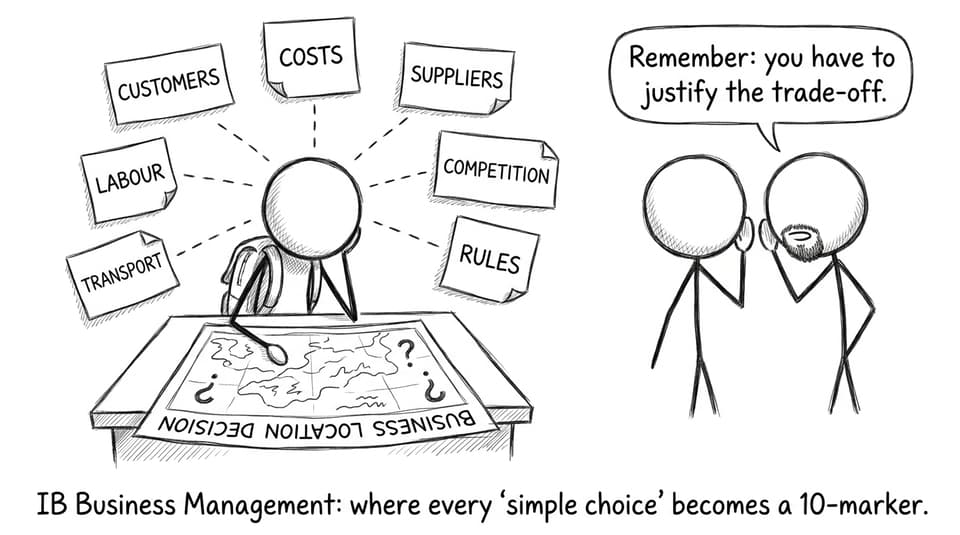
Why location decisions matter in IB Business Management
In IB Business Management, a strong answer explains why a location works for a specific business, not just what factors exist. Location affects operating expenses, revenue potential, labour supply, logistics, and risk. It also links neatly to Unit 5 operations, where you often need to connect a choice to efficiency, quality, and competitiveness.
If you want the syllabus-aligned version of this topic, start with IB Business Management Unit 5: Operations Management and then zoom into Notes for 5.4 Location.
Quick checklist: factors that influence where a business should locate
Use this list as a fast plan for short answers and longer responses in IB Business Management:
-
Proximity to customers
-
Costs (rent, taxes, utilities, insurance)
-
Labour availability and skills
-
Transport links and infrastructure
-
Raw materials and supplier access
-
Competition and clustering
-
Government policies and regulations
-
Room for future growth
Customer proximity: revenue often lives nearby
Businesses that depend on walk-in demand (cafes, clinics, retail) usually need to be where customers already are. Even online businesses have a “customer proximity” issue: delivery times, returns, and service expectations still depend on geography. In IB Business Management, you can add analysis by explaining how convenience increases sales volume, repeat purchases, and brand loyalty.
Cost: the rent is never just the rent
A central location can boost visibility and footfall, but it can also lock a business into high fixed costs. A cheaper site might protect cash flow, but reduce demand or increase transport costs. In IB Business Management, cost earns top marks when you discuss opportunity cost and show balanced judgment.

To practise writing that balance under time pressure, try exam-style prompts in the 5.4 Location Questionbank.
Labour availability: skills, wage levels, and reliability
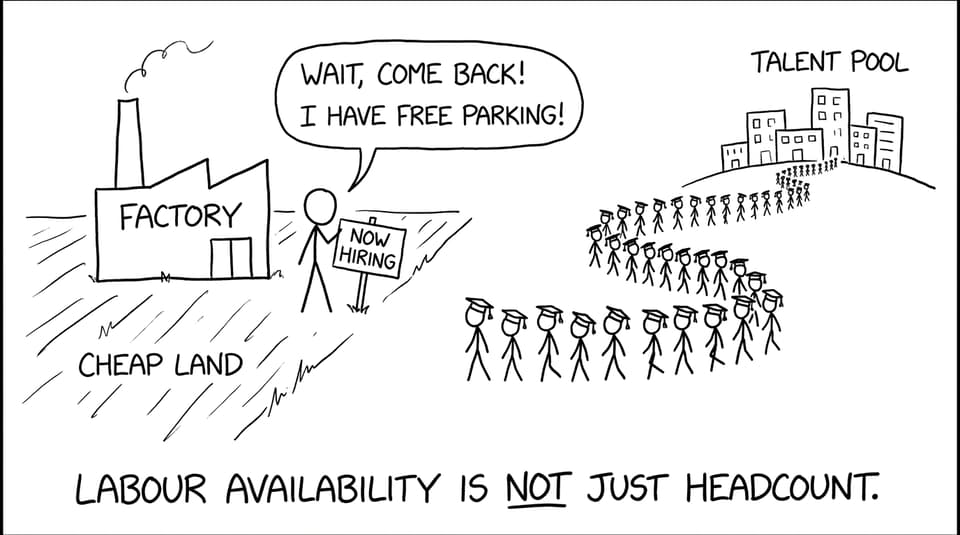
A business can only operate as well as its people allow. A tech firm may choose a city with universities and experienced workers, while a hotel may prioritise a large pool of service staff. In IB Business Management, you can deepen your answer by mentioning training costs, staff turnover, productivity, and how labour shortages restrict growth.
For wider operations context, see 5.1 Introduction to operations management and the big-picture hub IB Business Management Resources.
Infrastructure, transport, and suppliers: the hidden engine of efficiency
Good roads, ports, airports, broadband, and reliable utilities reduce delays and protect quality. Manufacturers and warehouses often locate to minimise logistics costs and improve delivery speed. Being near suppliers is especially important for bulky, fragile, or perishable inputs. In IB Business Management, link this to efficiency, customer satisfaction, and risk reduction (fewer disruptions).
Competition, government, and future growth: the long game
Locating near competitors can help when customers like to compare options (think car dealerships), but it can also intensify price competition. Regulations and incentives matter too: tax breaks may attract investment, while zoning and environmental rules may raise compliance costs. Finally, firms consider growth spaceexpansion is easier when there is room for additional capacity, storage, or new outlets.
If you want a clean syllabus framing, read IB Business Management Revision Notes (SL/HL) and the focused detail in 5.4.1 Reasons for a Specific Location of Production Notes.
Final takeaway for IB Business Management students
Location decisions look like geography, but they are really about strategy. In IB Business Management, the best answers connect location factors to objectives, explain trade-offs, and finish with a justified recommendation. When you revise this topic, use RevisionDojo’s Study Notes to lock in definitions, Flashcards to memorise key terms, and the Questionbank to practise real exam-style application. If you want to simulate exam conditions, build your own Mock Exams, check performance with Grading tools, and use AI Chat to tighten your evaluation. The more you practise, the more “where should the business locate?” turns into a question you can control.


