
The quiet difference between where a species could live and where it does live
In IB Biology, few ideas feel as instantly intuitive as “a species lives where it can survive.” Then you meet a real ecosystem and everything gets messier. A plant that should grow across an entire hillside only appears in one corner. A crab that tolerates a wide salinity range hugs a narrow strip of coast. It’s not that nature is inconsistent. It’s that potential and reality are two different maps.
That gap is exactly what fundamental niche vs realized niche is about, and it’s a high-return concept for exams because it links definitions to interactions: competition, predation, mutualism, and limiting factors.
IB Biology quick checklist (what examiners want)
-
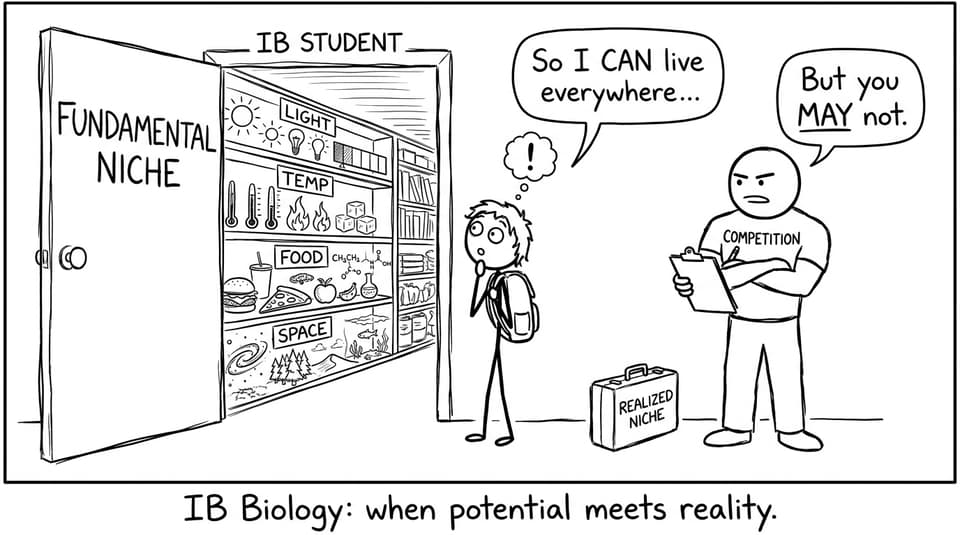
Define fundamental niche: the full range of conditions/resources a species could use without biotic limits.
-
Define realized niche: the range it actually occupies in nature.
-
Name the key determinants: abiotic tolerance (sets outer limits) and biotic interactions (usually shrink the niche).
-
Use at least one interaction example: competition, predation/herbivory, mutualism.
-
Add one linking phrase: realized niche is “often smaller due to limiting factors.”
For the syllabus framing, start with B4.2 Ecological niches and the definition work in B4.2.1 Ecological niche as the role of a species in an ecosystem.
What determines the fundamental niche in IB Biology?
Think of the fundamental niche as the “engineering specs” of a species. In IB Biology terms, it’s shaped mainly by abiotic factors and the organism’s physiology and genetic traits.
Key determinants include:
-
Zones of tolerance for temperature, pH, salinity, and water availability
-
Resource requirements like light intensity (for plants) or prey size (for predators)
-
Reproductive conditions such as breeding sites or seasonal cues
These factors set the outer boundaries of where survival and reproduction are possible. If you want a clean way to anchor this to the wider unit, connect it back to ecosystems and limiting conditions in What Is an Ecosystem?.
What determines the realized niche in IB Biology?
The realized niche is where the story gets human (and exam-friendly): it’s what happens when a species tries to use its full potential in a world full of other organisms.
Competition and the realized niche
Interspecific competition is one of the strongest forces compressing a realized niche. When two species rely on the same limited resource, one may reduce the other’s access enough that it cannot persist in part of its fundamental niche. That’s the logic behind the competitive exclusion principle.
In exam answers, you score well by stating the mechanism: overlap in resource use leads to reduced survival or reproduction for one competitor, which narrows its distribution.
Use RevisionDojo’s focused explanation of interactions in C4.1.11 Herbivory, Predation, Interspecific Competition, Mutualism, then lock it in with exam-style practice from the B4.2 Ecological Niches Questionbank.

Predation, herbivory, and the realized niche
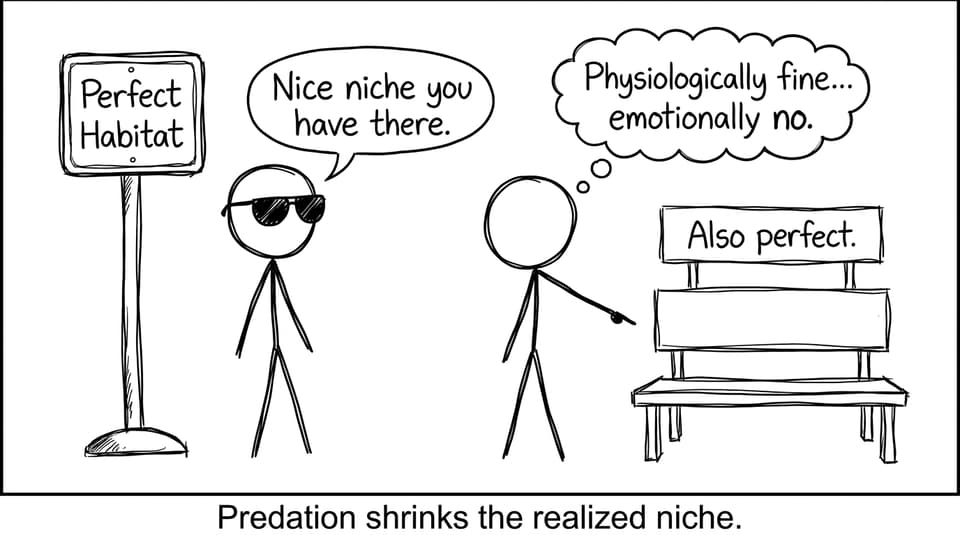
Sometimes a habitat is “perfect” on paper, but dangerous in real life. Predation and herbivory can restrict realized niches because organisms avoid areas where mortality risk is high, even if abiotic conditions are suitable.
For IB Biology, phrase it like this: predation pressure acts as a biotic limiting factor that reduces population growth in parts of the fundamental niche, shrinking the realized niche.
Mutualism can also limit the realized niche
Not all limits are “enemies.” A mutualistic relationship can act like a dependency. If a plant requires a specific pollinator, or a coral relies on symbiotic algae, then areas missing that partner may be unavailable in practice. Abiotic conditions might be fine, but the biology isn’t.
To see how IB-style questions treat these relationships, explore the broader topic hub C4.1 Populations and communities notes and then check your understanding with C4.1.11 Questionbank.
Exam practice: how to write it in 2-3 lines
A strong IB Biology mini-answer looks like this:
-
Fundamental niche: full abiotic range and resource use possible based on physiology.
-
Realized niche: smaller, because competition, predation/herbivory, and mutualism limit where the species can persist.
Then practise turning that into marks with this short-answer style prompt: Distinguish between a fundamental niche and realized niche.
Bring it home with RevisionDojo
If you’re revising IB Biology, niches are a perfect “definition-to-application” topic: short definitions, then big marks through examples. Use RevisionDojo’s IB Biology Ecology hub to move from Study Notes to Flashcards (including B4.2.12 Fundamental and realized niches Flashcards) and then into the Questionbank with worked solutions.
When you’re ready to simulate exam pressure, RevisionDojo’s Mock Exams, Grading tools, AI Chat, and Predicted Papers (see IB Biology Predicted Papers) help you practise writing the same crisp niche explanations you’ll need on test day. In IB Biology, that’s the real goal: turning a neat concept into reliable marks.