



A war rarely begins with a single gunshot. It begins with years of small choices that felt sensible at the time.
That is the quiet challenge of IB History when you study the causes of World War I: you are not memorising a list, you are explaining why a continent became a machine that could only move forward. For Paper 2, examiners reward students who can separate long-term pressures, short-term accelerants, and immediate triggers--then judge which mattered most.
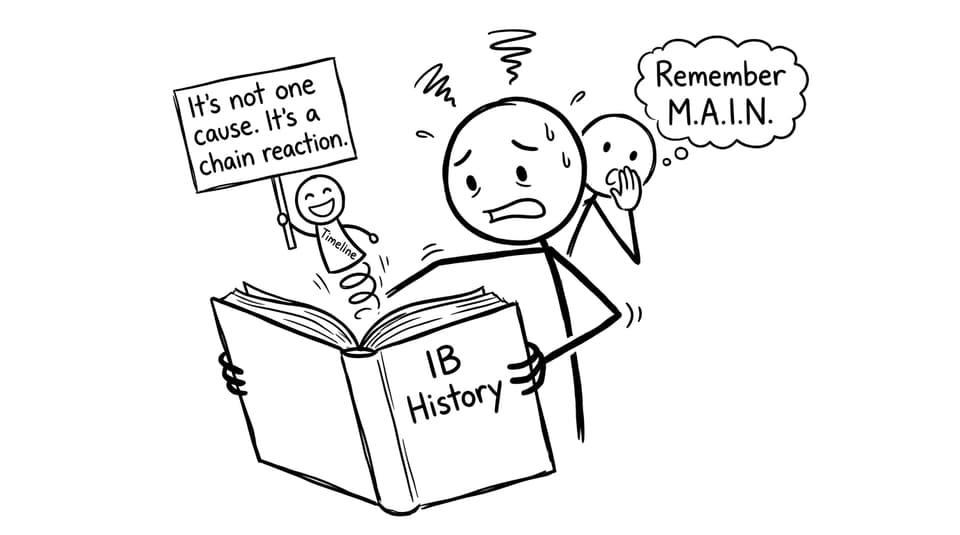
IB History quick checklist: how to answer “What caused WWI?”
Use this as your IB History planning frame before you write:
-
Identify long-term causes (often summarised as M.A.I.N.).
-
Add short-term crises that intensified fear and rivalry.
-
Explain the immediate trigger (Sarajevo) and the July Crisis escalation.
-
Evaluate relative importance: which cause made war likely, and which made it unavoidable?
If you want a clean set of syllabus-aligned notes to anchor that plan, start with Causes of the First World War Notes and keep them open while you practise.
The long-term causes: M.A.I.N. in IB History
Most IB History teachers use M.A.I.N. because it gives structure without oversimplifying: Militarism, Alliances, Imperialism, Nationalism. The key is to show how these factors interacted.
Militarism: when plans become pressure
European states expanded armies and glorified military strength. Industrial capacity made mobilisation faster, and generals gained influence in decision-making. The naval rivalry between Britain and Germany became symbolic: if status equals ships, then insecurity becomes policy.
In essays, link militarism to rigid war plans and the fear of falling behind. Even when leaders wanted time, timetables pushed them.
Alliances: security that created rigidity
Two major blocs dominated:
-
Triple Alliance (Germany, Austria-Hungary, Italy)
-
Triple Entente (Britain, France, Russia)
Alliances were meant to deter war, but they also created a system where a local conflict could pull in outsiders quickly. In IB History, this is where you show causation: alliances did not force war, but they shaped decision-making under stress.
To practise writing this under timed conditions, use the IB History Topic Paper 2 Questionbank on RevisionDojo and aim to produce one clear paragraph of “how alliances escalated risk.”
Imperialism: global competition, European resentment
Colonial rivalry increased suspicion and status anxiety, particularly as Germany sought greater influence. Flashpoints like the Moroccan Crises (1905, 1911) exposed mistrust and hardened attitudes.
A strong IB History essay treats imperialism as a pressure multiplier: it shaped diplomacy, deepened rivalries, and fed public nationalism, even if it did not directly trigger war in 1914.
Nationalism: pride, fear, and the Balkan problem
Nationalism operated in two ways:
-
Great-power nationalism (prestige, rivalry, belief in superiority)
-
Ethnic nationalism inside empires, especially in the Balkans
Austria-Hungary faced internal instability; Serbia promoted South Slavic nationalism; Russia saw itself as protector of Slavs. Nationalism made compromise feel like humiliation, which matters in IB History because it explains why leaders took risks they could not reverse.
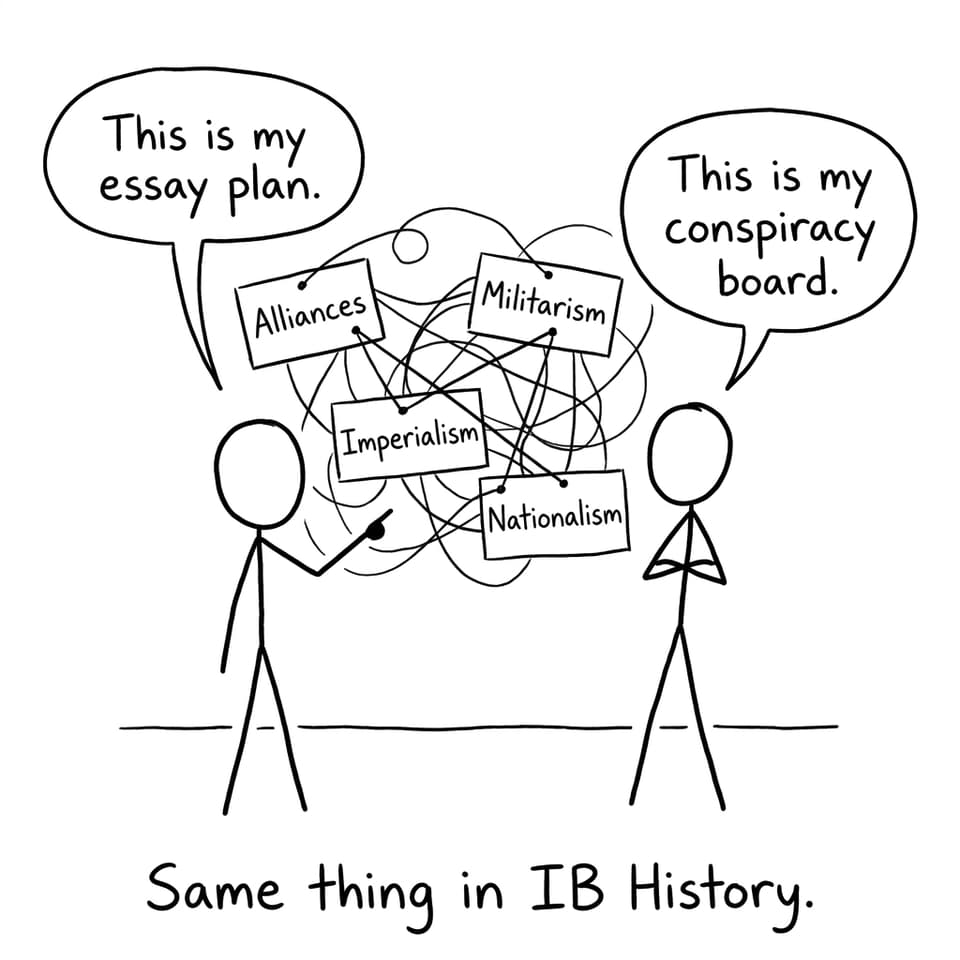
Short-term causes: why 1912–1914 mattered
Long-term causes explain vulnerability. Short-term causes explain timing.
The Balkan crises
The Balkans became known as a “powder keg” because empires, alliances, and nationalist groups overlapped in a small space. The Balkan Wars (1912–1913) weakened the Ottoman Empire and increased tensions between Austria-Hungary and Serbia.
In IB History, this is a great area for evaluation: Balkan instability made a regional crisis likely, but a world war still required great-power decisions.
The assassination in Sarajevo (28 June 1914)
Archduke Franz Ferdinand was assassinated in Sarajevo by Gavrilo Princip, linked to Serbian nationalist networks including the Black Hand. This was the spark, but sparks only matter when the air is dry.
For revision, pair this with broader WWI context using IB History Section 13: Europe and the First World War.
The July Crisis: the chain reaction IB History essays love
The July Crisis turned a regional confrontation into a general war through mobilisation, ultimatums, and miscalculation:
-
Austria-Hungary issued a harsh ultimatum to Serbia.
-
Russia mobilised to support Serbia.
-
Germany declared war on Russia (1 August) and France (3 August).
-
Germany invaded Belgium; Britain entered the war (4 August).
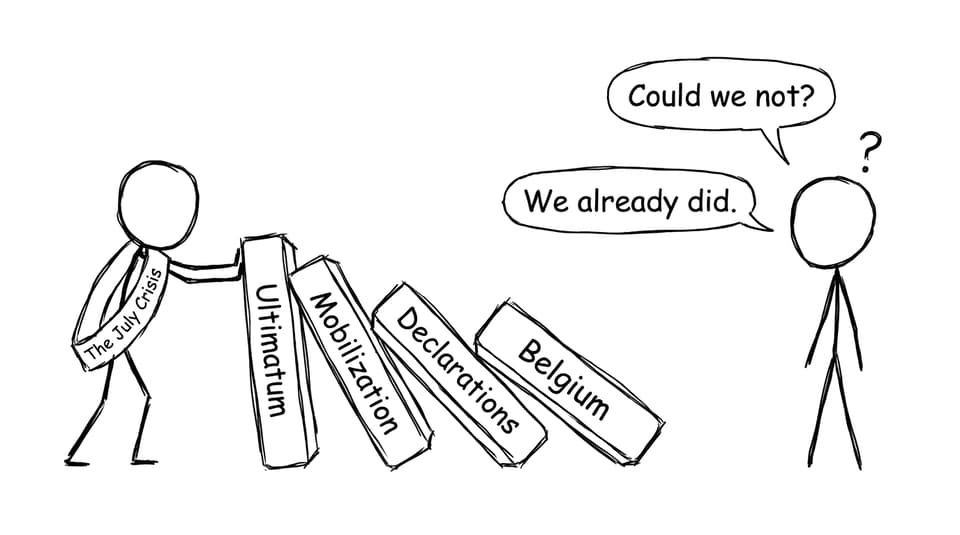
A high-scoring IB History explanation shows escalation logic: once mobilisation began, leaders feared delay more than war.
How to evaluate causes in IB History (and actually score marks)
Examiners want judgement, not just description. Try this:
-
Argue that M.A.I.N. created the conditions for war.
-
Then argue that the alliance system + July Crisis decisions made war spread.
-
Use historiography briefly: the Fischer Thesis emphasises Germany’s responsibility; other interpretations stress shared responsibility or structural pressures.
Then practise. On RevisionDojo, you can move from notes to active recall using IB History Cheatsheets, test yourself with Flashcards, and refine paragraphs with AI Chat and Grading tools.
Bringing it home: how to revise IB History for WWI causes
If World War I feels like an unstoppable domino run, your revision should do the opposite: slow it down, label each step, and practise explaining the links. Start with IB History Resources, drill weak areas in the Questionbank, and use RevisionDojo’s Study Notes, Flashcards, AI Chat, and Grading tools to turn “I kind of get it” into exam-ready paragraphs.
Because in IB History, the goal is not knowing what happened. It is proving you understand why it happened--and why it happened then.