
Varnashramadharma is a Hindu framework connecting a person's duties with social function and stage of life. The Sanskrit compound combines varṇa, social classification, āśrama, stage of life, and dharma, conduct sustaining moral, social and cosmic order.
This definition needs care. Varnashramadharma appears as an ideal in particular Brahmanical texts, not a system practised identically by all Hindus. Its interpretations raise difficult questions about caste, birth, gender and inequality.
For IB World Religions SL, define the framework, ground it in primary texts, distinguish varṇa from jāti, and compare interpretations. RevisionDojo's study notes on dharma, varna and Hindu society provide a foundation.
Varnashramadharma at a glance
| Concept | Sanskrit term | Basic meaning | Key qualification |
|---|---|---|---|
| Dharma | Dharma (धर्म) | Duty, right conduct and sustaining order | Its meaning changes with context |
| Varna | Varṇa (वर्ण) | Fourfold model of social functions | It is not identical to the many local jātis |
| Ashrama | Āśrama (आश्रम) | An ideal stage of life | Historically framed especially around upper-varna male life |
| Personal duty | Svadharma (स्वधर्म) | One's own appropriate duty | Interpreted through role, character, circumstance or devotion |
| Universal duty | Sādhāraṇa dharma (साधारण धर्म) | Ethical obligations shared more widely | Often includes virtues such as truthfulness and non-violence |
A revision checklist:
- Define dharma as more than occupation.
- Name the four varṇas and four āśramas.
- Distinguish textual models from lived reality.
- Use a primary-text reference.
- Compare hereditary, qualities-based and devotional interpretations.
- Connect duty to liberation and ethics.
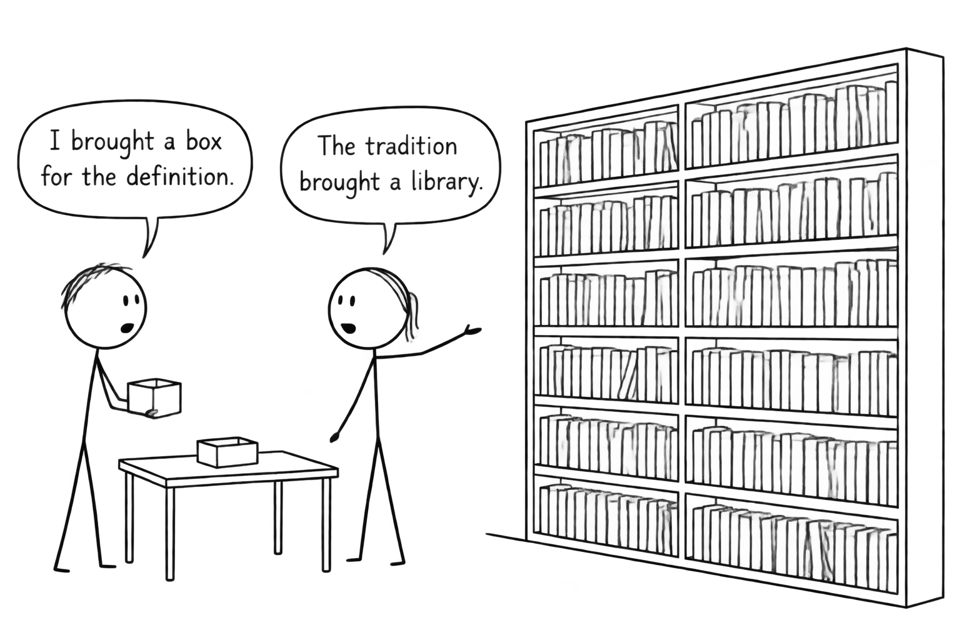
Two students discover that one definition cannot contain an entire religious tradition.
Dharma: the idea holding the framework together
Dharma comes from the Sanskrit root dhṛ, meaning to hold, support or sustain. It can refer to religious teaching, moral responsibility, law, social duty or cosmic order. Translating it only as “duty” misses its broader spiritual dimensions.
Sanātana dharma means eternal or enduring dharma and is a name many Hindus use for their religious tradition. Svadharma is a person's particular duty. Varṇāśrama dharma relates duty to social function and life stage, while sādhāraṇa dharma describes general virtues not restricted to one role.
A ruler and a renouncer may have different responsibilities, but neither is necessarily released from truthfulness, self-control or concern for others. RevisionDojo's notes on Sanatana Dharma and statements of belief place these meanings within wider Hindu thought.
Varna: a textual model of society
Varṇa literally means colour or category. Brahmanical literature describes four broad groups:
- Brāhmaṇa: priests, teachers and custodians of sacred learning
- Kṣatriya: rulers and warriors
- Vaiśya: agriculturalists, pastoralists and traders
- Śūdra: labourers and service providers
The Puruṣa Sūkta in Rig Veda 10.90 presents these groups through the sacrificed cosmic person, Puruṣa. The Brahmin is associated with the mouth, the ruler with the arms, the Vaishya with the thighs and the Shudra with the feet. One interpretation emphasizes interdependence within one body. Another observes that the image can support hierarchy when bodily locations are ranked socially.
In Bhagavad Gītā 4.13, Krishna connects the fourfold order with guṇa, qualities associated with material nature, and karma, action. Verses 18.41-44 assign characteristic qualities and work to the four varnas. Some interpreters understand this as classification by disposition and conduct. Others read these verses within societies where status was substantially inherited.
Varna is not the same as jati
Varna is the fourfold conceptual scheme found in Sanskrit texts. Jāti, meaning birth or birth-group, refers to the many localized and often endogamous communities shaping South Asian social life.
The English word “caste” has been used for both, concealing their differences. Yet separating them completely can hide how textual ideals and inherited social structures reinforced one another.
Caste discrimination has caused real harm, including to communities described today as Dalits. Students should neither defend that harm as an automatic expression of Hinduism nor imply that every Hindu understands dharma through caste. The tradition contains hierarchy, resistance and reform. RevisionDojo's Hinduism in context notes help prevent sweeping claims.
Ashrama: four ideal stages of life
The āśrama model organizes life into four stages:
- Brahmacarya: disciplined student life under a teacher
- Gṛhastha: householder life, involving family, work and social responsibility
- Vānaprastha: gradual withdrawal, literally associated with becoming a forest dweller
- Saṃnyāsa: renunciation of possessions, status and ordinary social attachments
The model connects ordinary life with spiritual liberation. The householder supports family, society and religious activity. Later withdrawal creates space for detachment and mokṣa, liberation from saṃsāra, the cycle of death and rebirth.
These stages are not a biography followed literally by all Hindus. The classical scheme developed particularly around twice-born males in the first three varnas. Women's lives and other communities' experiences often involved different expectations. Some renunciants also left household life early. The scheme expresses changing priorities while reflecting a restricted historical ideal.
Competing Hindu interpretations
Role, qualities and action
One interpretation treats varnashramadharma as a division of responsibilities. Society needs learning, governance, production and service, while individuals move through education, participation and detachment. In this reading, function should follow guṇa and karma rather than inherited rank.
The Bhagavad Gītā is central here. Arjuna wants to withdraw from battle, but Krishna teaches that abandoning action does not automatically overcome its consequences. In 3.35, following one's own dharma imperfectly is preferable to performing another's well. Action should be performed without possessive attachment to its fruits, an approach known as karma yoga.
Hereditary and Dharmashastra readings
Dharmaśāstra texts, including the Manusmṛti, organize obligations around birth, gender, social status and life stage. They influenced historical legal and social ideals, although Hindu communities never applied them uniformly.
These sources make varnashramadharma explicitly hereditary and hierarchical. They raise an evaluative question: can an order be morally sustaining if opportunities and obligations are assigned unequally at birth? Strong analysis recognizes both these texts' historical authority and the ethical criticism directed at them.
Bhakti and Vedanta perspectives
Bhakti traditions centred on loving devotion often complicate hierarchy. In many Vaishnava traditions, surrender to Vishnu or Krishna is open across social backgrounds. Bhagavad Gītā 18.66 asks Arjuna to relinquish all dharmas and seek refuge in Krishna alone. Ordinary duties may remain meaningful, but devotion and divine grace become ultimate.
Advaita Vedānta places liberation in knowledge of the identity of ātman, the deepest self, with Brahman, ultimate reality. Social duty may prepare the mind through disciplined action, but social identity cannot be the self's final truth. Varnashramadharma can therefore be valid within conventional life while transcended through liberating knowledge.
These interpretations do not erase caste from history. They reveal competing understandings of the relationship between social duty and liberation.
Connections across the five themes
Rituals: Varna and life stage have historically affected eligibility for rites, study and domestic responsibilities. Householder life connects with family and sacrificial obligations.
Sacred texts: The Rig Veda, Bhagavad Gītā and Dharmaśāstra literature offer different settings for social order and duty. Their authority and interpretation vary.
Doctrines and beliefs: Dharma, karma, samsara, moksha, guṇa and the nature of the self explain why action has spiritual significance.
Religious experience: Student discipline, household worship, devotional surrender and renunciation represent distinct experiences. No pattern describes every Hindu practitioner.
Ethics and moral conduct: The framework raises questions about role-specific duties, universal virtues, social harmony and justice. RevisionDojo's notes on dharma, caste duty and yogic paths connect ethics to liberation, while flashcards on duty as Hindu ethics reinforce vocabulary.
How to write a strong IB response
Begin with a qualified definition. Explain what a primary text contributes rather than merely naming it. Compare two interpretations before evaluating whether the framework promotes interdependence, hierarchy, spiritual discipline or a combination.
Phrases such as “some Vaishnava interpreters,” “Brahmanical legal texts,” or “a qualities-based reading of the Gītā” demonstrate precision. Avoid reducing dharma to employment: it concerns the moral character and spiritual consequences of action.
RevisionDojo brings this process together through Study Notes, Flashcards and AI Chat for understanding; Questionbank and Predicted Papers for application; and Grading tools and Mock Exams for timed practice and feedback. The Coursework Library supports analytical structure, while Tutors help untangle apparently contradictory interpretations.
A framework that should remain a question
Varnashramadharma is a debate about living within society while seeking freedom beyond it. Its texts preserve ideals of responsibility and interdependence alongside histories of inherited hierarchy and exclusion.
Strong IB World Religions analysis holds both in view. Who defines duty? Does it follow birth or character? When does liberation challenge social identity? RevisionDojo helps students move beyond memorizing varnas and ashramas toward these careful distinctions, where genuine understanding begins.