


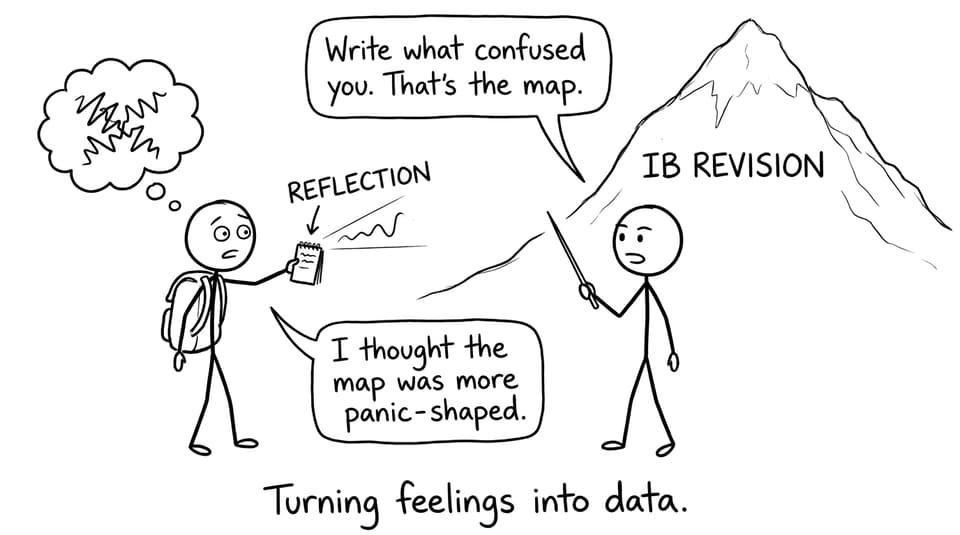
If you’ve ever finished an IB study session with that vague feeling of “I worked, but did I improve?”, you already understand why reflection matters. The secret is that your reflection isn’t just a personal diary entry. Done well, it becomes evidence: proof of what helped, what blocked you, and what the learning environment is actually like from the inside.
Schools chase improvement with spreadsheets and averages. But IB learning is also about the invisible stuff: confidence, clarity, agency, and the small moments where a concept finally clicks. Student reflection captures those moments. And when many students reflect in a structured way, patterns emerge that a school can actually act on.
Quick checklist: make IB reflection usable evidence
Use this simple routine to turn reflection into something your school can learn from:
-
Keep reflections short (3-6 sentences) but specific.
-
Anchor each reflection to one concrete piece of work (a quiz, timed set, lab write-up, essay plan).
-
Tag it to one IB skill area (ATL, command terms, feedback, time management).
-
Add one next step you will test within a week.
-
Repeat regularly so your reflections show trends, not moods.
Why IB student reflection is powerful evidence
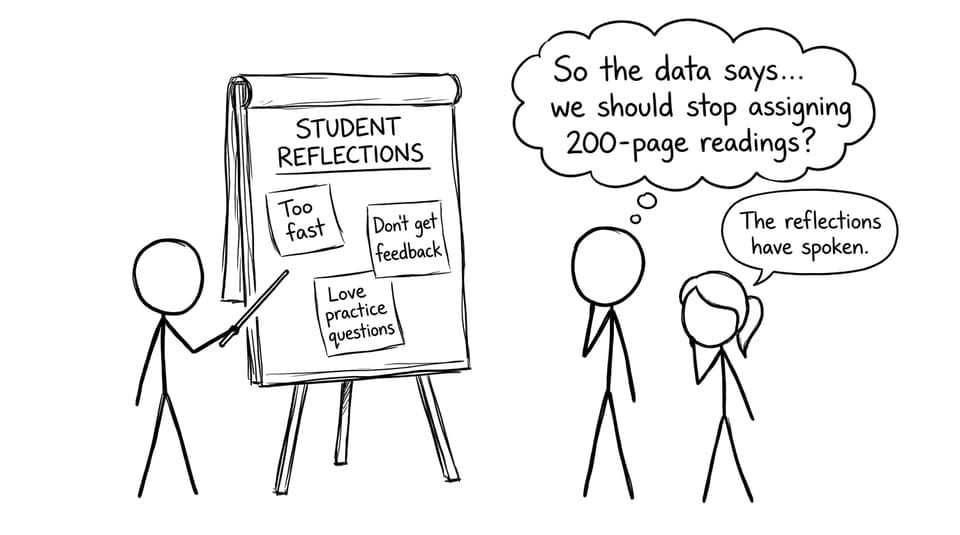
A single reflection can be emotional. A hundred reflections become a dataset.
In IB, reflection is uniquely valuable because it reveals things grades often hide:
-
Engagement signals: when students feel lost, rushed, or over-assessed.
-
Conceptual understanding: whether learning transfers beyond memorizing.
-
Skill gaps: patterns in command terms, structure, and exam technique.
-
Wellbeing pressure points: where workload or pacing becomes unrealistic.
This is what school improvement needs: not just “what happened,” but “why it happened.” If a cohort repeatedly reflects that they misunderstand “evaluate,” or that feedback arrives too late to use, that’s evidence of a system issue, not a student flaw.
For students, the payoff is immediate too: structured reflection makes your revision diagnostic, which is exactly the mindset behind effective IB exam prep.
How to turn IB reflection into something schools can measure
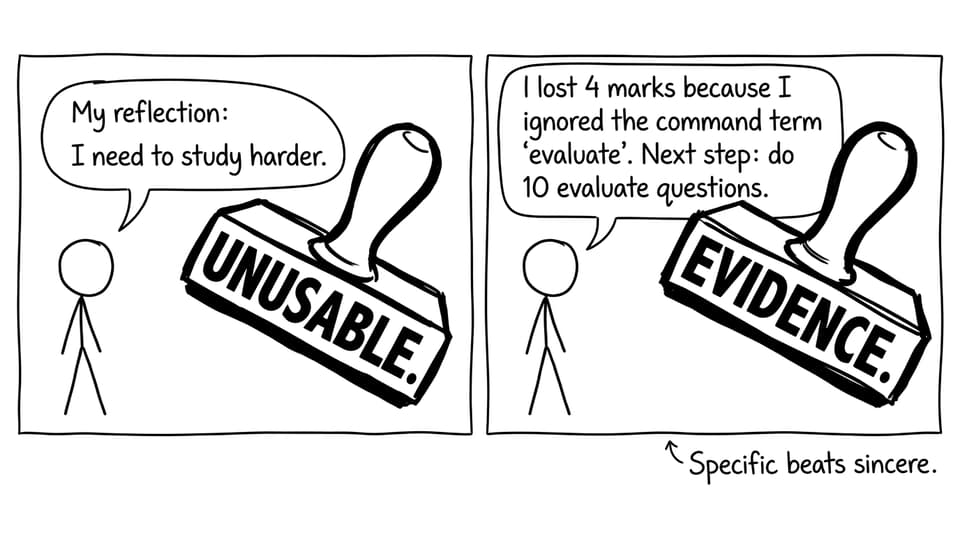
The easiest mistake is collecting reflections that sound nice but mean nothing. “I will study harder” is sincere, but it’s not actionable evidence.
A better approach is to make reflection visible and comparable across classes:
Use shared formats (without making it robotic)
A consistent template helps schools spot patterns. You can still sound like yourself, but you answer the same core questions.
A strong IB reflection template includes:
-
What task did I attempt?
-
What went wrong (exactly)?
-
What strategy will I try next?
-
What evidence will show it worked?
If your school uses a platform like RevisionDojo for Schools, reflections can be collected alongside performance evidence, making trends easier to discuss at departmental level.
Tag reflections to IB frameworks
Schools can “read” reflection data more effectively when it is tagged to shared language.
Two natural options:
-
ATL skills (self-management, thinking, communication, research, social)
-
IB Learner Profile traits (especially reflective, thinkers, communicators)
If you want to understand the learner profile link more clearly, see What Is a Reflective IB Learner Profile?.
Using reflection to improve your IB exam prep (and help your school)
Here’s the quiet win: when you reflect well, you don’t just become a better IB student. You generate better evidence for what teaching and revision support actually works.
A practical loop you can run with RevisionDojo looks like this:
-
Practice using the Questionbank
-
Check understanding with Study Notes
-
Lock in recall with IB Flashcards with Spaced Repetition (SRS)
-
Use AI Chat and Grading tools to turn “wrong” into “next step”
-
Build realism with Mock Exams and Predicted Papers
Then reflect on what the data actually says, not what your stress says.
If you want prompts that force useful specificity, Creating Actionable Reflection Prompts for IB Students is a strong starting point.
What coordinators and teachers can learn from IB reflections
Even if you’re a student, it helps to know what schools do with this evidence. The best schools treat student reflection like a feedback instrument, not a poster slogan.
Common school-improvement uses include:
-
Evaluating learning impact: Are students describing transfer, or just repetition?
-
Adjusting curriculum pacing: Do reflections repeatedly mention rushing or surface learning?
-
Prioritizing teacher development: Are the same misconceptions appearing across classes?
For a deeper look at the wider culture, see Creating a Culture of Reflection in IB Schools with RevisionDojo and How RevisionDojo Helps IB Schools Strengthen ATL Skill Progression Over Time.
Closing: IB reflection that actually changes something
In IB, reflection is easy to treat as a soft skill. But it’s closer to engineering: you run a test, observe the failure point, change one variable, then test again. When students reflect with that kind of precision, schools gain evidence that numbers can’t explain, and students gain a revision compass that points to marks.
If you want a system where practice, feedback, and reflection connect in one place, explore RevisionDojo for IB and see how Questionbank, Study Notes, Flashcards, AI Chat, Grading tools, Mock Exams, Predicted Papers, Coursework Library, and Tutors can turn reflection into results.