Thermal decomposition is one of those IB Chemistry ideas that feels simple until the exam asks you for products, conditions, and an energy explanation in two tight sentences.
You can almost picture it: you’re revising late, the kettle clicks, and you realise you’ve seen the same pattern everywhere: carbonates, nitrates, hydroxides, hydrocarbons. One compound goes in. Heat goes in. Several products come out. If you learn the story behind that pattern, thermal decomposition stops being memorisation and starts being prediction, the skill examiners actually reward.
Thermal decomposition in IB Chemistry: the definition that scores marks
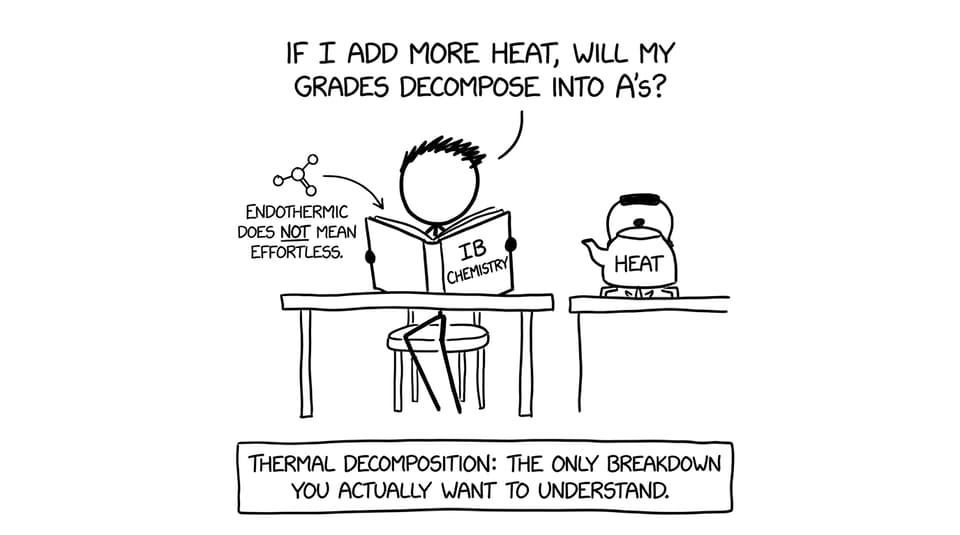
In IB Chemistry, thermal decomposition is a reaction where one compound breaks down into two or more simpler substances when heated.
The exam-friendly features are:
-
Heat is required (you often write Δ or “heat” over the arrow)
-
One reactant forms multiple products
-
It is usually endothermic overall
-
Bond breaking is a key idea (energy must be supplied to start the breakdown)
A general form looks like:
AB(s) (heat) → A(s) + B(g)
That “heat” is not decoration. In IB Chemistry, it’s a signal that energy is being put in to overcome bond energies and destabilise the original structure.
Quick checklist before you answer any IB Chemistry decomposition question
Use this 20-second checklist in IB Chemistry:
-
What type of compound is it (carbonate, nitrate, hydroxide, peroxide, hydrocarbon)?
-
Do the products usually include a metal oxide?
-
Is a gas expected (CO2, NO2, O2, H2O vapour)?
-
Should you include states (s, g, l) for energetics clarity?
-
Does the question want ΔH sign and an energy profile comment?
For practice that mirrors how marks are actually awarded, build a quick set in RevisionDojo’s Questionbank and tag the ones you miss for repeat review.
Classic thermal decomposition patterns you must know for IB Chemistry
Metal carbonates: oxide + carbon dioxide
Many metal carbonates decompose on heating to form a metal oxide and carbon dioxide:
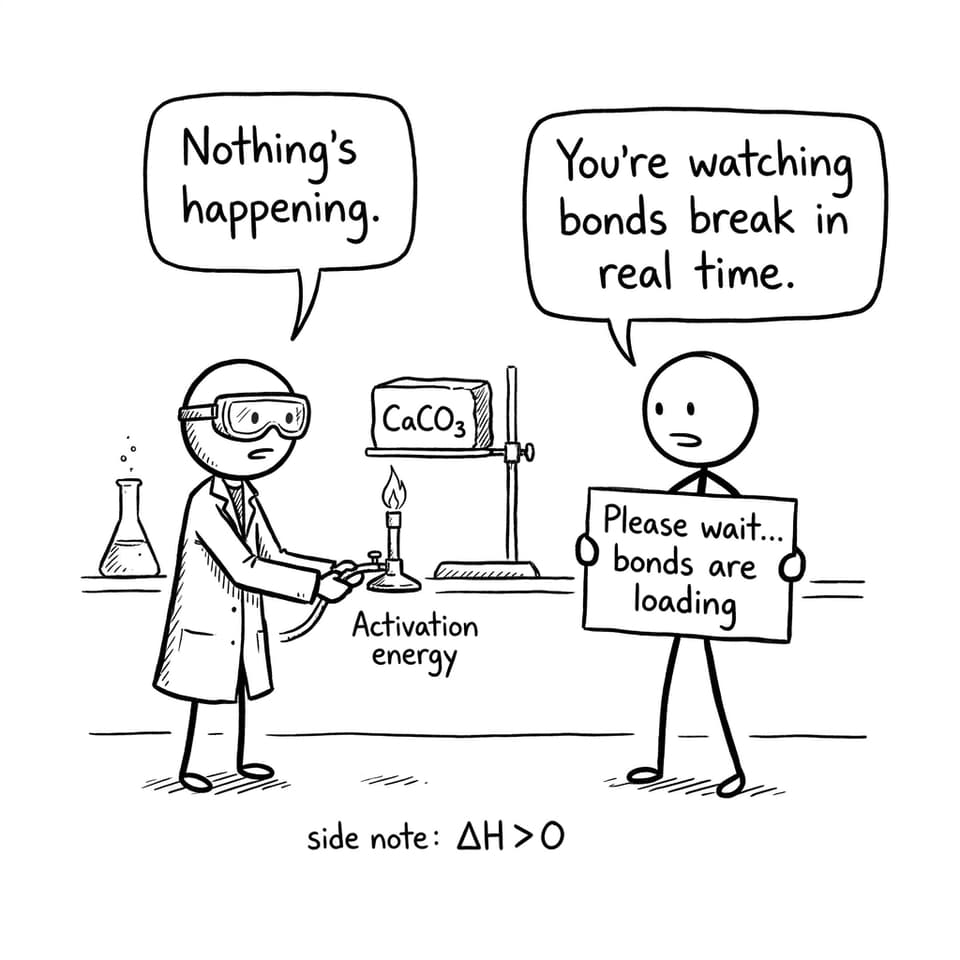
CaCO3(s) (heat) → CaO(s) + CO2(g)
This is the same chemistry behind lime production (and plenty of exam questions about gas collection, mass loss, and energetics). If you want the energetics framing that connects directly to enthalpy, keep Energetics and Thermochemistry notes open while you revise.
Metal hydroxides: oxide + water
A common IB Chemistry pattern:
Cu(OH)2(s) (heat) → CuO(s) + H2O(g/l)
In words: hydroxides often lose water and leave the oxide behind.
Metal nitrates: depends on the metal
Many nitrates decompose to give a metal oxide, nitrogen dioxide, and oxygen:
2Pb(NO3)2(s) (heat) → 2PbO(s) + 4NO2(g) + O2(g)
But Group 1 nitrates are a well-known exception you may be asked to mention: they tend to form nitrites rather than oxides. Examiners love “most do X, but Group 1 does Y” statements.
Hydrocarbons: thermal cracking is thermal decomposition
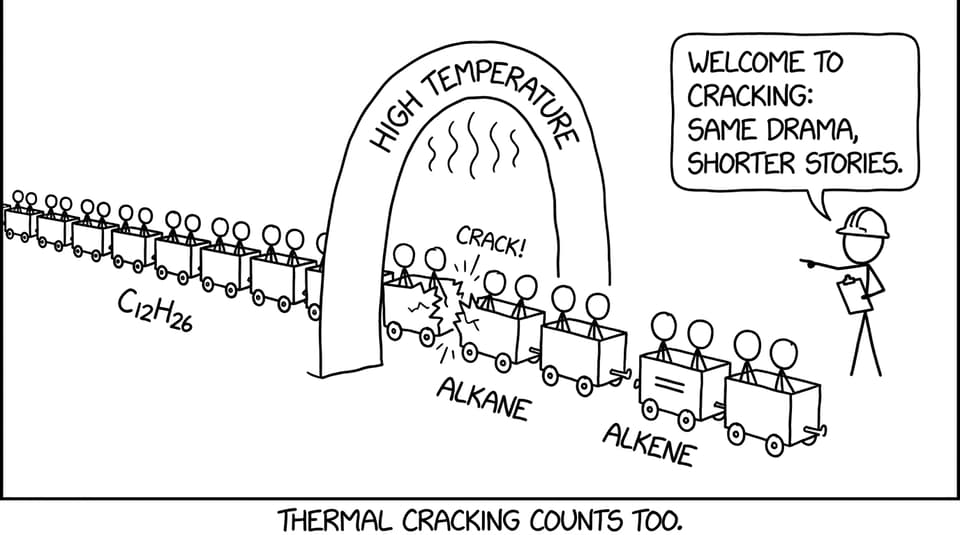
Long-chain hydrocarbons can break into shorter molecules at high temperature:
C12H26 (heat) -> C8H18 + C4H8
RevisionDojo’s Polymer Cracking explained simply is a good companion if cracking feels like a separate topic. In IB Chemistry, it’s the same underlying idea: heat drives bond breaking, then atoms rearrange into more stable products.
Energetics: why thermal decomposition is usually endothermic in IB Chemistry
Here’s the clean reasoning examiners want in IB Chemistry:
-
Breaking bonds requires energy (always endothermic for that step)
-
Thermal decomposition begins when particles gain enough energy to overcome activation energy
-
The overall reaction is often endothermic, so ΔH is usually positive
A high-yield example used repeatedly in IB Chemistry energetics is:
CaCO3(s) (heat) -> CaO(s) + CO2(g) (ΔH > 0)
If energetics language is where you lose marks, pair this topic with Enthalpy change explained for IB Chemistry and then drill question styles in the Energetics and Thermochemistry Questionbank.
Predicting ease of decomposition: the trend examiners like
Thermal stability depends on how strongly the compound holds together.
In IB Chemistry, you’ll often discuss carbonates:
-
Some carbonates decompose easily (for example, lithium carbonate is less stable)
-
Many Group 1 carbonates (except Li2CO3) are stable enough that a Bunsen burner won’t decompose them easily
-
Several Group 2 carbonates do decompose with strong heating
When you explain “why,” anchor it in lattice stability and ionic size trends, not just “because that’s the rule.” For deeper support topics that show up in explanations, RevisionDojo’s IB Chemistry hub is a useful home base: IB Chemistry resources.
Common IB Chemistry mistakes (and how to fix them fast)
-
Mistake: “Thermal decomposition is always exothermic.”
Fix: Bond breaking needs energy input, so overall it’s usually endothermic. -
Mistake: “All carbonates decompose easily.”
Fix: Many Group 1 carbonates are thermally stable (with the classic exception). -
Mistake: “Decomposition always produces a gas.”
Fix: Some decompositions can yield only solids, depending on the compound.
Bringing it home: make thermal decomposition an easy IB Chemistry mark
Thermal decomposition is simple chemistry with high leverage: it connects reaction types, energetics, trends, and real industrial processes in one place. If you can recognise the compound family, write the expected products, and explain the energy story clearly, you’ll collect marks quickly in IB Chemistry.
To lock it in, use RevisionDojo as your workflow: learn the idea in Study Notes, cement it with Flashcards, practise in the Questionbank with AI Chat feedback, then finish with Mock Exams, Grading tools, and Chemistry Predicted Papers. When you revise like that, thermal decomposition stops being a topic you “covered” and becomes one you can actually use.

