RevisionDojo logoRevisionDojo logo
FeaturesSubjectsPricingSchools
Back to all posts
  1. Home
  2. /Blog
  3. /Polymer Cracking Explained Simply for IB Chemistry

Polymer Cracking Explained Simply for IB Chemistry

IB Chemistry
RevisionDojo Team
•Last updated: 19 Jul 2026•7 min read
ShareShare on XShare on WhatsAppShare on LinkedInShare on Facebook
Add as a preferred source on Google
Polymer Cracking Explained Simply for IB Chemistry

Join 650k+ students breezing through the IBReady to breeze through the IB?

Footer

General

  • Download apps
  • For parents
  • For schools
  • Pricing
  • Gift RevisionDojo
  • Tutoring
  • IB syllabus
  • MYP syllabus
  • Blog
  • Student Questions

Features

  • Question Bank
  • Test Builder & Exam Mode
  • Predicted Papers
  • Past Papers
  • Study Notes
  • Interactive Lessons
  • Flashcards
  • Jojo AI Tutor
  • Coursework Studio
  • View all features

Research

  • All research
  • Jojo AI vs leading AI study tools
  • 2026 State of Learning Survey
  • 2025 State of Learning Survey
  • IB Moderation Analysis
  • Jojo AI vs ChatGPT
  • Jojo AI vs Gemini
  • Jojo AI vs Perplexity
  • Jojo AI vs Claude
  • Jojo AI vs Poe

Platform

  • About RevisionDojo
  • RevisionDojo vs Others
  • Content philosophy
  • Trustpilot
  • Join usWe're hiring
  • Student Ambassador
  • Help center
  • Contact us
  • Terms of Service
  • Data & privacy
  • Privacy policy
  • Cookie policy
  • Trust Center

IB Subjects

  • Arabic A
  • Arabic A Lit
  • Arabic ab initio
  • Arabic B
  • Biology
  • Business Management
  • Chemistry
  • Chinese A Lang & Lit
  • Chinese B
  • Computer Science (CS)
  • Computer Science (First Exam 2027)
  • Design Technology (DT)
  • Design Technology (First Exam 2027)
  • Digital Society (DS)
  • Economics
  • English A Lang & Lit
  • English A Lit
  • English B
  • Environmental systems and societies (ESS)
  • French A
  • French A Lit
  • French ab initio
  • French B
  • Geography
  • German A
  • German A Lit
  • German ab initio
  • German B
  • Global Politics
  • History
  • History (First Exam 2028)
  • Mathematics Analysis and Approaches (AA)
  • Mathematics Applications & Interpretation (AI)
  • Philosophy
  • Physics
  • Psychology
  • Psychology (First Exam 2027)
  • Spanish A
  • Spanish A Lit
  • Spanish ab initio
  • Spanish B
  • Sports, exercise and health science (SEHS)
  • Theory of Knowledge (TOK)
  • World Religions

MYP Subjects

  • MYP Biology
  • MYP Chemistry
  • MYP Design
  • MYP English Lang & Lit
  • MYP Extended Mathematics
  • MYP History
  • MYP Individuals & Societies
  • MYP Integrated Sciences
  • MYP Physics
  • MYP Standard Mathematics
  • MYP Biology
  • MYP Chemistry
  • MYP Design
  • MYP English Lang & Lit
  • MYP Extended Mathematics
  • MYP History
  • MYP Individuals & Societies
  • MYP Integrated Sciences
  • MYP Physics
  • MYP Standard Mathematics
RevisionDojo logo

© 2022 - 2026 RevisionDojo (MyDojo Inc)

RevisionDojo was developed independently of the IBO and as such is not endorsed by it in any way.

Download on the App StoreGet it on Google Play
GDPR compliant

Polymer cracking is one of those IB Chemistry ideas that feels industrial and distant until you notice it keeps showing up in exam questions. Not because the IB wants you to become a refinery engineer, but because cracking quietly connects the whole organic story: alkanes vs alkenes, reaction conditions, energy, and mechanisms.

At its core, polymer cracking is a simple trade: you take a big, sluggish hydrocarbon chain and turn it into smaller molecules that are easier to burn, easier to transport, and easier to turn into plastics.
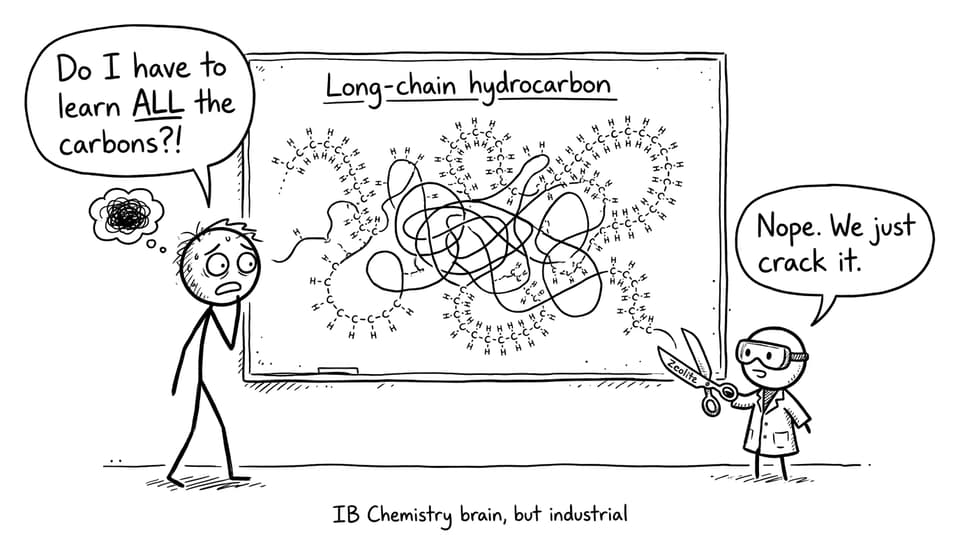
A stressed IB student meets a catalyst with scissors

Polymer cracking in IB Chemistry (one-sentence definition)

In IB Chemistry, polymer cracking (usually just called cracking) is the thermal decomposition of long-chain hydrocarbons into shorter alkanes and alkenes, using heat and often a catalyst.

A good exam-safe wording is:

  • Break C-C bonds in long hydrocarbons

  • Produce a mixture of short-chain alkanes and alkenes

  • Conditions determine the product balance

If you want the bigger organic map around this topic, the IB Chemistry Organic Chemistry Notes are a clean place to anchor it.

Quick checklist: what to remember for IB Chemistry cracking questions

Use this as your 30-second pre-answer routine in IB Chemistry:

  • Cracking primarily breaks C-C, not C-H.

  • Products include at least one alkene (common in questions and markschemes).

  • Thermal cracking: higher temperature, more alkenes.

  • Catalytic cracking: lower temperature, zeolites, often more branched alkanes.

  • Write a balanced example equation and state conditions.

To sharpen exam technique for how marks are awarded, pair this topic with the Breakdown of IB Chemistry Marking Schemes.

Why polymer cracking matters (the “menu problem”)

Crude oil contains lots of long-chain fractions. They’re often high-boiling, viscous, and not as useful in the forms people demand most.

But modern demand is skewed toward:

  • Short-chain alkanes (fuel-friendly)

  • Alkenes (chemical feedstock for polymers)

Cracking is how industry makes supply match demand. And in IB Chemistry, it’s also how you justify why a process exists, not just what it does.
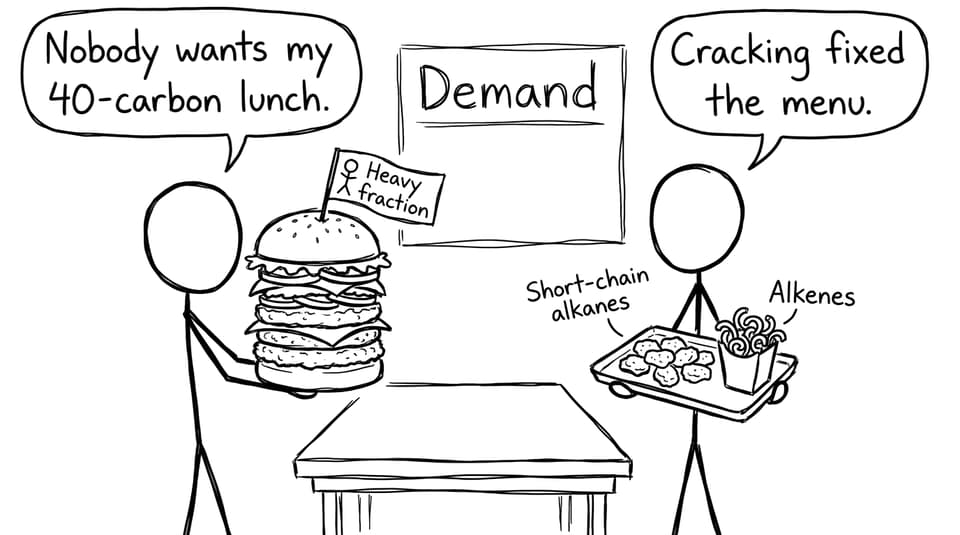
Cafeteria joke about supply vs demand

Thermal vs catalytic cracking in IB Chemistry

Thermal cracking (hotter, harsher, alkene-heavy)

Thermal cracking uses:

  • Very high temperatures (often cited around 700-1200°C)

  • High pressure

In IB Chemistry, the takeaway is product style: thermal cracking tends to give more alkenes. Those alkenes matter because they’re the starting point for many addition reactions and polymer formation.

If alkenes still feel slippery under pressure, revise the difference using Distinguishing Alkanes vs Alkenes in Chemistry.

Catalytic cracking (smarter conditions, refinery-friendly)

Catalytic cracking uses:

  • Lower temperatures (often around 450-750°C)

  • A zeolite catalyst (aluminosilicates)

  • Lower pressure than thermal cracking

Why it’s prized: it’s typically more energy efficient and commonly produces branched alkanes (useful for fuel performance) while still generating some alkenes.

For syllabus-aligned practice on organic topics and conditions, the IB Chemistry hub is the fastest way to jump from notes to targeted questions.

The general equation pattern (what the IB loves)

A classic IB Chemistry cracking pattern looks like:

Long alkane → shorter alkane + alkene

Example:

  • C₁₀H₂₂ → C₇H₁₆ + C₃H₆

Why alkenes show up: when you split a saturated chain, you often can’t distribute hydrogen atoms in a way that keeps every product saturated. The “missing hydrogens” appear as a C=C.

This links naturally to reaction mechanisms you already study, especially anything involving reactive intermediates.

Mechanism snapshot: why free radicals appear

At IB level, cracking is commonly described using homolytic fission:

  • A C-C bond breaks evenly

  • Each carbon takes one electron

  • Free radicals form

Then those radicals rearrange, combine, or abstract atoms to form stable small molecules.

That mechanism connection is why cracking can stop feeling like a random industrial fact and start feeling like a familiar organic theme. If you want a broader mechanisms refresher for IB Chemistry, IB Chemistry: Electrophilic Addition Explained helps you stay fluent with alkene behavior after cracking.
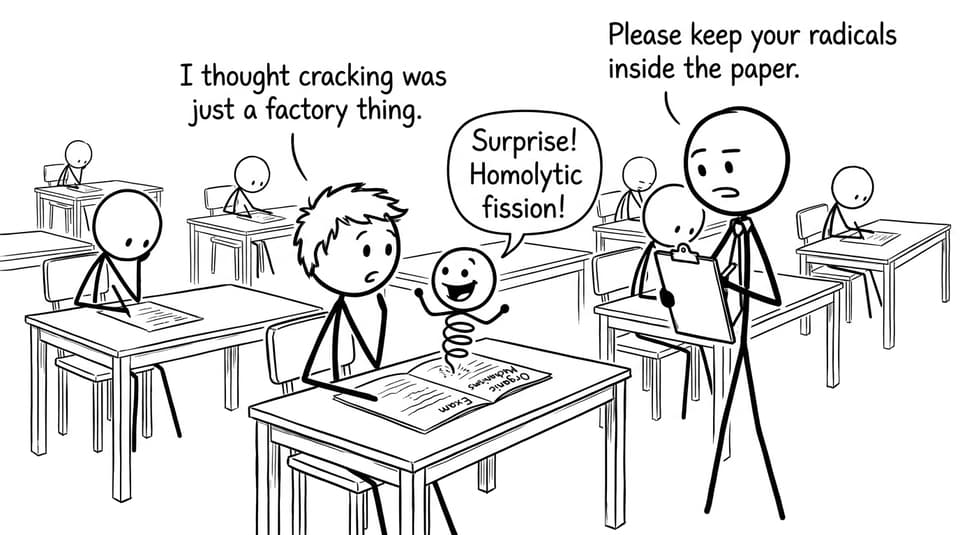
Exam hall radical surprise

Common IB Chemistry misunderstandings (and how to avoid them)

  • “Cracking only makes alkanes.” In IB Chemistry, cracking typically produces a mixture and often includes alkenes.

  • “Cracking breaks C-C bonds.” The key first step emphasized is usually C-C bond fission.

  • “Catalytic cracking makes no alkenes.” It may make fewer than thermal cracking, but it still produces some.

A helpful way to keep your organic vocabulary tight is revising Functional Groups Made Simple for IB Chemistry.

Closing: the calm way to remember cracking in IB Chemistry

Polymer cracking is simple when you treat it like a story of usefulness: long chains are awkward, short molecules are valuable, and IB Chemistry wants you to explain how heat and catalysts turn one into the other. Remember the exam anchors: C-C bond fission, alkenes appear, and conditions split into thermal vs catalytic.

When you’re ready to turn this into marks, build a tight routine with RevisionDojo: start at the IB Chemistry hub, practise with the Questionbank, reinforce with Flashcards, and pressure-test your understanding with Predicted Papers and Mock Exams. That’s how cracking stops being a fact you recite and becomes a process you can explain clearly, even in the final five minutes of a paper.

How helpful was this article?
Add as a preferred source on Google

Continue studying with RevisionDojo

  • IB Coursework GraderCheck an IA, EE, or TOK draft against IB assessment criteria.
  • IB Coursework ExamplesLearn from high-scoring coursework across IB subjects.
  • IB Grade CalculatorEstimate an IB grade using session-specific boundaries.
  • IB Grade BoundariesExplore historical grade boundaries by subject and session.

Frequently Asked Questions

Related Articles

IB en España · Oct 24, 2026 · 9 min read

Cómo preparar Química IB antes del Diploma

Qué repasar en 4.º de ESO y durante el verano para preparar Química del IB antes del Diploma, con un plan práctico para NM y NS.

IB en España · Oct 24, 2026 · 9 min read

Cómo tomar apuntes de Química del IB

Aprende a crear apuntes de Química del IB útiles para NM y NS con Cornell, mapas conceptuales, resúmenes, recuerdo activo y práctica de examen.

IB en España · Oct 23, 2026 · 10

Cómo recuperar Química IB tras un mal primer año

Plan práctico para recuperar Química IB tras un mal primer año: diagnostica lagunas, fija prioridades y mejora con práctica corregida y apoyo eficaz.

IB en España · Oct 23, 2026 · 9

Rutina de estudio de Química IB: horario semanal

Organiza Química del IB con una rutina semanal realista para NM y NS, práctica activa, repaso espaciado y un horario compatible con el Diploma.

May 2028 Cohort · Oct 22, 2026 · 12

May 2028 IB Chemistry Study Advice That Works

May 2028 IB chemistry study advice: build a syllabus-aligned plan for SL or HL, practise calculations and data skills, and avoid exam errors early.

May 2028 Cohort · Oct 22, 2026 · 12

How to Get a 7 in IB Chemistry 2028

How to get a 7 in IB Chemistry 2028 with a two-year plan for Paper 1, Paper 2 and the scientific investigation, aligned to the current guide.

min read
min read
min read
min read