


The moment your formula “vanishes”
You know the feeling.
It’s 10:47 p.m. You just finished a clean set of IB Math questions. Your brain is calm. The derivative rules feel obvious. The probability identities look almost friendly.
Then the next day, you open your notebook and the same formula stares back like a stranger.
This isn’t laziness. It’s not even a “bad memory.” In IB, forgetting is often the default setting, because the brain is designed to drop information that doesn’t get used in the right way.
The science of memory is reassuring: long-term retention is less about “more hours” and more about how you practice recall, and when you revisit it. With a simple loop, active recall, spaced repetition, and real application, your formulas start to stay.
Quick checklist: the IB formula retention loop
If you want a short system that works even during busy IB weeks, use this:
-
Pick 8-12 formulas you hesitate on (not the entire syllabus)
-
Turn each into a question (not a statement)
-
Review with spaced repetition every day (7-12 minutes)
-
Immediately apply 2-4 of those formulas in exam-style questions
-
Keep an “error log” of how you misused the formula (one line)
-
Re-test the same formulas 48 hours later
RevisionDojo is built to support this loop in one place: Study Notes for clarity, Flashcards for recall, and Questionbank for application, plus AI Chat when you get stuck.
Helpful starting points:
-
Use RevisionDojo Flashcards for spaced repetition review
-
Practice with RevisionDojo Questionbank after each recall session
Why your brain drops IB formulas (and how to work with it)
Memory is picky. It keeps what it thinks you’ll need again, and it deletes what looks like clutter.
A math formula is especially easy to lose because it’s compact, abstract, and often learned in the same way: read it, copy it, do two questions, move on. That feels productive, but it doesn’t send the signal your brain trusts: “I can retrieve this under pressure.”
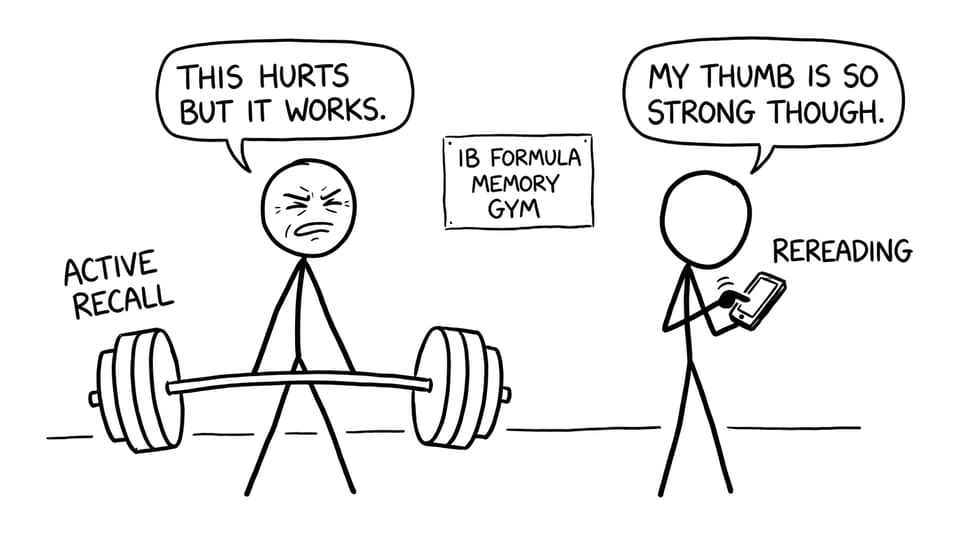
What strengthens long-term memory is retrieval.
Not rereading. Not highlighting. Not rewriting the formula beautifully.
Retrieval means you try to pull the formula out of your head before you see it. That struggle is not a sign you’re failing; it’s the stimulus that makes recall durable. For IB students, this matters because exam conditions don’t reward recognition. They reward fast access.
If you want structure around this, the IB Flashcard System guide shows how to build recall that holds up during exams.
Active recall for IB formulas: turn every equation into a question
Most students store formulas as decorations.
“Here is the quadratic formula.”
“Here is the chain rule.”
But your brain remembers prompts better than posters.
Try this instead:
-
Front of card: “Differentiate (e^{x}).”
-
Back of card: “(e^{x}).”
Or even better (because IB questions are rarely isolated):
-
Front: “Differentiate (e^{3x}). What’s the first step?”
-
Back: “Use chain rule: derivative is (3e^{3x}). First step: identify inner function (3x).”
That second version creates a retrieval path, not just an answer.
RevisionDojo makes this easier because Flashcards (feature page) are designed around active recall and spaced repetition, and you can keep sessions short enough that they don’t compete with your IA deadlines.
Spaced repetition: the IB advantage that feels too small to matter
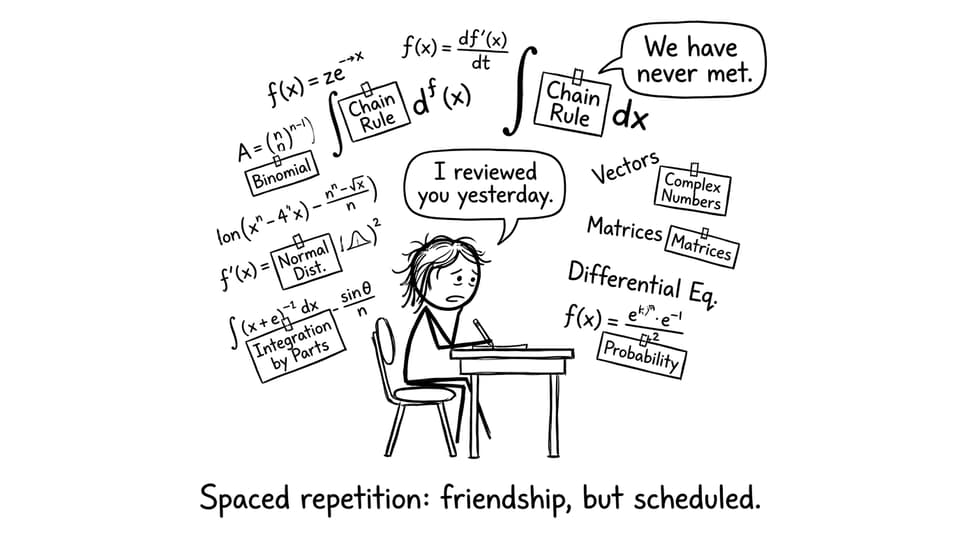
Spaced repetition works because it times review around forgetting.
Right before your brain fully drops a formula, you pull it back. Each successful retrieval strengthens the pathway. Over time, you need fewer reviews, and the memory lasts longer.
The trap in IB is cramming formulas in one intense weekend. You can get them into short-term memory, and it feels like success. But short-term success is expensive: you pay for it later when you have to relearn everything.
Instead, aim for daily, lightweight reviews.
A realistic IB pattern:
-
Day 1: learn + recall practice
-
Day 2: quick retest
-
Day 4: retest
-
Day 7: retest
-
Day 14: retest
If you want a concrete way to set this up inside a wider schedule, you can borrow structure from How to Create a Personal IB Math Revision Schedule and plug your formula reviews into the plan.
Don’t group formulas by chapter; group them by “decision”
In IB Math, formulas are rarely used alone. They come as families.
So instead of revising “Topic 3” formulas together, revise by the decision you need to make during an exam:
-
“Is this differentiation rule or algebraic manipulation first?”
-
“Is this discrete probability (binomial) or continuous (normal)?”
-
“Do I need a calculator method or a non-calculator method?”
This creates mental sorting, which makes recall faster.
To make this practical, use your course hub as a map:
Then apply the cluster immediately with targeted questions. For example, if calculus formulas are slipping, drill them in the Math AA Calculus Questionbank.
The “learn, apply, repair” loop: where formulas become usable
Long-term memory sticks when your formula becomes a tool, not trivia.
A clean IB workflow looks like this:
-
Learn (clarity): read a short explanation so you know what the formula is doing (not just what it is)
-
Apply (pressure): answer exam-style questions that force the formula to appear naturally
-
Repair (feedback): find the exact step you messed up, and turn that mistake into a flashcard
RevisionDojo is unusually strong here because the parts connect:
-
Study Notes help you rebuild understanding quickly: Study Notes
-
Questionbank gives you targeted practice when you’re ready to prove it: How to Use the Questionbank for Targeted Math Revision
-
AI Chat helps in the moment you get stuck (before you waste 30 minutes spiraling)
And once you’re close to exams, timed rehearsal matters too. That’s where Mock Exams and Predicted Papers become useful training environments, not for fortune-telling, but for stamina and decision-making.
Sleep is not optional: it’s where IB memory consolidates
There’s a quiet psychological trick to studying formulas: you want to feel “done.”
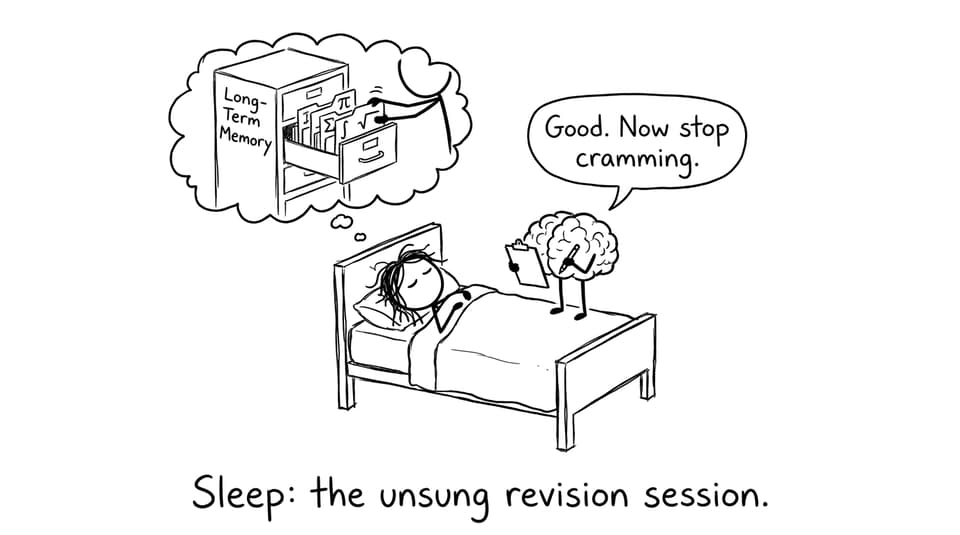
But memory doesn’t care about your feeling of completion. It cares about consolidation, which happens heavily during sleep.
So if you can only do one small habit, do this: a short active recall session in the evening, then stop. Let sleep do its part.
This is also why marathon late-night cramming backfires. You may squeeze in extra exposure, but you steal the biological process that turns exposure into retention.
A calm IB promise: small reviews compound
The students who retain formulas long-term aren’t usually the ones who grind the hardest. They’re the ones who keep showing up for short, slightly uncomfortable retrieval sessions, then prove recall with real questions.
So keep it simple.
Pick today’s 10 formulas. Retrieve them. Miss a few. Fix the misses. Apply them in a handful of questions. Sleep.
If you want one ecosystem that supports the whole IB loop, including Questionbank, Study Notes, Flashcards, AI Chat, Grading tools, Predicted Papers, Mock Exams, Coursework Library, and Tutors; make RevisionDojo your home base. Start with RevisionDojo Flashcards, then move straight into the IB Math AA hub or your relevant course area and build consistency that lasts.