
IB Math: The Power of Active Recall for Exam Prep
There’s a specific kind of confidence you can’t fake in an IB math exam.
It’s not the confidence of “I read this chapter.”
It’s the confidence of “I can produce the method on a blank page, under time, with no hints.”
Most students don’t lose marks because they never learned the topic. They lose marks because, in the pressure of an IB paper, knowledge that felt familiar becomes unreachable. Your brain recognizes the formula when it’s printed in front of you, but cannot retrieve it when the question asks for a setup, a justification, and the next step.
That gap is exactly what active recall closes. And once you build it into your math routine, the whole subject changes: less guessing, fewer blank-outs, faster starts, and calmer exams.
Active recall, explained in one sentence (IB-friendly)
Active recall means you try to pull information out of your memory without looking--then you check, correct, and try again.
In IB math, this is bigger than memorizing formulas. It includes:
-
Recalling which technique applies (binomial vs normal approximation, chain rule vs product rule)
-
Recalling the sequence of steps that earns marks
-
Recalling the conditions that make a method valid (domain restrictions, assumptions, model limits)
-
Recalling how to communicate the method clearly, not just get an answer
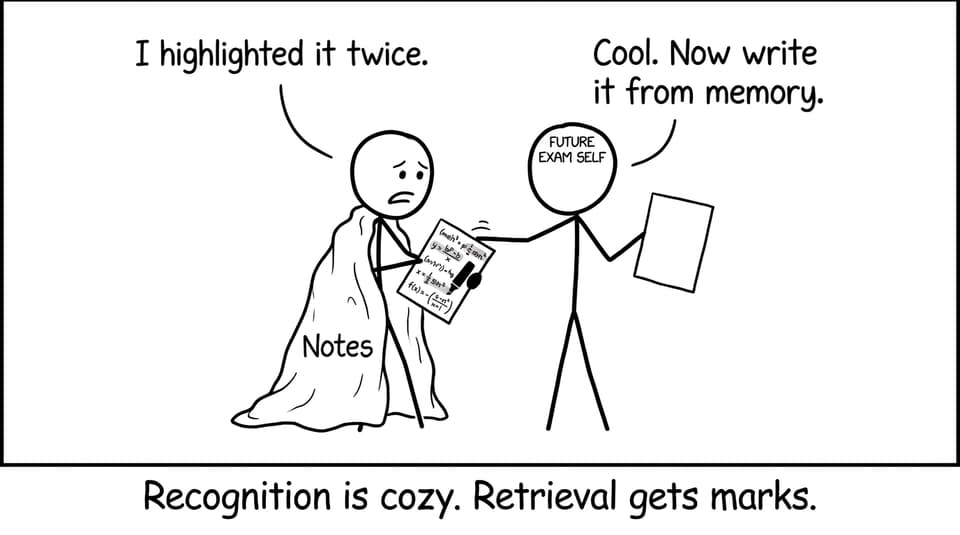
Recognition says, “Yes, I’ve seen this.” Retrieval says, “I can do this.” The IB rewards the second one.
Quick-start checklist: a 25-minute active recall loop
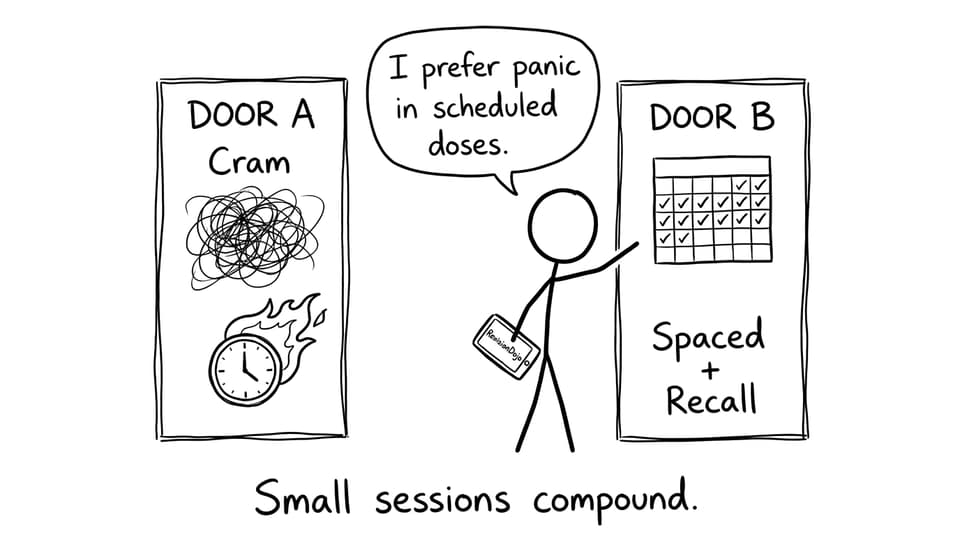
Use this loop 4--6 days per week. It’s short enough to sustain and strong enough to move grades.
-
Pick one micro-topic (not a whole unit)
-
Do 8--12 minutes of recall using flashcards or blank-page blurting
-
Do 10--12 minutes of targeted questions (timed if you can)
-
Spend 3--5 minutes reviewing mistakes and turning them into new recall prompts
If you want a clean starting map for topics, open your course hub first: IB Mathematics Analysis and Approaches Resources.
Why passive study fails so often in IB Math
Passive study is comforting because it lowers the emotional cost of being wrong.
Rereading notes, rewriting worked examples, or watching solution videos can feel like progress. But in an IB exam, you don’t get marks for feeling familiar. You get marks for producing the method and the reasoning under constraints.
Here’s what passive study typically trains:
-
Pattern recognition without execution
-
“I understand when I see it” knowledge
-
Short-term comfort, long-term fragility
Active recall trains the opposite: it makes you practice the exact moment an exam demands--starting from nothing.
If you’ve been stuck in “I do so much math but my score won’t move,” you’re usually missing retrieval practice, not effort.
The testing effect: why active recall works (and why it feels hard)
Active recall feels harder because it reveals the truth: what you can and can’t retrieve today.
That discomfort is not a sign you’re failing. It’s the signal that learning is happening. The brain strengthens memory when it’s forced to retrieve, check, and rebuild.
In IB math terms, this is why:
-
You start recalling formulas faster
-
You stop confusing similar methods
-
You get better at choosing the right approach early
-
You build “first line” momentum (the hardest part of many questions)
A great explanation of the principle is in How Active Recall Can Revolutionize Your Study Routine and the deeper framework in Active Recall for IB: The Only Method You Need.
How to use active recall for IB Math formulas (without turning life into flashcard admin)
Flashcards work when they force retrieval, not when they become tiny notes.
Use RevisionDojo’s Flashcards feature as your daily recall engine: Flashcards (RevisionDojo Feature).
Build cards that match how IB marks are awarded:
-
Front: “State the condition for using ___”
-
Back: One clean sentence + one common trap
-
Front: “Differentiate: \n \n (write the method, not just the answer)”
-
Back: Step sequence + final form expectations
-
Front: “When do you use the normal approximation to the binomial?”
-
Back: Conditions + what to do if they fail
If you want a practical guide for shaping decks, use IB Formula Mastery With RevisionDojo Flashcards and How to Use Flashcards Effectively in the Digital Age.
The highest-leverage move: pair active recall with a Questionbank
Active recall helps you retrieve. A Questionbank helps you apply retrieval in the form your examiner will see.
That pairing matters. Because IB math is not only “know the formula.” It’s also:
-
choose the correct method
-
show working efficiently
-
interpret a result
-
avoid common traps
After your flashcards, run a short, targeted set using RevisionDojo’s math question hubs, for example:
To make this systematic, follow IB Math: Targeted Revision Using the Questionbank.
Here’s the simple rule: recall first, then prove it with questions. That’s how IB exam performance is built.
Make mistakes useful: the active recall mindset in IB Math
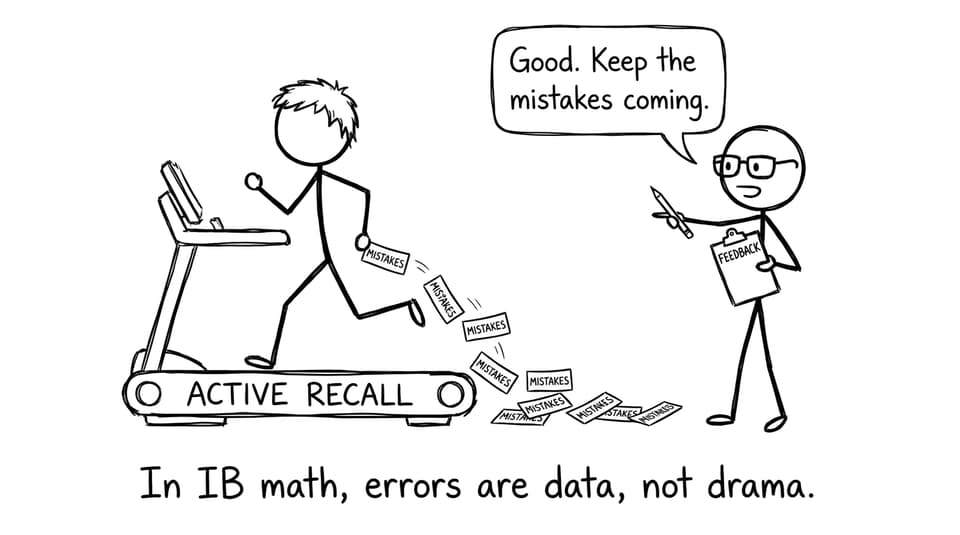
Mistakes are not proof you’re “bad at math.” They’re a map of what your brain cannot retrieve yet.
After each Questionbank session, pick one error and write a “rule”:
-
“If the function is composite, I check chain rule before anything else.”
-
“If it’s a model, I state assumptions and domain limits.”
-
“If I use calculator regression, I interpret parameters in context.”
Then turn that rule into a flashcard. This is how your weakest spots become your strongest retrieval cues.
A full approach is in Revision Tips: Turn IB Math Mistakes Into Progress.
A calm weekly plan (built for real IB life)
Most IB students don’t fail because they lack ambition. They fail because the plan collapses when CAS, IAs, and deadlines arrive.
Try this structure:
Daily (15--25 minutes)
-
Flashcards active recall (7--12 minutes)
-
A tiny Questionbank set on the same micro-topic (8--12 minutes)
-
One mistake turned into one new recall prompt (2 minutes)
Twice per week (45--60 minutes)
-
One deeper topic session using notes and practice
-
If you study Math AI, you can anchor topics using resource hubs like IB Mathematics Applications & Interpretation Statistics and Probability
Weekly (60--120 minutes)
-
One timed rehearsal (this is where Mock Exams and Predicted Papers come in)
-
Review longer than you attempt
RevisionDojo is designed for this loop: Study Notes to clarify, Flashcards for active recall, Questionbank for exam-style retrieval, AI Chat for stuck moments, Grading tools for feedback, plus Mock Exams and Predicted Papers to rehearse pressure. If you need structure across the whole season, How to Revise IB Math AA and AI Effectively and The Ultimate IB Math Study Routine for Busy Students are strong anchors.
Closing: the quiet advantage active recall gives IB students
In the IB, the students who improve fastest aren’t always the ones studying the most hours. They’re the ones who repeatedly practice the exact exam skill: retrieval under pressure.
Active recall is that skill, turned into a routine.
If you want your next math session to actually stick, build the loop inside RevisionDojo: clarify with Study Notes, retrieve with Flashcards, apply with the Questionbank, then use AI Chat and Grading tools to tighten your explanations. When exams get close, rehearse with Mock Exams and Predicted Papers, and pull support from the Coursework Library and Tutors when something won’t click.
Start small today: one micro-topic, one recall session, one targeted set. In a few weeks, you won’t just “know” the math. You’ll be able to retrieve it, which is what the IB has been testing you for all along.
