


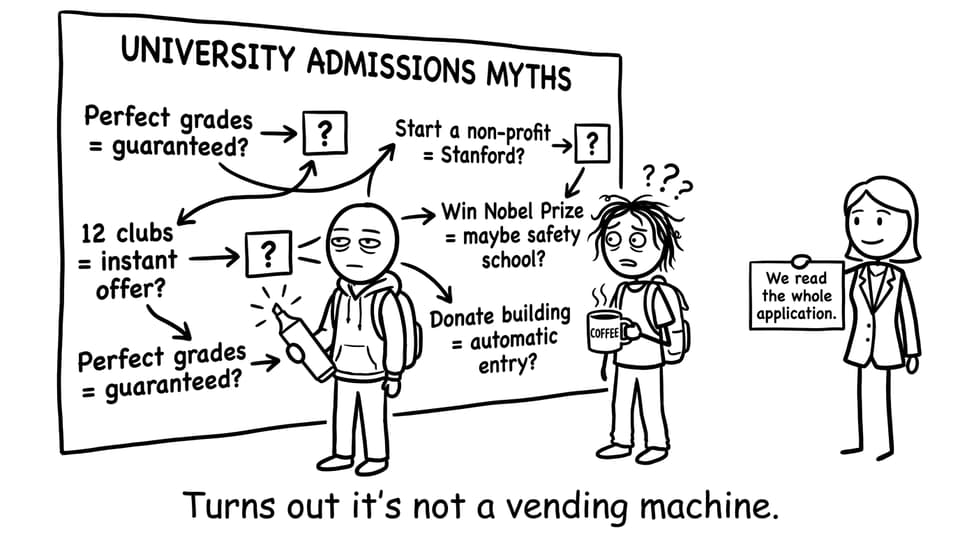
University admissions advice spreads the way stress spreads: quietly at first, then everywhere.
One student says you need perfect grades. Another says you need ten extracurriculars. Someone’s cousin swears there’s a “secret formula.” If you’re an IB student preparing for exams, these myths can turn a hard year into a constant background panic.
Here’s the calmer truth: admissions teams are not looking for a machine-made applicant. They’re looking for evidence you’ll thrive in their environment. That’s good news, because evidence is something you can build.
Quick reality-check checklist for IB students
-
Anchor your IB routine in what you can control: learning, practice, feedback, and consistency.
-
Aim for strong grades, but remember universities read context, trends, and choices.
-
Choose depth in activities (impact, leadership, commitment) over sheer quantity.
-
Write like a real person: specific, reflective, and clear.
-
Use exam prep tools to reduce stress and protect time for applications.
If you need a home base for your revision system, start with RevisionDojo for IB.
Myth: Only perfect grades matter in IB
Strong IB grades matter. But “perfect or nothing” is a myth that makes students chase point totals instead of growth.
Admissions officers often look for:
-
Academic readiness (rigor, consistency, improvement)
-
Evidence you can handle workload and think independently
-
Fit with the course and campus culture
A student with excellent grades and no direction can look flatter than a student with strong grades and clear momentum. If one term went badly, your story is not “ruined.” Your job is to show what changed and what you did differently.
To stabilise grades before applications pile up, build a loop: understand, practice, review, repeat. The fastest way to do that is usually targeted questions with feedback, like RevisionDojo’s Questionbank and its guide to The Ultimate Guide to Revision for IB Students.
Myth: You need dozens of extracurriculars
Universities rarely reward a long list of shallow memberships. They reward proof.
Proof can look like:
-
One sustained commitment that shows responsibility
-
A CAS project with real outcomes and reflection
-
A small initiative you stuck with when it got boring
Quantity is easy to fake. Depth is hard to fake. And because it’s hard to fake, it’s credible.
If your week is overloaded, your IB performance usually pays the price first. A better plan is to protect your exam prep system so your academics stay strong while your activities remain meaningful. If you’re rebuilding your routine, IB Exams Without Pausing Your Life is a practical reset.
Myth: Personal statements must sound formal and serious
“Formal” is not the same as “empty.” A personal statement that sounds like it was generated by a committee is easy to forget.
Strong applications tend to be:
-
Specific (real moments, real decisions)
-
Reflective (what you learned, what you changed)
-
Coherent (why this subject, why this path)
The goal is not to sound impressive. The goal is to sound true, and then back it up.

Myth: Connections guarantee admission
Some applicants do have networks. But most competitive admissions processes still rely on academic signals, written materials, recommendations, and overall fit.
The danger of this myth is that it encourages passivity. Students stop building what they can build because they assume outcomes are decided elsewhere.
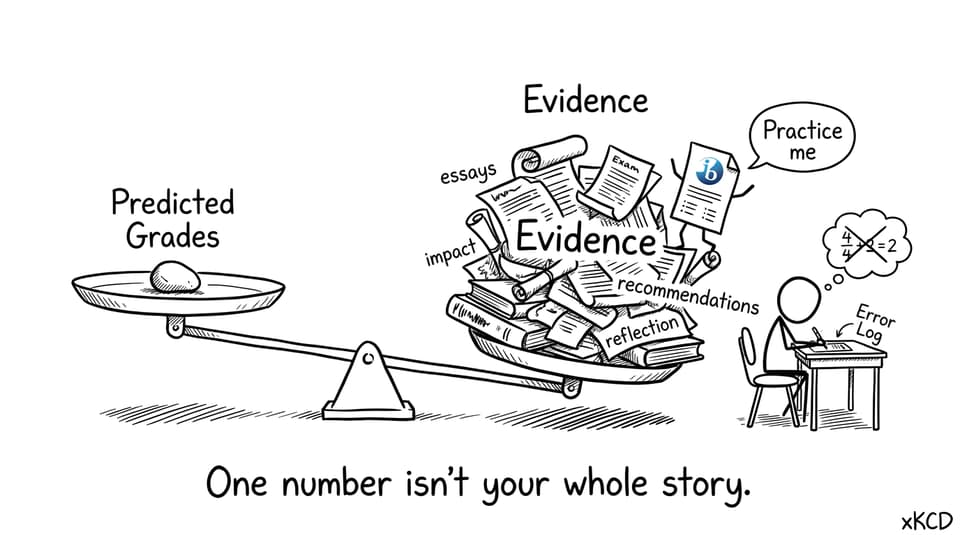
A more useful mindset for an IB student: treat the application like a portfolio of evidence. Your grades show readiness. Your activities show commitment. Your writing shows thinking. Your recommendations show how you work with others.
Myth: Mock exams or predicted grades define everything
Predicted grades and mocks matter, but they are not the entire story.
Admissions readers often see:
-
Your full transcript pattern
-
Your subject choices and rigor
-
School context
-
Writing quality and recommendations
If you want predicted performance to improve, don’t just “study more.” Study smarter and test under pressure. RevisionDojo’s IB Predicted Papers are designed for realistic rehearsal, and IB Predicted vs Specimen Papers: What They Mean helps you use them without superstition.
Myth: There’s a “secret formula” for admissions
If there were a single formula, the internet would have turned it into a checklist years ago.
What actually works is a system:
-
Build skills through consistent IB practice
-
Get feedback quickly (so effort compounds)
-
Show a clear academic direction
-
Keep your life steady enough to sustain it all
RevisionDojo is designed for that kind of system: Study Notes, Flashcards, AI Chat, Grading tools, Predicted Papers, Mock Exams, a Coursework Library, and Tutors. When exam prep is organised, applications feel less like a second full-time job. For a practical workflow, see RevisionDojo App: The Smarter Way to Prep for IB Exams and What’s the Best Way to Revise for IB Exams?.
Conclusion: build evidence, not myths
University admissions isn’t a vending machine where you insert perfect IB grades and receive a guaranteed offer. It’s closer to a conversation built from evidence: academic readiness, meaningful commitments, and a voice that sounds like yours.
If you want to spend less time guessing and more time improving, use RevisionDojo to keep your IB prep structured: drill weaknesses in the Questionbank, rehearse under pressure with IB Predicted Papers, and tighten feedback loops with AI Chat and Grading tools. The myths fade fastest when your system gets stronger.