


Midway through the year, there’s a specific kind of tired that shows up.
You’ve done the homework. You’ve sat the tests. You’ve written enough comments like “I understand this” to fill a small novel.
And yet, when you imagine the IB exams, your confidence doesn’t rise in a straight line. It flickers.
That’s why a mid-year curriculum review matters for IB students preparing for exams. Not the formal, school-wide kind with meeting minutes. The personal kind: a calm pause where you look at evidence, tell yourself the truth, and adjust.
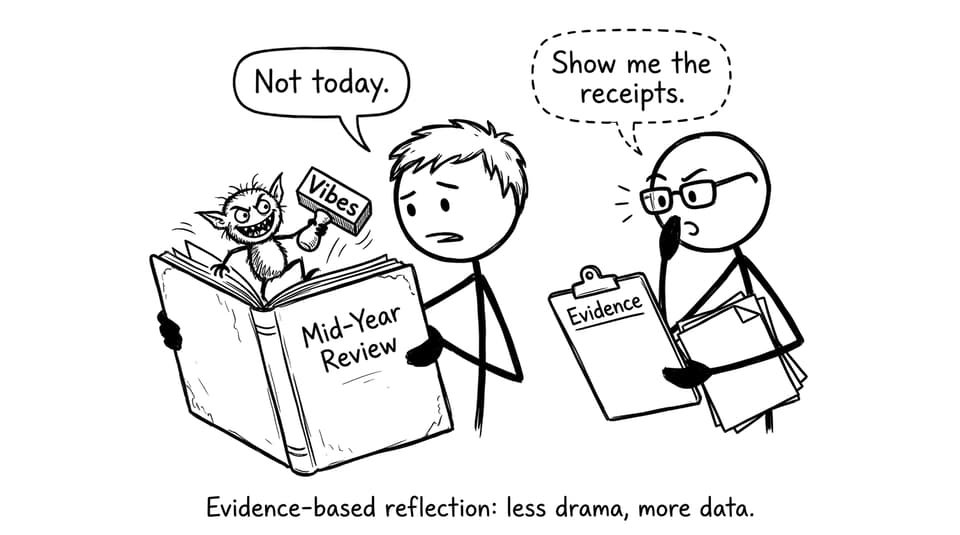
Evidence-based reflection is the difference between “I should revise more” and “I lose marks on command terms under time pressure, especially in Topic 3.” One is a mood. The other is a plan.
The IB mid-year review checklist (10 minutes to reset)
If you want a fast, exam-focused mid-year curriculum review for IB, use this checklist. It’s built to be quick enough that you’ll actually do it, but structured enough that it produces real next steps.
-
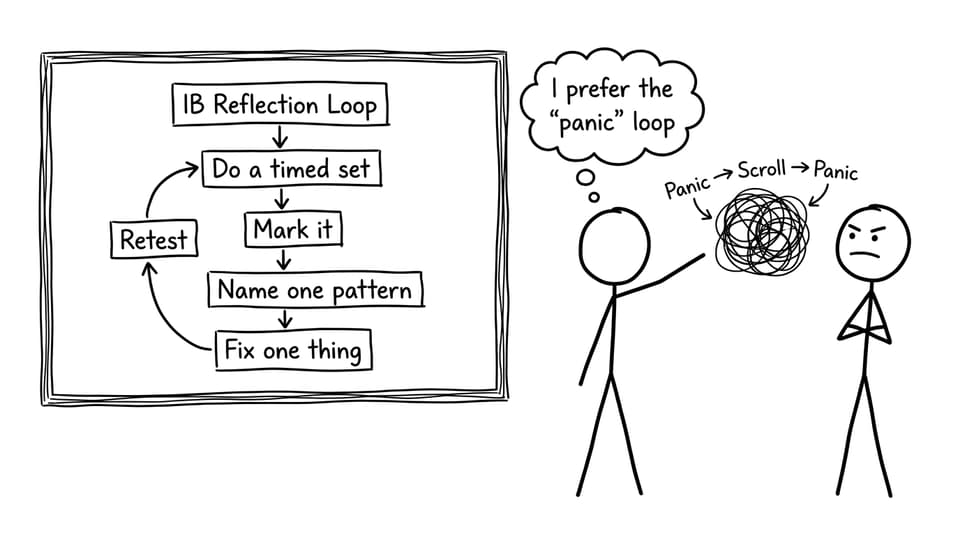
Collect three evidence sources (scores, feedback, timed performance).
-
Identify two patterns (one strength, one weakness).
-
Choose one fix you can run this week.
-
Schedule one retest within 72 hours.
-
Record the result in one sentence.
If you want a platform that keeps this loop in one place, start at RevisionDojo for IB, then build your review around practice and feedback rather than guesswork.
Why evidence-based reflection changes your IB results
Most students don’t fail the IB because they didn’t work hard. They stall because they can’t see clearly.
Evidence-based reflection gives you clarity in three ways:
-
It replaces opinion with patterns. “I’m bad at chemistry” becomes “I lose marks on explanations, not calculations.”
-
It protects your time. You stop rereading topics you already know and start repairing the few that leak marks.
-
It turns revision into a feedback loop. Practice produces data. Data produces decisions. Decisions produce better practice.
RevisionDojo is designed for this kind of loop: you practise with the Questionbank, patch gaps using Study Notes, retain with Flashcards, and use AI Chat and Grading tools to shorten the distance between “I tried” and “I improved.”
What counts as “evidence” in an IB mid-year review?
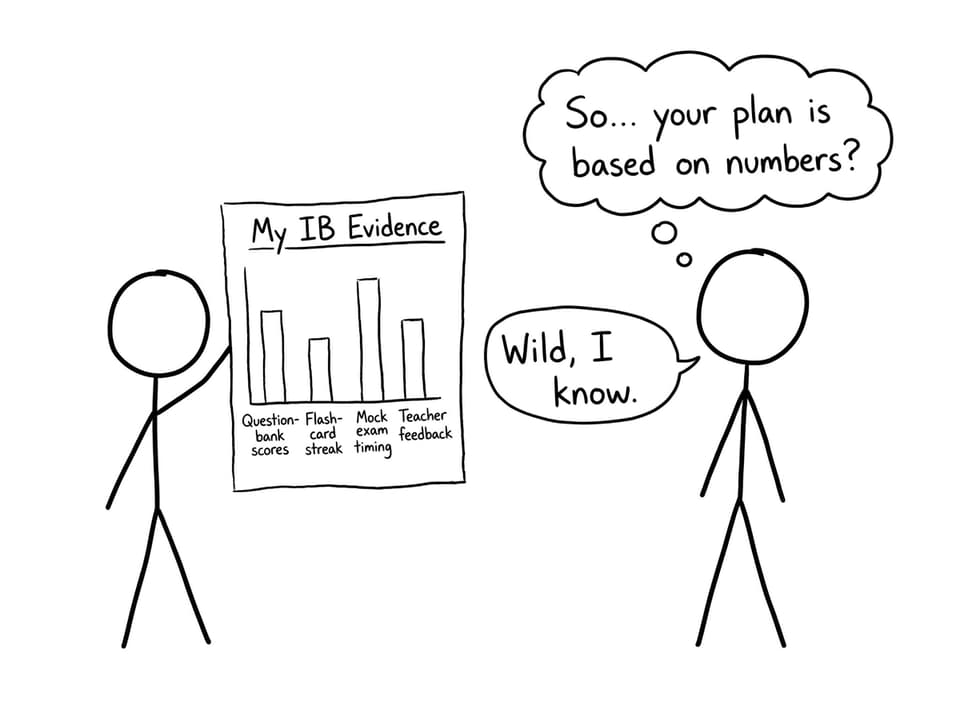
Good evidence is not “a lot.” Good evidence is useful. For an IB student preparing for exams, the strongest evidence usually comes from five places:
Timed performance evidence
This is your most honest mirror.
-
How many marks do you score under timed conditions?
-
Where do you slow down?
-
Which question types cause panic even when you understand the content?
To build stamina, use structured timed practice through RevisionDojo’s exam workflows described in RevisionDojo App: The Smarter Way to Prep for IB Exams.
Question-level evidence
A mid-year review improves fast when you can point to specifics.
Use a question bank session to find patterns like:
-
you miss “evaluate” prompts (argument quality)
-
you drop method marks (steps missing)
-
you misread data-response questions (interpretation)
If you want the tactics, see IB Question Bank | How to Use It Effectively and Making the Most of IB Question Banks and Practice Papers.
Memory evidence
Your brain gives warning signs. Most students ignore them.
If you cannot recall definitions, formulas, or case study details on demand, that’s evidence that you need spaced repetition. That’s exactly where Flashcards belong, especially when paired with notes so you’re not memorising nonsense.
Feedback evidence
Teacher comments, rubric rows, and annotation patterns are gold because they often repeat.
If you’re working on coursework too, your mid-year review should include how feedback is trending, not just what it says once. RevisionDojo’s Grading tools and Coursework Library help you build that longer view, so you can stop rewriting blindly and start improving deliberately.
Reflection evidence
This is where most students become vague.
A strong reflection is tagged to a specific performance moment: a question number, a timing breakdown, a rubric descriptor. If your reflection cannot point to something concrete, it’s not reflection yet. It’s just emotion.
For a practical structure, read Creating Actionable Reflection Prompts for IB Students.
Turning IB data into dialogue (even if it’s just you)
A mid-year curriculum review works best when it becomes a conversation: with yourself, with a teacher, or with a study group.
Use these evidence-based questions to guide the dialogue:
-
What are the top two recurring errors I made this month?
-
Which topic feels “fine” but collapses under timing?
-
Where am I losing marks: content, command terms, or communication?
-
What would a one-week fix look like, in sessions I can actually keep?
Then turn the answers into a schedule.
A simple pattern many IB students can sustain:
-
3 short practice sessions in the Questionbank (targeted by topic)
-
2 flashcard reviews (10 minutes)
-
1 timed mini-mock (one section, not a full paper)
-
1 reflection log entry that ends with a retest date
If motivation dips mid-year, it helps to remember that “consistency” is a design problem, not a personality trait. Build the loop so it’s hard to avoid.
Link your mid-year review to the IB Learner Profile (without making it cheesy)
The IB Learner Profile can sound like poster language until you connect it to evidence.
Try this:
-
Reflective: Do I regularly record what cost me marks and what I changed?
-
Risk-taker: Do I attempt hard questions early, or do I hide in comfort topics?
-
Communicator: Can I write answers that earn method marks and clarity marks?
This approach stays grounded. It turns “values” into behaviours you can measure.
If you want a deeper routine that uses reflection data, see Harnessing Reflection Data to Support IB Learner Profile Development.
Build an action plan that actually survives a busy week
A mid-year plan fails when it’s too big to execute.
Keep it painfully small:
Choose one priority weakness
Example: “I lose marks because my explanations are too thin.”
Pick one tool and one routine
-
Patch understanding with Study Notes
-
Prove it with the Questionbank
-
Get unstuck fast with AI Chat
-
Use Grading tools for rubric-aligned feedback on written responses
Retest quickly
Retest within 24-72 hours. The point is to create a tight feedback loop. Long gaps turn reflection into a diary entry instead of an improvement engine.
Add one realism session
Realism means timed practice. That can be Mock Exams or Predicted Papers inside RevisionDojo, used as training tools for coverage and stamina.
To understand how to use predicted sets sensibly, read IB Predicted vs Specimen Papers: What They Mean.
Closing: The IB mid-year review is where you stop guessing
A mid-year curriculum review is not a school chore. For IB students preparing for exams, it’s the moment you trade hope for evidence.
Collect proof. Name patterns. Choose one fix. Retest fast.
And if you want that loop to feel simpler, not heavier, build it inside RevisionDojo: practise with the Questionbank, clarify with Study Notes and AI Chat, lock in recall with Flashcards, improve writing with Grading tools, rehearse with Predicted Papers and Mock Exams, and lean on the Coursework Library and Tutors when you want examples or a human plan.
Start your next IB mid-year review here: RevisionDojo.