


In the last stretch before IB exams, the smallest things start to feel huge.
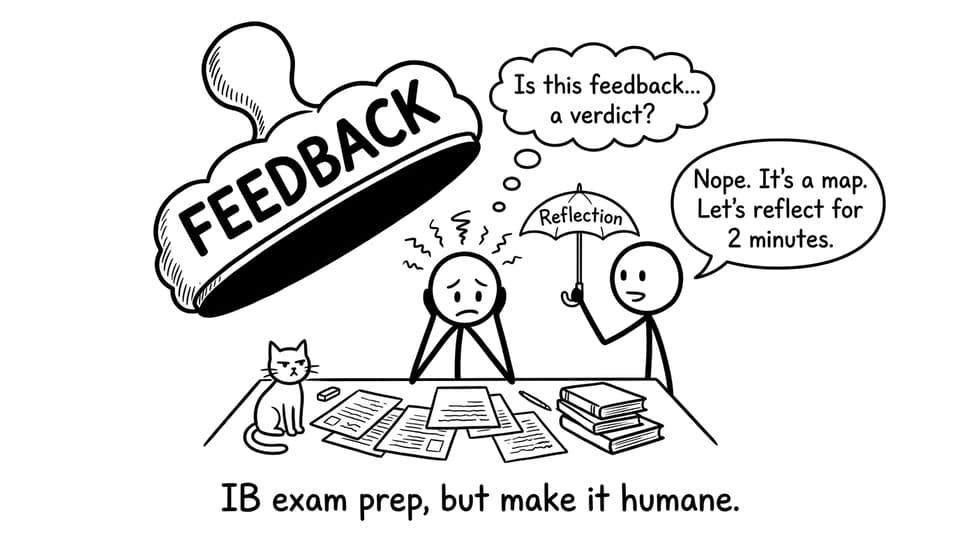
A comment in the margin. A raised eyebrow when you answer too quickly. A “See me after class” that sits in your stomach like a stone.
Most of the time, nothing terrible is happening. But IB pressure has a way of turning normal classroom moments into personal stories: They think I’m not good at this. I’m behind. I’ve disappointed them.
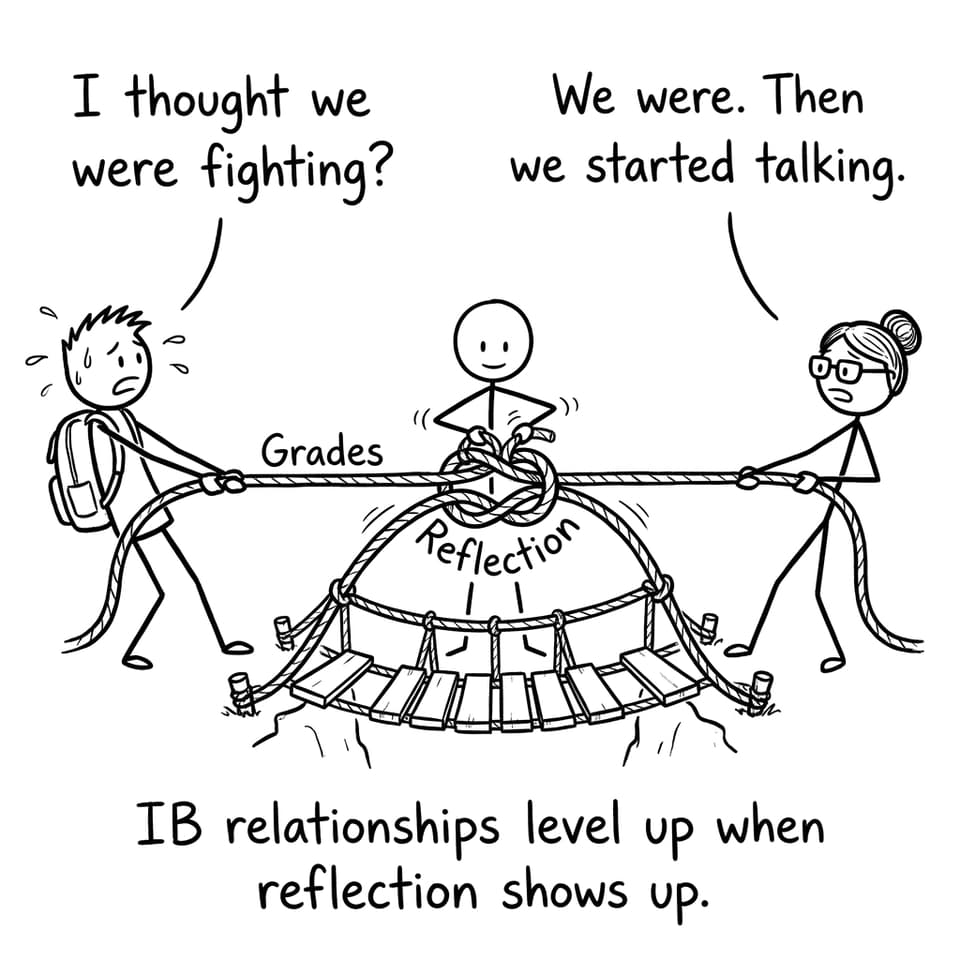
Reflection is the quiet tool that interrupts that story. It gives you and your teacher a shared language that’s about improvement, not judgment. Done well, reflection makes the relationship feel less like “grader vs. student” and more like “two people solving the same problem.” And for IB students preparing for exams, that shift can change how fast you improve.
Quick checklist: reflection that strengthens IB relationships
Use this mini-checklist after any quiz, timed response, mock, or feedback conversation in IB:
-
Write one sentence: what went well.
-
Write one sentence: what didn’t work (be specific).
-
Choose one next step you can do within 48 hours.
-
Ask your teacher one clean question (not five anxious ones).
-
Reattempt a small set and report back: “I fixed X by doing Y.”
This is the kind of reflection that builds trust quickly in IB: brief, honest, and measurable.
Why student-teacher relationships matter for IB exam prep
In IB, your teacher isn’t only teaching content. They’re also helping you interpret standards, command terms, and what “top-band” really looks like under time pressure. When the relationship is strong, feedback lands as guidance. When it’s weak, the same feedback can feel like a verdict.
Strong relationships help because they create psychological safety: you can admit confusion early, ask for clarity, and take risks in your writing or problem-solving. That matters in IB because exam performance is rarely limited by effort alone. It’s limited by misunderstood expectations and uncorrected patterns.
If your revision loop needs structure, pair relational reflection with an exam-focused system: 10 Proven Study Techniques for IB Students and How to Study for IB Exams: Step-by-Step Guide both map the kind of routines that make teacher feedback easier to use.
Reflection turns feedback into a shared project (not a power dynamic)
Here’s the subtle truth about IB feedback: the best teachers can’t “fix” your work for you. They can only point.
Reflection is what turns pointing into progress.
When you reflect, you show your teacher your thinking process: why you chose that structure, where you panicked, what you thought the question was asking, what you ran out of time to do. That information helps them coach you like a person, not evaluate you like a spreadsheet.
A simple script that works in almost every IB subject:
-
“I lost marks on X. I think it happened because Y.”
-
“Next time I’ll try Z. Can you check if that’s the right fix?”
That last line is relationship gold. It signals effort and ownership without pretending you already know everything.
Use micro-reflection to make teacher support feel accessible
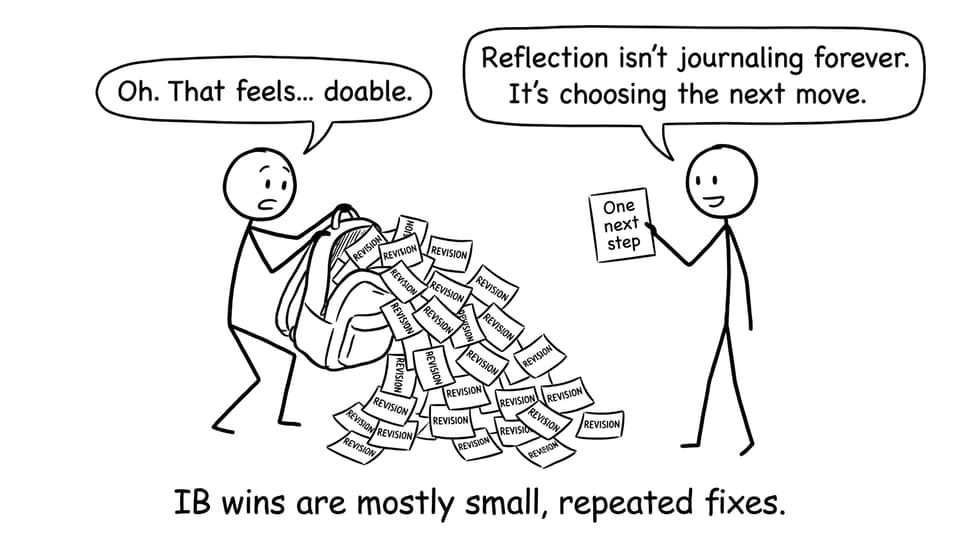
Big reflective journals sound nice. But during IB exam season, you need reflection that fits into real life.
Try the “2-minute debrief” after practice:
-
Trigger: right after a Questionbank set, a timed paragraph, or a marked assignment.
-
Prompt 1: “What decision did I make that helped?”
-
Prompt 2: “What decision did I make that hurt?”
-
Prompt 3: “What’s the smallest change that would gain marks?”
When you bring this to your teacher, conversations get sharper and kinder. You’re no longer asking, “What’s wrong with me?” You’re asking, “What’s the lever that moves my mark?” That’s a very IB question.
If you want a ready-made workflow for this, RevisionDojo helps you keep reflection attached to practice: drill in the Questionbank, clarify with AI Chat, lock details with Flashcards, and test timing with Mock Exams and Predicted Papers. The point isn’t doing more. It’s doing the loop.
Related reads that pair well with this approach: Building Resilience and Reflection in IB Classrooms and Revision Tips: Build a Study Routine That Actually Works.
Model the relationship you want: reflective honesty without drama
A surprising part of strengthening student-teacher relationships in IB is learning to communicate like a calm scientist.
Not cold. Not robotic. Just clear.
Instead of “I’m bad at Paper 2,” try:
- “My introductions are vague and I lose focus by paragraph 2.”
Instead of “I don’t get this topic,” try:
- “I can do the basic questions, but I fail when the wording changes.”
This kind of reflection makes it easier for a teacher to respond with targeted help, because you’ve already done the first step of diagnosis.
If you also need support beyond class time, RevisionDojo’s Tutors can act like a second feedback channel: they help you spot patterns across attempts, not just correct one assignment.
Make reflection visible: evidence builds trust fast
Teachers trust what they can see. So do students.
The fastest way to strengthen a student-teacher relationship in IB is to return with evidence that you acted on feedback.
A practical routine:
-
Do a short timed attempt.
-
Use Grading tools (or your teacher’s rubric comments) to identify one criterion to improve.
-
Reflect: “My weakness is ___ because ___.”
-
Fix: use Study Notes or the Coursework Library to study an exemplar pattern.
-
Reattempt: do a smaller version within 48 hours.
-
Report back: “I changed ___, and here’s what improved.”
This is also why many students like the RevisionDojo ecosystem: your practice, feedback, and retests live in one place, so reflection doesn’t disappear into random notebooks.
If you’re building your wider resource plan, these two help: Best Resources for IB Exam Preparation and Countdown to IB Exams: Use IB Resources That Work.
Reflection prompts you can actually use with teachers in IB
Use these prompts to start better conversations in IB without making it feel like a therapy session:
-
“What’s the most common reason students lose marks on this question type?”
-
“Which command term am I misunderstanding here?”
-
“If I could only fix one thing before the next assessment, what would you pick?”
-
“Can you show me one example of what ‘analysis’ looks like in a top response?”
-
“Here’s my reflection in one sentence. Is my diagnosis correct?”
Each question says: I’m working. I’m listening. Help me aim. That’s how relationships strengthen in IB classrooms.
Closing: make IB reflection the habit that protects your confidence
The most effective IB students aren’t always the most naturally calm. They’re the ones who keep turning pressure into a process.
Reflection is that process. It strengthens student-teacher relationships because it replaces guessing with dialogue, and replaces judgment with shared problem-solving. You don’t need a perfect journal. You need a repeatable loop: attempt, reflect, fix, reattempt.
If you want one place to run that loop, RevisionDojo is built for it: Questionbank, Study Notes, Flashcards, AI Chat, Grading tools, Predicted Papers, Mock Exams, Coursework Library, and Tutors working together so your reflection leads somewhere.
When you’re ready, start small: reflect for two minutes after your next practice. Then bring one sentence to your teacher. In IB, that one sentence can change the whole relationship.