

Standard state sounds like a boring footnote until you lose marks for it.
In IB Chemistry, it’s the quiet rule behind almost every “standard” value you use: ΔH°, ΔS°, ΔG°, E°, and even equilibrium ideas. If you’ve ever copied numbers from a data table and still felt unsure why your answer looks “off,” standard state is often the missing piece. It’s not trivia. It’s the reference point that makes thermodynamics and electrochemistry comparable.

The exam definition of standard state in IB Chemistry
Standard state is the pure, most stable physical form of a substance at a pressure of 100 kPa (1 bar) and a specified temperature (almost always 298 K unless the question states otherwise).
In IB Chemistry, standard state works like a set of “default settings”:
-
Pure substances only (not mixtures or impure samples)
-
Correct state symbol matters: (s), (l), (g), (aq)
-
Pressure = 100 kPa for gases
-
Temperature = 298 K unless another temperature is explicitly given
-
For aqueous ions, the standard state is typically 1.0 mol dm⁻³
If you want the official phrasing to match your exam writing, the IB Chemistry Key Definitions page is a clean anchor while you revise.
Quick checklist: how to spot standard state marks fast
When a question says “standard,” run this micro-check in your head (and in your working):
-
Did I use the most stable form? (graphite, not diamond)
-
Did I include state symbols correctly?
-
Did I assume 298 K only because nothing else was stated?
-
For gases, did I stick to 100 kPa?
-
For solutions, did I treat aq species as 1.0 mol dm⁻³?
That checklist is small, but in IB Chemistry it prevents the classic “everything looks right but the markscheme disagrees” moment.
Why standard state matters (and why IB keeps testing it)
Without standard state, thermodynamic and electrochemical values would be a mess. A value like ΔH° is only meaningful if everyone agrees what “°” means.
Standard state is what makes these moves valid in IB Chemistry:
-
Comparing enthalpy values across reactions
-
Using Hess’s law without hidden condition changes
-
Linking Gibbs free energy to equilibrium (because the reference conditions are defined)
-
Using standard electrode potentials from a table to predict cell direction
If thermodynamics still feels slippery, it helps to pair this topic with RevisionDojo’s explanations of Enthalpy Change Explained for IB Chemistry and IB Chemistry: Gibbs Free Energy Explained Simply.
Common standard states you must know in IB Chemistry
Here are the ones that show up repeatedly in exam questions.
Gases (standard state = gas)
At 298 K and 100 kPa, these are gases, so their standard state uses (g):
- H₂(g), N₂(g), O₂(g), Cl₂(g), CO₂(g)
Liquids
-
Water: H₂O(l) (liquid water, not steam)
-
Bromine: Br₂(l)
Solids
-
Carbon: C(s, graphite) is standard state (not diamond)
-
Iodine: I₂(s)
-
Most metals: Fe(s), Al(s), etc.

Aqueous ions
In IB Chemistry, when you see ions in solution under standard conditions, they are treated as (aq) at 1.0 mol dm⁻³. That’s why standard electrode potential definitions include ion concentration.
To practice this the way it appears in exams, use the IB Chemistry Resources hub, then drill with the Questionbank and check your explanations with AI Chat.
Standard state vs “standard conditions” (the confusion trap)
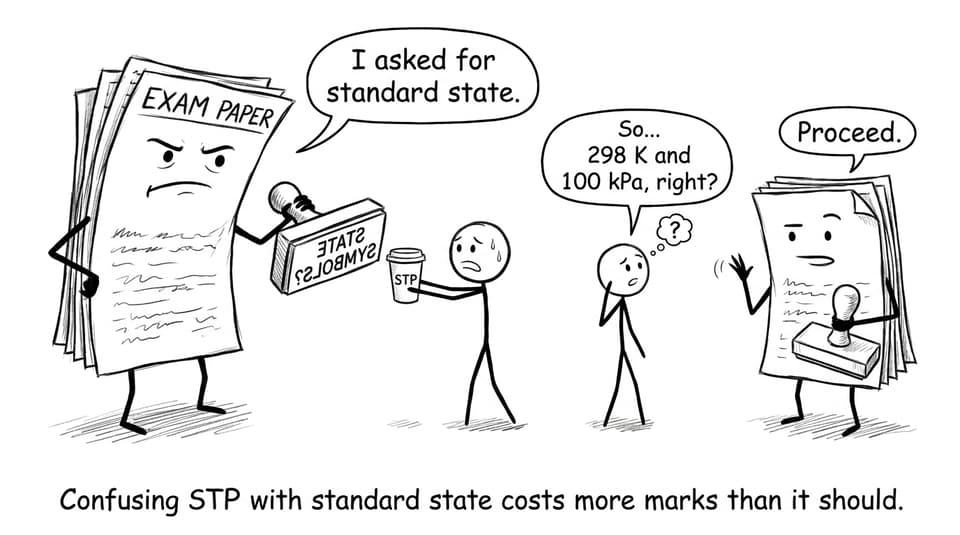
Students often mix up standard state with older “STP” language. In IB Chemistry, the safer exam habit is:
-
Treat standard state as the thermodynamics/electrochemistry reference
-
Use 298 K and 100 kPa unless told otherwise
-
Keep your focus on the substance’s most stable physical form
Where standard state shows up (so you can revise strategically)
Standard state isn’t a standalone fact. It’s built into definitions you use constantly in IB Chemistry:
-
Standard enthalpy of formation (ΔHf°): elements must be in their standard states
-
Standard enthalpy of combustion (ΔHc°): reactants and products in standard states (especially H₂O(l))
-
Standard Gibbs free energy (ΔG°): depends on standard state reference values
-
Standard electrode potential (E°): measured under standard conditions tied to standard state
Good companions for revision:
Closing: use standard state like a tool, not a memorized line
In IB Chemistry, standard state is the shared starting line that makes thermodynamics, equilibrium, and electrochemistry fair to compare. Once you treat it as a set of conditions plus the most stable form of each substance, definitions like ΔHf°, ΔG°, and E° stop feeling like disconnected memorization.
If you want to lock this in before exams, RevisionDojo helps you turn the idea into automatic exam habits: practise with the Questionbank, compress the definitions using Flashcards, check wording with AI Chat, and build timed sets with Mock Exams and Predicted Papers. Standard state is small, but in IB Chemistry it’s one of the cleanest ways to pick up marks you shouldn’t have to fight for.