
Standard cell potential sounds like one of those IB Chemistry phrases you memorise at 1 a.m. and forget by breakfast. But it’s actually a small, reliable compass: it points to reaction direction, tells you whether a cell is spontaneous, and helps you avoid the classic exam trap of mixing up anode and cathode.
If you’ve ever stared at a table of standard reduction potentials and thought, “These numbers look confident, and I feel the opposite,” this guide is for you. In IB Chemistry, standard cell potential is less about fancy arithmetic and more about disciplined interpretation.
The definition you must get word-perfect (IB Chemistry)
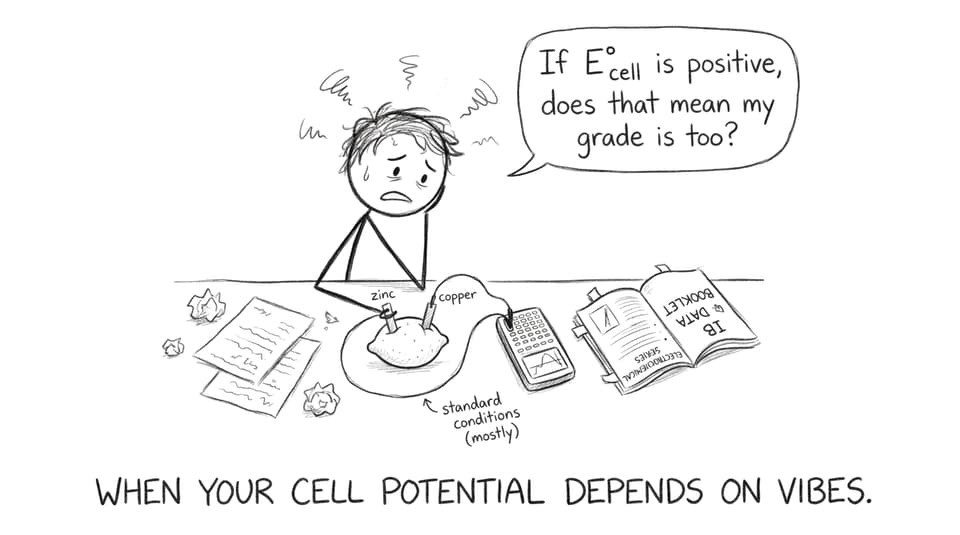
In IB Chemistry, the standard cell potential (E°cell) is the voltage produced by an electrochemical cell under standard conditions.
Standard conditions (as used for E° values) are:
-
1.00 mol dm⁻³ for aqueous ions
-
1 atm (or 100 kPa in many modern contexts) for gases
-
298 K (25°C)
Think of E°cell as the “default setting” voltage. It’s not pretending real life always behaves like this; it’s giving everyone the same starting line so comparisons are meaningful.
If you want the syllabus framing for where this sits, anchor it inside the IB Chemistry Redox Processes hub.
A quick exam checklist for E°cell questions
Use this when IB Chemistry gives you two half-reactions and asks anything about voltage or spontaneity:
-
Identify which half-reaction is reduction (cathode)
-
Identify which half-reaction is oxidation (anode)
-
Use data booklet standard reduction potentials (E° values)
-
Calculate: E°cell = E°cathode - E°anode
-
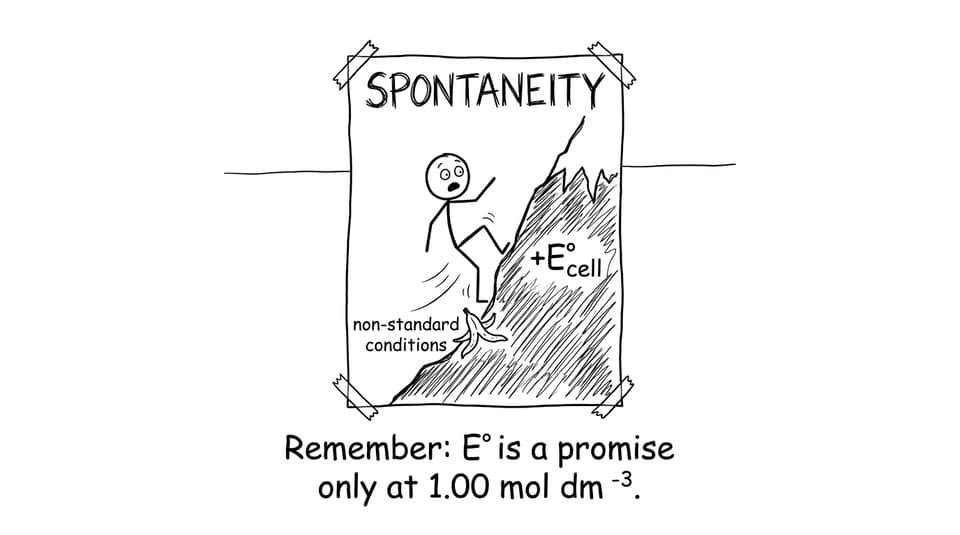
Check the sign: E°cell > 0 implies spontaneous under standard conditions
For extra practice right after reading, go straight to the Electrochemical cells (HL) Questionbank and drill 10 quick E°cell calculations.
How to calculate E°cell without falling for the sign traps
A cell has two half-cells:
-
Anode: oxidation happens here
-
Cathode: reduction happens here
In IB Chemistry, the data booklet lists standard reduction potentials (all written as reductions). That one detail explains the rules students trip over.
The formula that keeps you safe
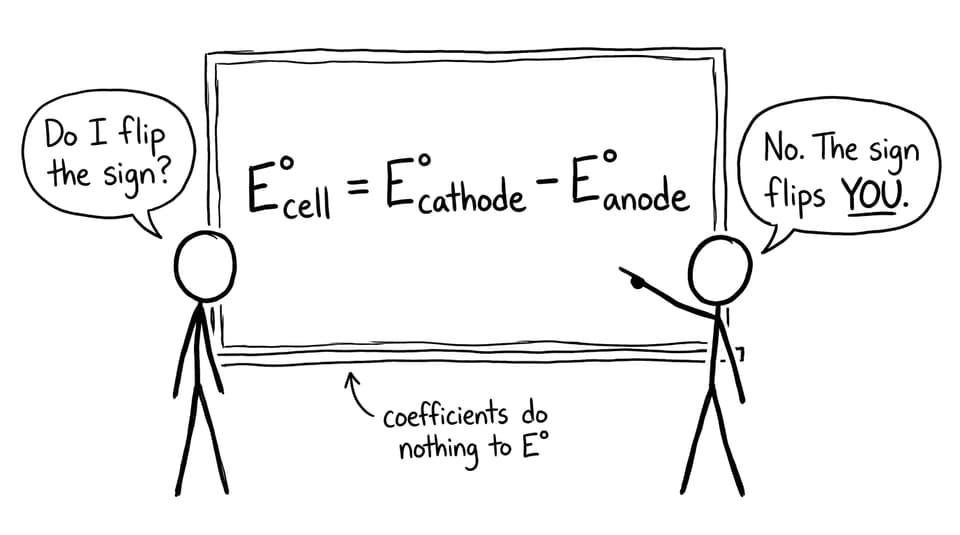
E°cell = E°cathode - E°anode
Three rules that matter more than the formula itself:
-
You subtract the anode value because the anode is the oxidation half-cell, but the table is written as reductions.
-
If you reverse a half-equation for balancing, do not change the E° sign.
-
Multiplying a half-equation by coefficients does not multiply E° (E° is intensive).
If your redox foundations feel shaky, clean them up first with Oxidation and Reduction Explained for IB Chemistry or What’s a Redox Reaction? IB Chemistry Explained.
Worked example: the classic Zn/Cu cell (IB Chemistry)
Given standard reduction potentials:
-
Zn²⁺ + 2e⁻ → Zn(s) E° = -0.76 V
-
Cu²⁺ + 2e⁻ → Cu(s) E° = +0.34 V
Step 1: Choose cathode and anode
-
The more positive reduction potential is reduced more easily. So Cu²⁺/Cu is the cathode.
-
Zinc is then the anode (it oxidises).
Step 2: Apply the formula
E°cell = E°cathode - E°anode
E°cell = (+0.34) - (-0.76) = +1.10 V
In IB Chemistry language: because E°cell is positive, the overall redox reaction is spontaneous under standard conditions.
If you want to connect this to how a real battery behaves, read How Batteries Work (Explained Simply) and notice how E°cell becomes a story about “separated reactions” rather than just numbers.
What E°cell tells you about spontaneity (and why examiners love it)
E°cell is basically the energy “push” for electron flow.
-
E°cell > 0: spontaneous (galvanic/voltaic cell)
-
E°cell < 0: non-spontaneous as written (would require an external power source)
-
E°cell = 0: equilibrium under standard conditions
In IB Chemistry, this ties neatly to Gibbs free energy:
ΔG° = -nFE°cell
So:
-
Positive E°cell gives negative ΔG° (spontaneous)
-
Negative E°cell gives positive ΔG° (non-spontaneous)
To connect signs and cell types visually and conceptually, pair this with Galvanic Cells Explained Simply and Electrolytic Cells Explained Simply for IB Chemistry.
Common misunderstandings (and the clean fixes)
-
“If I reverse a half-equation, I reverse the sign.”
Not for tabulated E° values in IB Chemistry. The table is a reference list; the number is tied to that couple, not your chosen direction. -
“Concentration changes E°cell.”
E°cell is defined at standard conditions. Change concentrations and you’ve moved to non-standard potentials (a different idea). -
“Higher E° means faster reaction.”
E° is thermodynamics (feasibility), not kinetics (rate). Fast and feasible are different questions.
For official definitions in the same wording you’ll be assessed on, use the IB Chemistry glossary and keep your phrasing consistent.
Conclusion: make E°cell your calm anchor in IB Chemistry
Standard cell potential is one of the most dependable scoring tools in IB Chemistry: define standard conditions, apply E°cell = E°cathode - E°anode, and interpret the sign to decide spontaneity. Once that loop feels automatic, electrochemistry questions stop feeling like puzzles and start feeling like translation.
To lock it in, use RevisionDojo’s Study Notes for clarity, then switch immediately to the Questionbank for repetition, reinforce with Flashcards, and pressure-test your timing using Mock Exams and Predicted Papers. When you get stuck mid-solution, AI Chat can walk you through the exact sign logic, and the Grading tools help you spot the same mistake before it becomes a habit. That’s the point: in IB Chemistry, confidence isn’t a feeling; it’s a system you can repeat.