

A strange thing happens the first time you revise solutions properly: the numbers feel calm, but the ideas feel slippery. You can calculate a mole fraction in seconds, yet still hesitate when a question asks what happens to vapor pressure, boiling point, or a distillation graph.
That’s why Raoult’s Law is such a quiet cornerstone in IB Chemistry. It looks like one short equation, but it ties together volatility, intermolecular forces, colligative properties, and those HL “explain the deviation” prompts that appear when you least want them to.
If you want extra support around the surrounding ideas, it helps to pair this with Vapor Pressure Explained for IB Chemistry and the broader IB Chemistry resources hub.
Raoult’s Law in IB Chemistry (the one-line definition)
In IB Chemistry, Raoult’s Law states that for an ideal solution, the vapor pressure of a component equals the vapor pressure of the pure component multiplied by its mole fraction in the solution.
For a solvent with a non-volatile solute:
Where:
-
(P_{\text{solution}}) is the vapor pressure of the solvent above the solution
-
(X_{\text{solvent}}) is the mole fraction of the solvent
-
(P^{\circ}_{\text{solvent}}) is the vapor pressure of the pure solvent
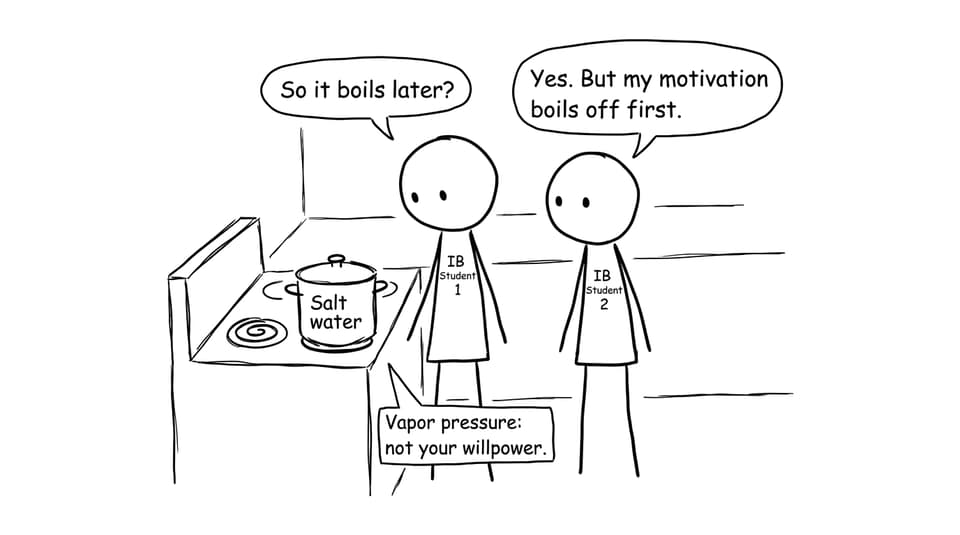
The built-in message: diluting a solvent lowers its vapor pressure.
Quick exam checklist (before you touch your calculator)
Use this quick mental checklist whenever Raoult’s Law shows up in IB Chemistry questions:
-
Are we assuming an ideal solution?
-
Is the solute non-volatile or are both liquids volatile?
-
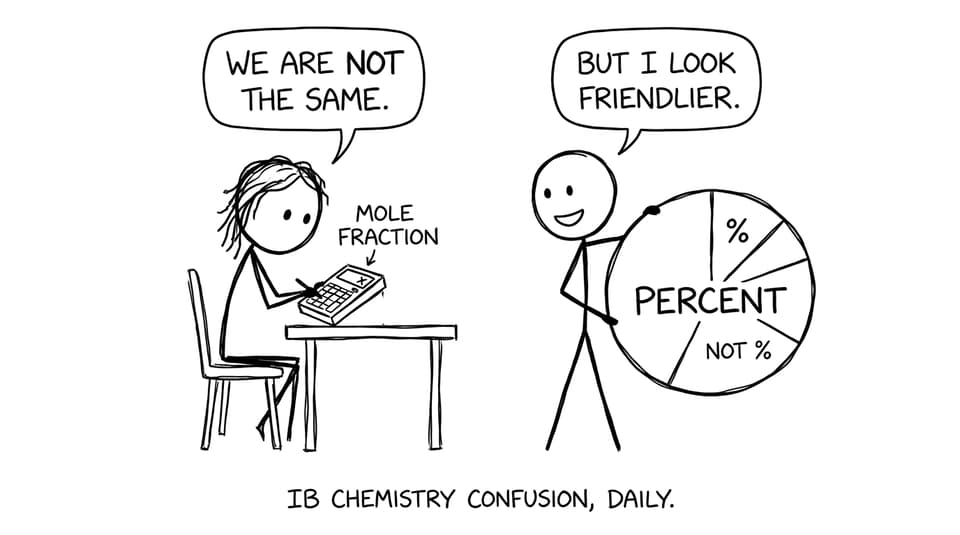
Are you using mole fraction (not percentage)?
-
Do you need an explanation using particles at the surface and dynamic equilibrium?
-
Is it actually a question about intermolecular forces and deviations?
If “mole fraction” still feels too easy to mess up, reinforce the basics with Solute vs Solvent Explained Simply and practise the arithmetic on the S1.4.1 The mole and Avogadro constant page.
Why vapor pressure drops when you add solute
A story you can picture tends to survive exam stress.
Imagine a pure solvent in a closed container. Molecules are escaping into the gas phase while others return to the liquid. That’s dynamic equilibrium, and it’s central to IB Chemistry thinking (if you need a refresh, Dynamic Equilibrium Explained for IB Chemistry connects the dots).
Now add a non-volatile solute like NaCl to water. The solute doesn’t evaporate, but it takes up “space” in the liquid structure. Statistically, fewer solvent molecules are at the surface at any moment, so fewer escape into the vapor per unit time. Equilibrium is reached at a lower vapor pressure.
That single particle-level idea underpins boiling point elevation and freezing point depression, which is why exam questions love to pivot from Raoult’s Law to broader solution behavior.
What counts as an ideal solution?
In IB Chemistry, “ideal” essentially means: the attractions between unlike molecules are similar to the attractions between like molecules.
So when you mix the two liquids:
-
the intermolecular forces don’t change much,
-
there’s no significant enthalpy change of mixing,
-
and vapor pressure follows Raoult’s Law cleanly.
Common near-ideal examples are pairs of similar, non-polar molecules (like hexane and heptane) or similar alcohols.
To build better intuition for why similarity matters, revise the role of intermolecular forces using S2.2.9 Intermolecular forces and physical properties.
Raoult’s Law when both components are volatile
If both liquids can evaporate, each contributes its own partial pressure:
This matters for fractional distillation and for interpreting composition of the vapor phase. A good exam sentence to remember is: the vapor is richer in the more volatile component (the one with higher (P^{\circ})).
Practically, RevisionDojo’s Questionbank and Mock Exams are where this becomes automatic: you see the same structure across different contexts until your brain stops treating it as “new.” Start from the IB Chemistry revision notes, then use timed sets.
HL: positive and negative deviations (how to explain them)
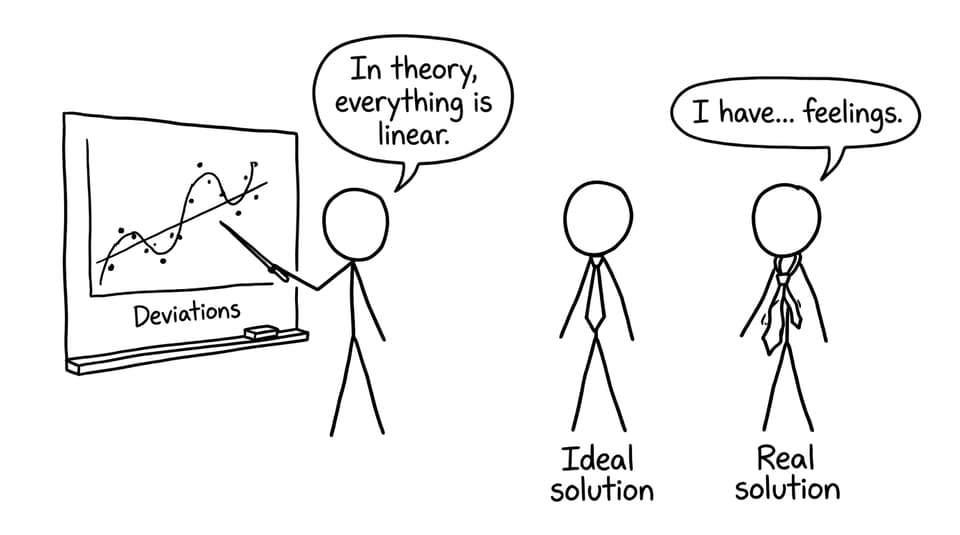
Real solutions often break the ideal assumption. In IB Chemistry HL, you’re expected to connect the direction of deviation to intermolecular forces.
Positive deviation
-
Intermolecular attractions between unlike molecules are weaker than expected.
-
Molecules escape more easily.
-
Vapor pressure is higher than Raoult’s Law predicts.
Negative deviation
-
Intermolecular attractions between unlike molecules are stronger than expected.
-
Molecules are held more tightly.
-
Vapor pressure is lower than Raoult’s Law predicts.
A fast way to avoid vague explanations is to explicitly mention: “strength of attractions” and “ease of escaping into the vapor phase.”
Common IB Chemistry mistakes (and how to sidestep them)
-
Saying vapor pressure increases when you add a non-volatile solute (it decreases).
-
Using percent instead of mole fraction.
-
Forgetting the ‘ideal’ condition, then being surprised by a deviation graph.
-
Mixing up volatility and boiling point: higher volatility usually means lower boiling point.
For quick formula confidence, keep the IB Chemistry Data Booklet open during practice so you learn what’s given vs what’s expected.
Closing: make Raoult’s Law feel inevitable
Raoult’s Law is one of those IB Chemistry ideas that becomes simple only after you stop treating it as a formula and start treating it as a surface story: who gets to escape into the vapor, and how easily. Once that clicks, vapor pressure lowering, boiling point elevation, freezing point depression, and HL deviations stop feeling like separate topics.
If you want this to stick under timed conditions, build a short loop: revise the concept in IB Chemistry revision notes, drill it in the Questionbank, test it with Flashcards, then simulate pressure with Mock Exams and Predicted Papers. RevisionDojo brings all of that into one place so your IB Chemistry revision feels connected, not scattered.