


It usually happens in a quiet moment.
You open a marked piece of work and feel two opposite things at once: relief that it’s over, and dread that you still don’t know what to fix first. The feedback is “helpful,” technically. But in the IB, helpful is not the same as exam-ready.
IB exams reward a specific kind of thinking: visible, structured, criterion-aligned thinking under time pressure. Feedback builds exam readiness only when it trains that exact behavior. Not when it becomes a long list of things you did wrong, or a motivational paragraph you’ll never operationalize.
This guide shows you how to use IB feedback like a training plan: tight, repeatable, and calm. And it shows how RevisionDojo can turn that plan into a loop you can actually run.
Quick checklist: turn IB feedback into marks
Use this short checklist every time you get IB feedback (or self-mark a practice set):
-
Link every comment to a criterion or command term
-
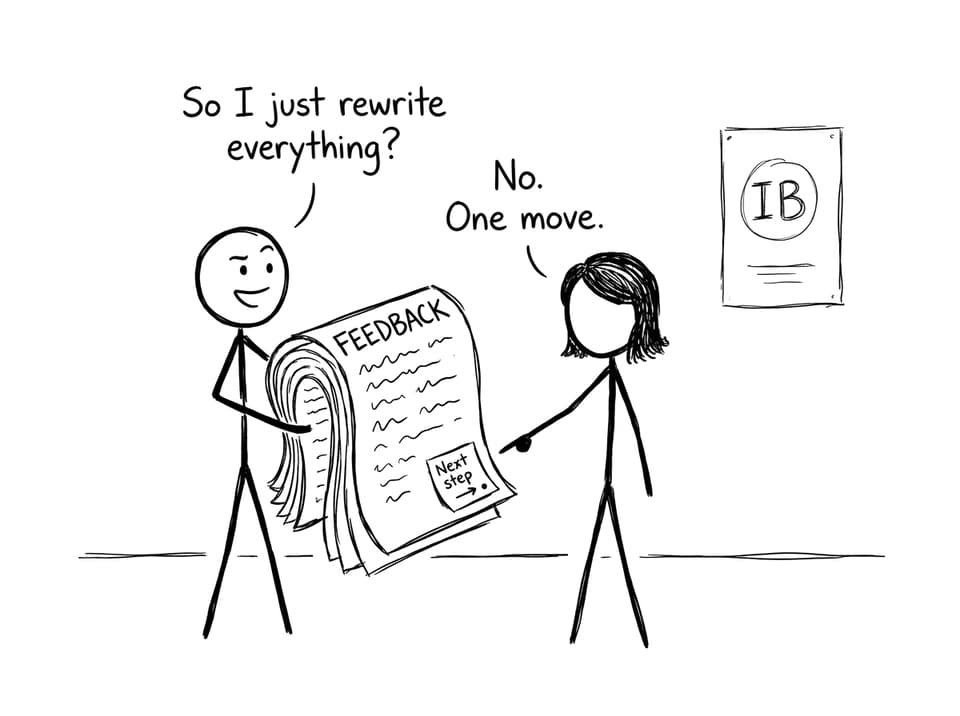
Choose one move to improve next time (not ten)
-
Rewrite one answer in top-band style while the feedback is fresh
-
Retest the same skill within 48 hours
-
Track the pattern across tasks, not the score on one task
If you want a single home base for that loop, start at the RevisionDojo homepage.
Why IB feedback matters more than “more practice”
Most students don’t lose IB marks because they didn’t work hard. They lose marks because they practiced without changing the mechanism that creates their answers.
IB assessments are designed to separate:
-
knowing content vs applying it
-
describing vs analyzing
-
having an opinion vs evaluating with criteria
-
writing a lot vs writing what the markscheme rewards
Good feedback makes those differences concrete. It tells you what the examiner can actually see in your response. And that matters because the IB doesn’t grade intentions. It grades evidence.
A practical way to deepen this is to study how questions are built. Command terms are often the hidden switch that flips an answer from “fine” to “top band.” Use IB Command Terms: How to Use Them to Score More to translate feedback like “needs more evaluation” into an exact answer shape.
High-impact IB feedback has four traits
You can judge feedback quickly. The best IB feedback tends to have four traits.
It is criterion-anchored
It references what the IB rewards: descriptors, criteria, and assessment objectives. If your feedback never names the target (Criterion A/B/C/D, or the required skill), it’s harder to act on.
To see what “actionable” looks like in practice, skim How RevisionDojo Makes IB Feedback More Actionable for Students. You’ll notice the difference between vague advice and feedback that points to a precise upgrade.
It is action-sized
The best feedback fits into a single next attempt.
Instead of “Your analysis is weak,” strong feedback sounds like:
-
“Add one sentence that explains why the evidence proves your point.”
-
“State a criterion, then judge your claim against it.”
Action-sized feedback is the only kind that survives a busy week.
It teaches transfer
IB students sit multiple subjects, which means you need feedback that travels.
A useful test: can you apply the same advice to English, History, Biology, and Economics? “Link back to the command term in the conclusion” transfers. “Add more quotes” does not.
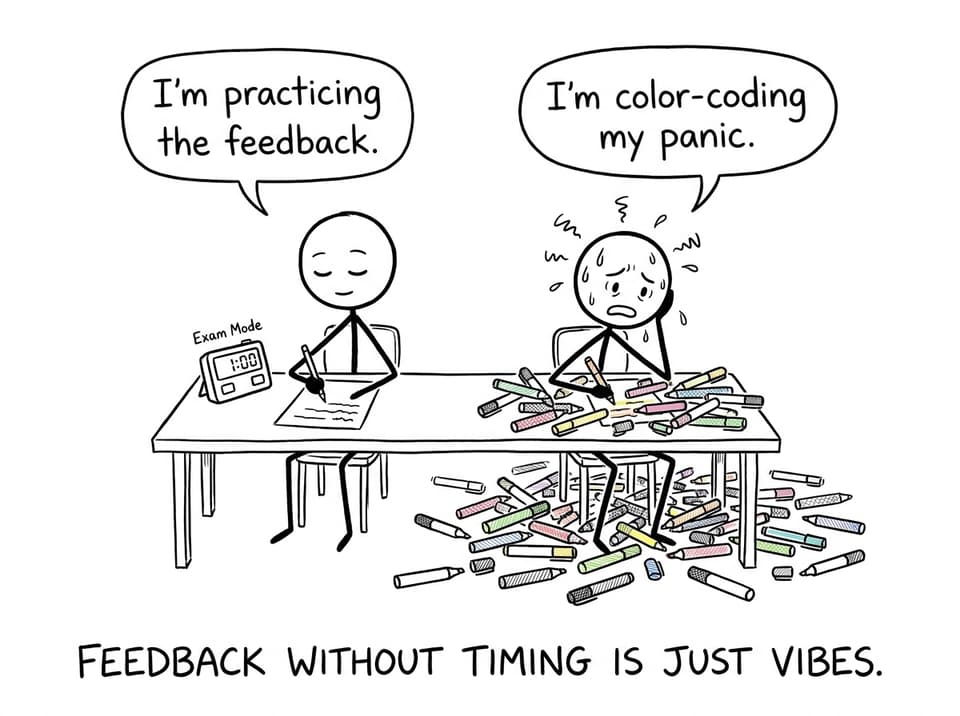
It includes time as a variable
In the IB, your best answer at home is not your answer in the room.
Feedback that ignores timing accidentally trains you to write answers you cannot deliver under pressure.
The IB feedback loop that actually builds exam readiness
Most students treat feedback like a receipt: proof that work happened.
Exam-ready students treat feedback like a loop. The loop has four stages, and you can run it weekly without burning out.
Practice under realistic conditions
Start with exam-shaped questions, not just notes.
RevisionDojo’s IB Question Bank: Thousands of Practice Questions is useful here because questions are organized by topic and designed to match how IB exams phrase tasks. This is where your feedback becomes specific fast.
If you’re not sure how to structure practice sessions, use IB Question Bank: How to Use It Effectively as your baseline.
Get feedback that names the skill
After each attempt, label the feedback as one of these:
-
concept gap (you didn’t understand)
-
technique gap (you didn’t show it properly)
-
timing gap (you ran out of time)
In RevisionDojo, this is where Grading tools and AI Chat shine: one helps you see rubric-aligned gaps, the other helps you clarify the exact misconception without turning revision into a research project.
Reflect in writing (briefly)
Reflection is not journaling. It’s decision-making.
Write three lines:
-
“I lost marks because…”
-
“Next time I will…”
-
“I will prove it by…”
Those three lines turn IB feedback into behavior.
Apply within 48 hours
The fastest way to waste feedback is to wait until “next unit.”
Retest the same skill quickly while the error pattern is still obvious. Use a small set of targeted questions, then rewrite one response with the feedback beside you.
If you want a clean answer-structure system that makes feedback easier to apply, read Structure IB Answers to Maximize Marks.
Make feedback feel like rehearsal, not judgment
A quiet truth about the IB is that anxiety often comes from ambiguity. When you don’t know what “good” looks like, every comment feels personal.
One antidote is rehearsal: timed practice that makes the exam feel familiar.
You can do that with RevisionDojo’s Mock Exams workflow (topic-focused and full-length). A good companion read is Custom IB Mock Exams: Build Practice Tests by Topic, which shows how to turn feedback patterns into targeted exam simulations.
For full-paper realism written by experienced examiners, use IB Predicted Papers by IB Examiners (Free). Then, after each sitting, extract just 2-3 repeating feedback themes and drill them.
A simple RevisionDojo workflow for IB feedback
Here’s a calm loop you can repeat:
-
Clarify fast with Digital IB Study Notes You Can Access Anywhere
-
Test yourself with the Questionbank
-
Turn repeated mistakes into Flashcards (so the same feedback stops reappearing)
-
Use AI Chat to diagnose what your answer is missing
-
Use Grading tools to see rubric alignment on longer responses
-
Once a week, run timed practice with Mock Exams or IB Predicted vs Specimen Papers: What They Mean as your strategy guide
The point is not to do everything. The point is to make feedback show up in your next attempt.

Conclusion: IB feedback is direction, not decoration
In the IB, feedback builds exam readiness when it changes what you do next: how you structure, how you justify, how you manage time, and how you respond to command terms.
Treat feedback like a map. Choose one next step. Retest quickly. Track the pattern.
If you want to run that loop in one place, RevisionDojo is built for it: Study Notes for clarity, Flashcards for recall, Questionbank for exam-style practice, AI Chat for diagnosis, Grading tools for rubric alignment, and Mock Exams plus Predicted Papers to make the real IB feel familiar. Start with one subject, one skill, and one feedback-driven change today.