
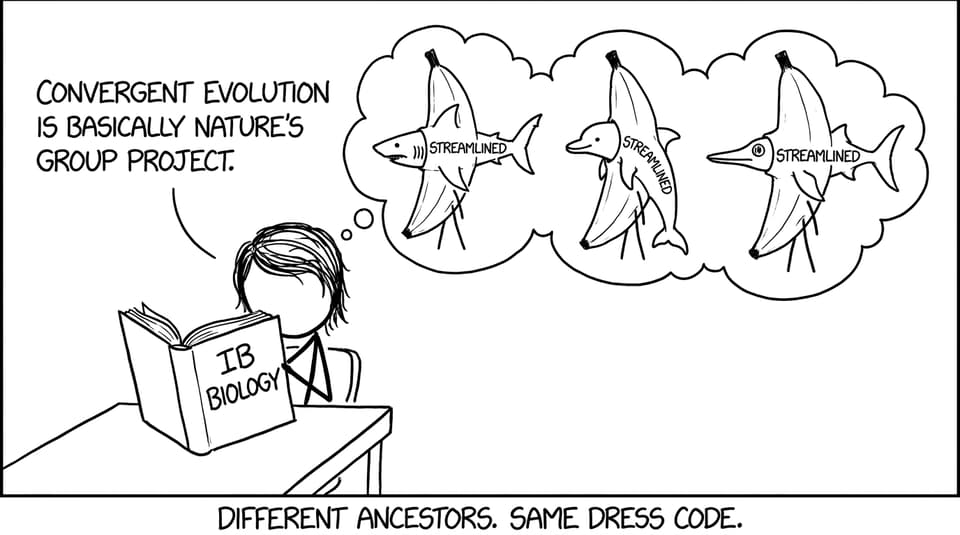
In the ocean, a shark slices forward like a blade. Nearby, a dolphin does the same. If you only saw silhouettes, you might swear they were close relatives.
But IB Biology has a quietly satisfying twist: sometimes nature repeats the solution without repeating the family tree. When different species face the same problem long enough, the environment acts like a strict examiner, rewarding similar answers.
The IB Biology idea: convergent evolution in one sentence
In IB Biology, convergent evolution is when unrelated species independently evolve similar traits because similar environments create similar selection pressures.
Those similar traits are usually analogous structures: they do the same job but come from different origins.
If you want syllabus-aligned wording to borrow in answers, keep the official definitions close via the IB Biology Key Definitions.
Quick exam checklist: how to spot “similar environments” questions
Use this checklist whenever an IB Biology prompt shows two unrelated organisms with similar features:
-
Identify the environmental pressure (abiotic factor, predator, food source, locomotion).
-
State the advantage (reduced water loss, reduced drag, better flight efficiency).
-
Link to differential survival and reproduction (natural selection).
-
Conclude: similarity is convergent evolution producing analogous structures.
For deeper support on the mechanism, pair this with What Is Natural Selection in IB Biology?.
Why similar environments produce similar traits in IB Biology
Physics and chemistry don’t negotiate. Water is dense, deserts are dry, and predators learn quickly. So in IB Biology, convergence often shows up as “the only workable design” for a repeated challenge.
Similar environments in IB Biology often mean similar functional demands
Aquatic life rewards streamlining because it reduces drag. That’s why sharks (fish), dolphins (mammals), and ichthyosaurs (reptiles) can converge on a similar body plan.
This is a great place to use precise exam language: selection pressures act on phenotypes, but the long-term change is seen in the gene pool. If you need that phrasing, revise D4.1.11 Changes in allele frequency in the gene pool (HL).
Harsh environments produce repeated “survival toolkits”
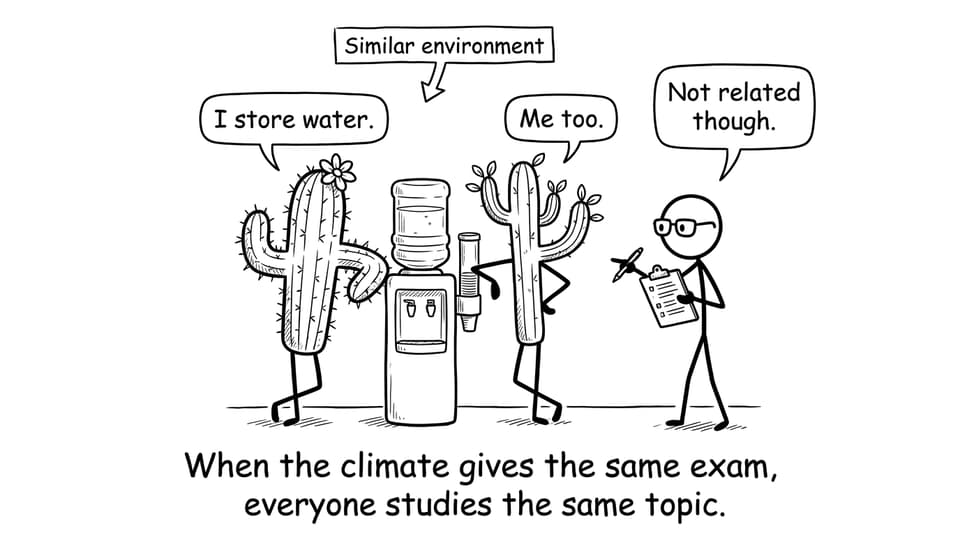
Deserts repeatedly select for water-saving traits: thick cuticles, reduced leaves, spines, and water storage tissues. So a cactus and a euphorbia can end up looking like cousins even when they aren’t.
If you want more examples of how abiotic factors shape adaptations in IB Biology, see B4.1.2 Adaptations of organisms to the abiotic environment and the clearer framing in Morphological vs Physiological Adaptations.
New niches often “invite” similar solutions
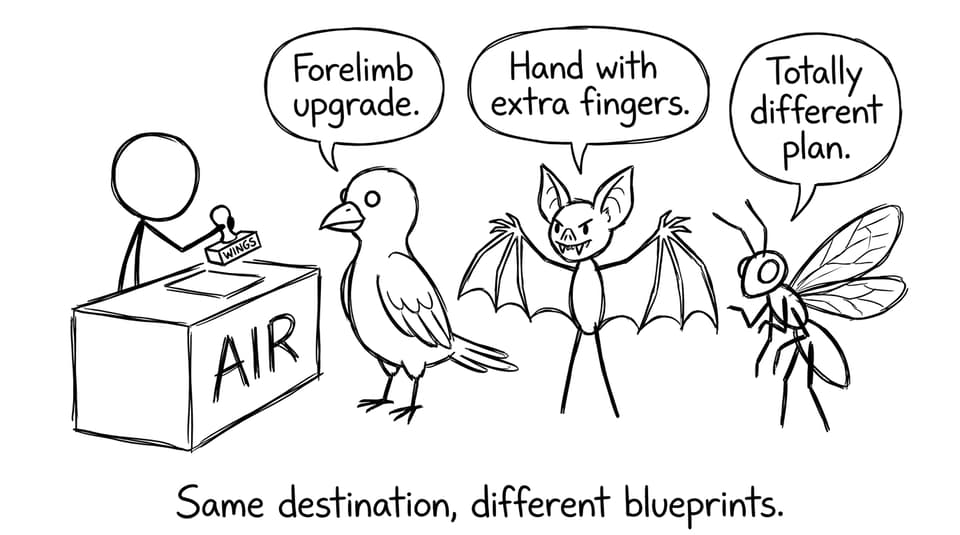
Flight is a classic IB Biology convergence example: birds, bats, and insects all evolved wings, but from different structures. The niche is the same (moving through air), so selection keeps discovering wing-like answers.
Convergent vs homologous: the common exam trap
A fast way to lose marks in IB Biology is to treat similarity as proof of close relatedness.
-
Homologous structures: same origin, may have different functions (evidence of common ancestry).
-
Analogous structures: different origin, similar function (evidence of convergent evolution).
To keep the big picture clear, revise IB Biology Topic A4.1: Evolution and Speciation and the focused page on A4.1.5 Convergent evolution as the origin of analogous structures (notes).
Final takeaway: the environment writes the question, evolution writes the answer
Similar environments produce similar traits because natural selection keeps rewarding the same advantages. In IB Biology, that repeats as convergent evolution: different lineages, similar solutions.
If you want to lock this down before exams, revise the A4.1 Evolution and Speciation notes, drill it in the Questionbank, and use RevisionDojo’s Flashcards, Study Notes, Predicted Papers, Mock Exams, and Grading tools to turn a neat idea into reliable marks in IB Biology.