
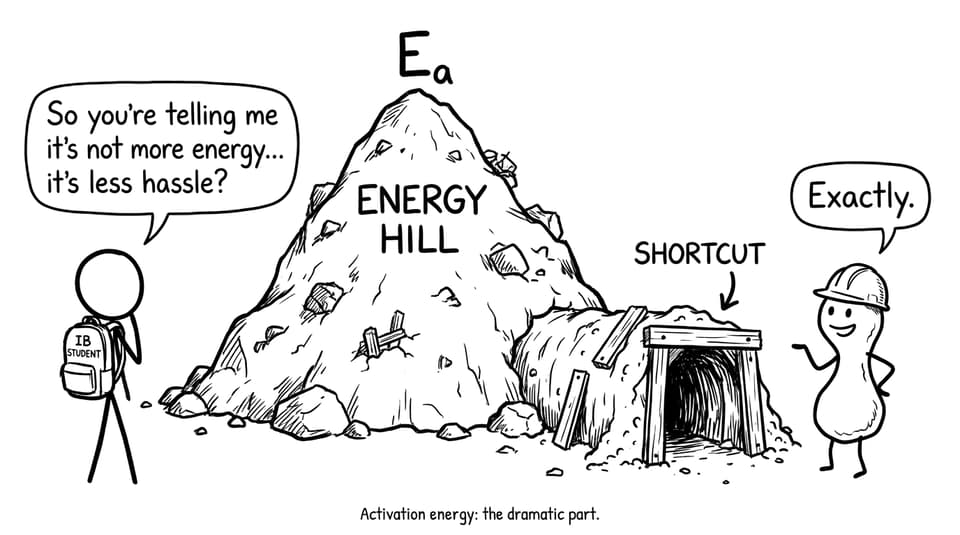
Metabolism is basically a city at rush hour: thousands of reactions need to move on time, in the right direction, without chaos. In IB Biology, enzymes are the quiet traffic engineers. They do not “add energy” to reactions. They simply make the hardest step less hard by lowering activation energy, so reactions that would take years can happen in milliseconds.
If you can explain how enzymes lower activation energy (not just that they do), you unlock a whole set of marks across enzymes, respiration, photosynthesis, and genetics.
IB Biology checklist: what to say for full marks
Keep this mini-checklist in your head when enzyme questions appear:
-
Define activation energy as the minimum energy needed to reach the transition state.
-
State that enzymes lower activation energy by stabilizing the transition state.
-
Add mechanisms: orientation, induced fit, microenvironment, temporary bonding, reduced entropy.
-
Clarify what enzymes do not change: overall energy change (ΔG) and equilibrium position.
For quick syllabus-aligned support, use Effect of Enzymes on Activation Energy Notes and the IB Biology Glossary to keep definitions exam-tight.
How enzymes lower activation energy (the story behind the graph)
Activation energy is the “entry fee” to a reaction. Molecules must collide with enough energy and the correct arrangement to form the transition state, where bonds are strained and ready to break or form. In a cell, most molecules simply do not hit that state often enough.
Enzymes solve this by building an easier pathway. The reaction still climbs a hill, but it is a smaller hill.
To connect this to your course, the C1.1 Enzymes and metabolism lessons and C1.1 videos map these ideas directly to exam language used in IB Biology.
The main mechanisms examiners love
Substrate orientation: fewer “useless collisions”
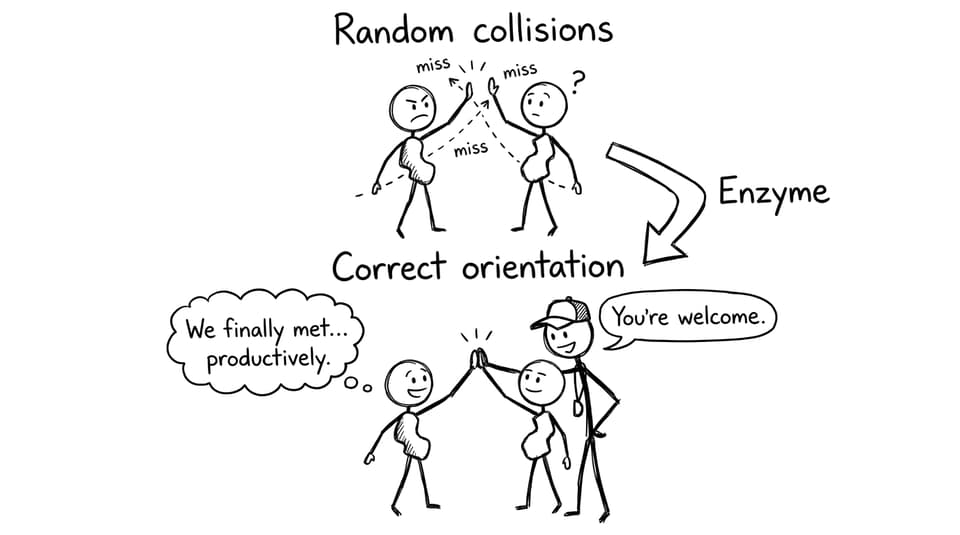
Substrates in solution collide randomly. Most collisions are the biochemical equivalent of bumping shoulders in a hallway. An enzyme binds substrates at the active site and orients them so the reactive groups line up, increasing the chance that a collision becomes a reaction.
For the collision-theory angle, see Role of Molecular Motion and Substrate-active Site Collisions.
Induced fit: the enzyme “leans in”
In IB Biology, induced fit is a high-yield phrase because it explains why binding matters. When the substrate binds, the active site shifts shape slightly. This can:
-
strain substrate bonds (making them easier to break), and
-
stabilize the transition state (making the peak easier to reach).
If you want a clean, mark-friendly explanation, use Interactions Between Substrate and Active Site (Induced Fit) Notes.
Microenvironment: chemistry in a tiny room
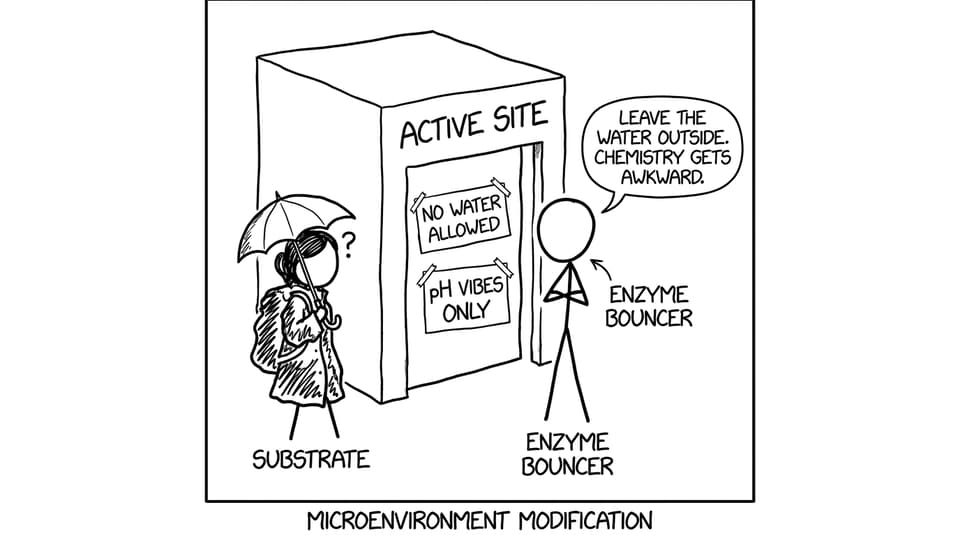
Active sites are not “average cytoplasm.” They can be more acidic, more basic, less watery, or positioned with charged side chains that make reactions more likely. This tailored microenvironment reduces activation energy by making the transition state easier to form.
Temporary bonding and reduced entropy
Some enzymes form temporary covalent interactions with substrates, creating an alternate reaction pathway with a lower activation energy. Also, binding substrates to an active site reduces randomness (entropy) by holding them in a reaction-ready position.
To reinforce structure-to-function links (a recurring IB Biology theme), pair this with Enzymes as Globular Proteins with an Active Site.
How to revise this fast with RevisionDojo
A smart pattern for IB Biology exam prep:
-
Learn the core explanation with What Are Enzymes and How Do They Work?
-
Drill application using the C1.1 Enzymes and metabolism Questionbank and 2.5 Enzymes Questionbank
-
Lock in terms with Flashcards for Enzymes as Catalysts
Along the way, RevisionDojo’s Study Notes, Flashcards, and AI Chat help you tighten wording, while Grading tools, Mock Exams, Predicted Papers, the Coursework Library, and Tutors turn understanding into exam performance.
Bring it home: make activation energy a scoring topic
When you revise enzymes, you are not just memorizing a definition. You are learning a reusable explanation for why metabolism is fast, controlled, and survivable. Build your IB Biology answer around activation energy, then add one or two mechanisms (orientation, induced fit, microenvironment) to secure the marks.
If you want to practise this exactly as it appears in exams, use RevisionDojo’s Questionbank and Study Notes today, and let the AI Chat polish your wording until it sounds like an examiner wrote it.